Tier-1 or New Tier-1 Cities? Job Search Strategies and Salary Comparisons Across Different Cities
Tier-1 or new tier-1? Comparison of 4 city types (tier-1/new tier-1/tier-2/remote), real data on salary vs. cost of living, city selection strategies for different career stages and 3 decision criteria, helping you make the best city choice for yourself.
At graduation, you agonize over whether to head to Beijing/Shanghai/Guangzhou/Shenzhen or return to your provincial capital. After 3 years of work, you debate moving from a tier-1 city to a new tier-1. After 5 years, you wonder if you should "downgrade" to a tier-2 city for an easier life. City selection is a dilemma that spans your entire career. Choose the right city, and your career development goes smoothly; choose wrong, and you might lose 5 years. But there's no standard answer — only the answer that's right for you. Today, we'll break down 4 types of cities with real data on salary, cost of living, and career opportunities, helping you make a choice you won't regret.
Why City Choice Affects Career Development
Many people think a city is just "where you live" — doesn't matter where you work? But a city's impact on your career is far greater than you imagine. It determines what opportunities, people, and industries you can access, and even sets your salary ceiling and growth rate.
- Industry concentration: Over 70% of top internet companies are headquartered in Beijing and Shenzhen, over 50% of core finance roles are in Shanghai, and e-commerce and foreign trade hubs are in Guangzhou and Hangzhou. The city you choose determines what industries and caliber of companies you can access
- Network quality: The density of industry meetups, salons, and training in tier-1 cities is 3-5 times that of new tier-1 cities. The people you meet at one product manager salon in Beijing might be more valuable than 10 events in a new tier-1 city
- Growth speed: The competitive intensity of tier-1 cities forces faster growth — your colleagues are more accomplished, projects are larger, and the pace is faster. Three years in this "pushed to run" environment might equal five years in a tier-2 city
- Salary ceiling: For the same product manager role, the salary ceiling in Beijing might be 80K/month, while in Chengdu it might be 30K/month. Your city determines your salary upper limit
But city selection isn't simply "bigger is better" — big cities offer higher salaries but also higher costs, pressure, and competition. The key is finding the balance point that works best for you among salary, cost, opportunity, and quality of life.
Comparison of 4 City Types: Tier-1 / New Tier-1 / Tier-2 / Remote
Let's look at the data before drawing conclusions. The following comparison is based on 2025-2026 market data, using the internet industry as an example (other industries can be proportionally referenced).
- Tier-1 cities (Beijing/Shanghai/Guangzhou/Shenzhen): Highest average salaries (internet industry monthly salary 15K-40K, median 22K), most top companies (ByteDance, Tencent, Alibaba, Meituan headquarters), richest career opportunities (3-5x more positions than new tier-1), but also highest living costs (single room rent 3000-5000 yuan, 1-2 hour commute), fiercest competition (one position may receive 500+ resumes), and hardest hukou requirements (Beijing/Shanghai point-based hukou thresholds are extremely high)
- New tier-1 cities (Hangzhou/Chengdu/Wuhan/Nanjing/Suzhou/Changsha etc.): Mid-to-upper salaries (internet industry monthly salary 10K-25K, median 15K), many top company branches (Alibaba in Hangzhou, Tencent in Chengdu, ByteDance in Wuhan), moderate living costs (single room rent 1500-3000 yuan, 30-60 min commute), relatively mild competition (one position may receive 100-200 resumes), low hukou barriers (most cities accept bachelor's degree for hukou), and higher quality of life (rich food, culture, and leisure resources)
- Tier-2 cities (Hefei/Kunming/Guiyang/Lanzhou etc.): Lower salaries (internet industry monthly salary 6K-15K, median 9K), few top companies (mostly outsourcing and branch offices), but low living costs (single room rent 800-1500 yuan, 15-30 min commute), low competition (one position may receive 30-50 resumes), suitable for those seeking stability and value
- Remote work: Salary depends on company location (earning tier-1 salary while living in a tier-2 city offers the best value), highest freedom (no commute, flexible hours), but social isolation (lacking workplace socializing and team atmosphere), limited promotion (remote employees are easily marginalized), and high self-discipline required (easy to slack off without supervision)
Each of the 4 city types has pros and cons — there's no absolute good or bad. The key is what career stage you're at, what you're pursuing, and what you're willing to sacrifice.
Real Comparison: Salary vs. Cost of Living
Many people only look at salary numbers without considering living costs — is 20K/month in Beijing or 12K/month in Chengdu actually "wealthier"? Let's do the real math.
- Beijing 22K/month real purchasing power: After social insurance, housing fund, and income tax, take-home is about 17K. Rent (single room) 3500, food (weekday takeout + weekend dining) 2500, transportation (subway + occasional taxi) 500, daily expenses (clothes, daily necessities, socializing) 2000, monthly savings about 8500. With shared housing or living further out, savings can reach 10K+
- Chengdu 15K/month real purchasing power: After deductions, take-home is about 12K. Rent (single room) 1800, food (Chengdu has great food value) 1800, transportation 300, daily expenses 1500, monthly savings about 6600. With shared housing, savings can reach 8000+
- Key finding: While tier-1 cities have higher absolute savings, the home-buying pressure is far greater. Beijing down payment starts at 2 million, Chengdu at 500-800K. At 10K monthly savings, it takes 17 years to save a down payment in Beijing vs. 5-7 years in Chengdu. That's the truth behind "high salary but can't save money"
- Hidden costs: Tier-1 cities have higher social costs (dinner out averages 200+ per person), good but hard-to-access medical resources, tight education resources (astronomical school district housing), and heavier overtime culture (hidden time cost). These hidden costs are much lower in new tier-1 and tier-2 cities
- Salary growth potential: The probability of salary doubling in 3-5 years is higher in tier-1 cities (15K to 30K is common), while 50%-80% growth is more realistic in new tier-1 cities (10K to 15-18K). Long-term, tier-1 cities have greater salary growth potential
Conclusion: In the short term, tier-1 cities offer higher absolute savings; long-term, new tier-1 cities offer better value and happiness. But if you're pursuing the career ceiling and wealth upper limit, tier-1 cities remain the irreplaceable choice.
City Selection Strategies for Different Career Stages
City selection isn't set in stone — different career stages have different optimal solutions. Here are city selection recommendations based on career development stages.
- Fresh graduate - 2 years experience (growth period): Prioritize tier-1 cities. At this stage, the most important things are rapid growth, experience accumulation, and network building. Tier-1 cities offer the best "training ground" with project scale, colleague caliber, and industry density. Even if you leave after 2 years, a tier-1 city resume is your strongest credential
- 3-5 years experience (rising period): Choose based on goals. Want to push for management? Stay tier-1 (more management positions, higher salaries). Want work-life balance? Consider new tier-1 (better value for mid-level positions). Want to start a business? See where industry resources are (e-commerce in Hangzhou, gaming in Chengdu, hardware in Shenzhen)
- 5-10 years experience (stable period): New tier-1 or tier-2 is better. At this stage, you may face major life events like buying a home, marriage, and children — living costs and housing quality become more important. New tier-1 salaries already meet needs, while quality of life far exceeds tier-1
- 10+ years experience (senior period): Depends on resources and network. At this stage, your career development depends more on connections and resources than the city itself. If your network and resources are concentrated in tier-1, stay; if you've built enough influence in new tier-1, there's no need to force your way into tier-1
Core principle: Go to tier-1 for "gilding" early in your career, choose based on goals in mid-career, and look at resources and network in late career. Don't stay in one city forever — flexibly adjusting your city strategy is smart career planning.
3 Decision Criteria to Help You Decide
If you're still torn, use these 3 criteria to quantify your decision.
- Criterion 1: Your salary goal 3 years from now. If your 3-year goal is 30K+/month, tier-1 is mandatory — new tier-1 and tier-2 rarely reach this level. If your goal is 15-20K/month with good quality of life, new tier-1 is more suitable. If 10K/month satisfies you and you don't want too much stress, tier-2 is enough
- Criterion 2: City concentration of your target industry and role. Which city has the highest concentration of your target industry and role? Internet in Beijing/Shenzhen, finance in Shanghai, e-commerce in Hangzhou, gaming in Chengdu/Guangzhou, new energy in Shenzhen/Hefei. Go where your industry is most concentrated for the most opportunities and fastest growth
- Criterion 3: Your minimum acceptable quality of life. If you can accept shared housing, long commutes, and high pressure, tier-1's salary advantage is worth pursuing. If you value personal space, short commutes, and weekend leisure more, new tier-1 or tier-2 is more suitable. There's no right or wrong — only what fits you
Score each criterion comprehensively — whichever city scores highest is your choice. Don't agonize over "what others would choose" — everyone's situation is different, and what works for others may not work for you.
Conclusion: There's No Standard Answer — Only the Answer That's Right for You
Tier-1 cities give you the highest salary ceiling and fastest growth, new tier-1 cities give you the best value and quality of life, tier-2 cities give you the lowest living pressure and highest stability, and remote work gives you the most freedom. Among 4 options, there's no absolute good or bad — the key is what career stage you're at, what you're pursuing, and what you're willing to sacrifice. Use 3 criteria to quantify your decision: salary goal in 3 years, industry concentration, and quality of life floor. Once you've decided, don't hesitate — every city has opportunities that belong to you. Remember: the city is just the stage; your ability is the star. No matter which city you're in, a professional resume is your key to opening doors of opportunity.
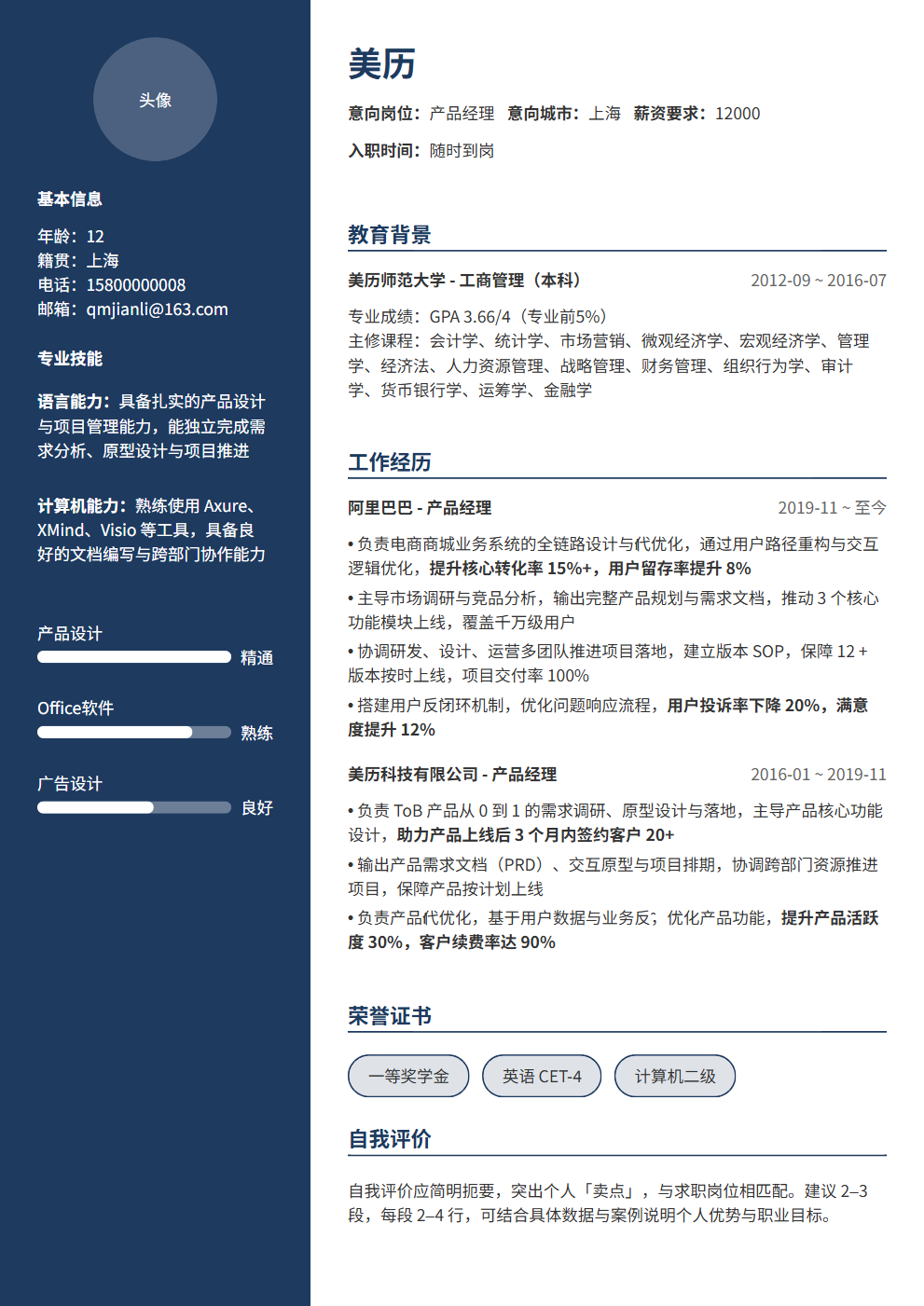
No matter which city you choose, the first step is getting your resume to earn you interview opportunities. Use BeautyResume to create a professional resume — whether applying to tier-1 or new tier-1 positions, let your strengths shine through at a glance.