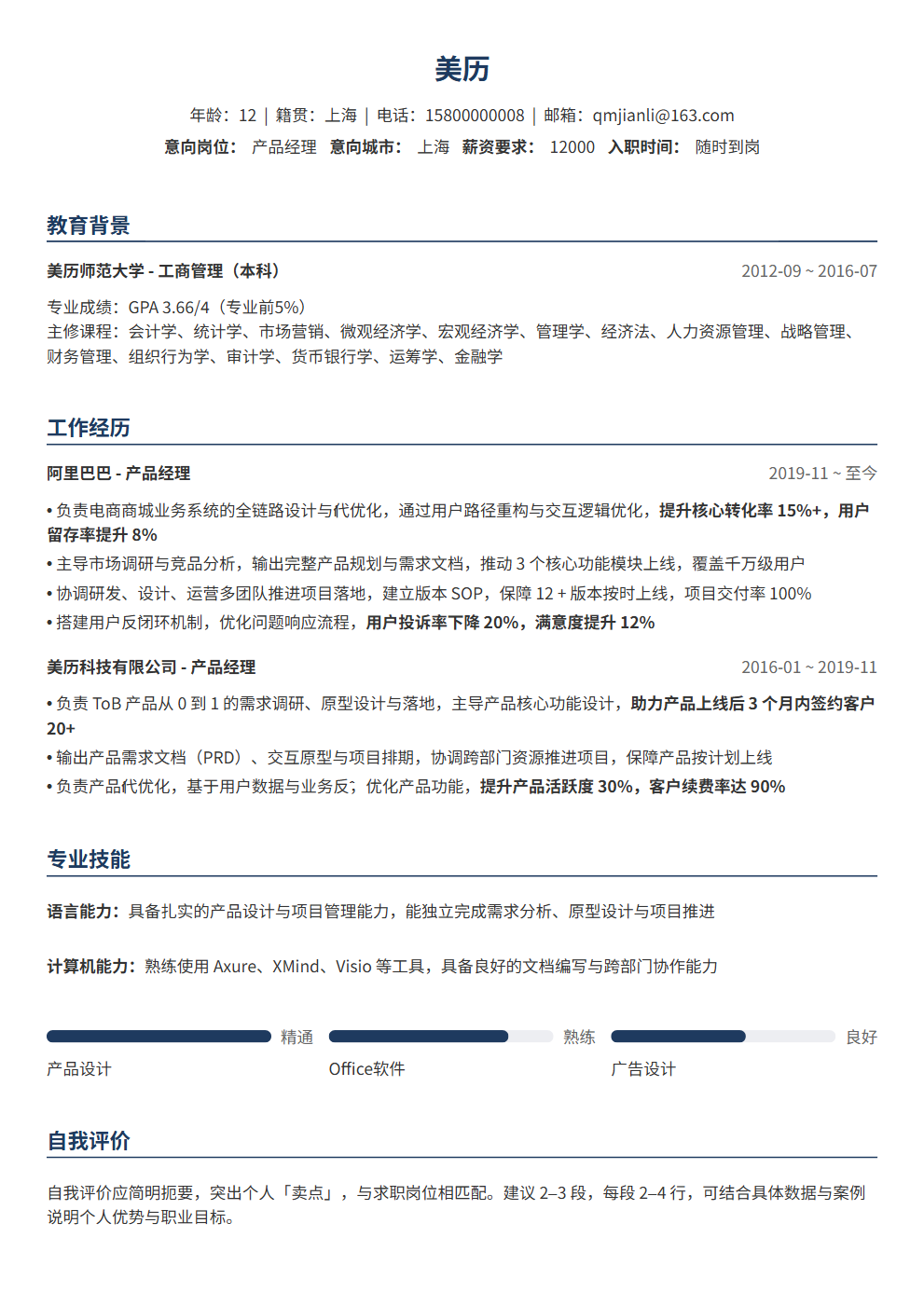
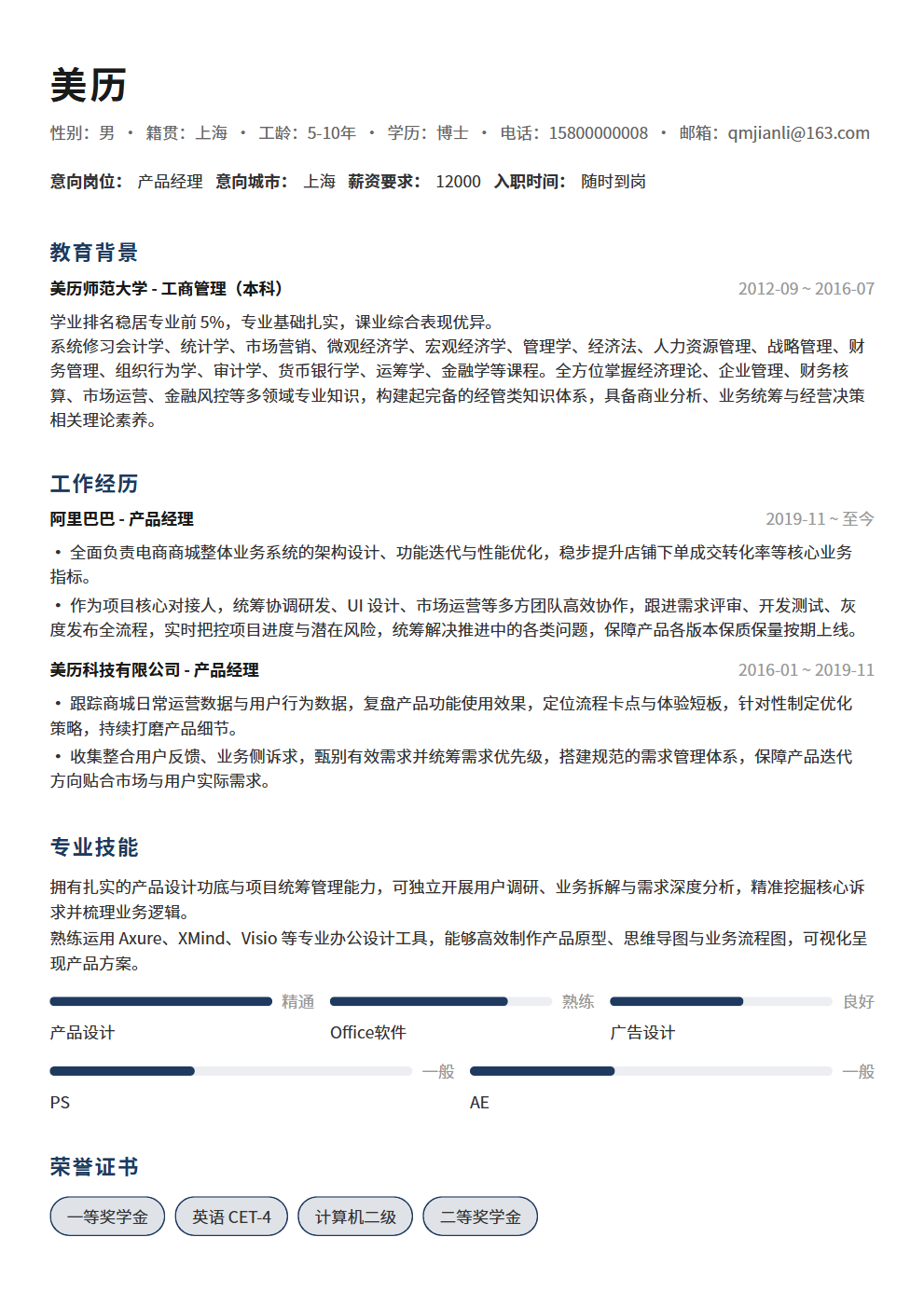
7 Things You Must Never Put on Your Resume: One Mistake and HR Eliminates You
Some content on your resume doesn't just fail to add value — it gets you eliminated by HR. This article covers 7 resume red lines: false information, negative expressions, irrelevant personal details, vague salary info, and more, each with real elimination cases to help you avoid fatal resume mistakes.
You've sent out 50 resumes but received fewer than 5 interview invitations. You start wondering if you're not capable enough, but the truth may be more painful—your resume contains things that make HR eliminate you on the spot. According to hiring platform data, HR spends an average of only 6-8 seconds scanning a resume, and 76% of resumes are eliminated at the initial screening stage. The reason for elimination often isn't that you're not qualified—it's that you've crossed a "red line" on your resume. The following 7 things are what HR explicitly says "eliminate on sight," each backed by real cases. Check your resume against this list and see how many you've committed.
#1: False Information—Fabricating Degrees and Work History Has Consequences Far More Serious Than You Think
This is the number-one forbidden zone on a resume, bar none. Some people think "sprucing up" a resume is harmless, but there's a clear line between "enhancement" and "fabrication"—enhancement means highlighting your strengths, while fabrication means making things up. Faking degrees, fabricating work history, and inventing project achievements are all forms of fabrication, and the consequences are extremely severe.
- What counts as false information: Degree fraud (claiming to have attended a university you didn't, listing a bachelor's when you have an associate degree, listing full-time when it was part-time), fabricated work history (claiming to have worked at a company you didn't, listing an internship as full-time employment, stretching 3 months into 1 year), invented project achievements (claiming team results as solo accomplishments, fabricating non-existent projects, inflating project scope and impact), fake certifications (listing certifications you don't hold, not noting expired credentials)
- Why you must avoid it: Background checks are standard in hiring, especially at mid-to-large companies. Surveys show over 85% of mid-to-large companies conduct background checks on candidates, with degrees and work history being mandatory verification items. Background check firms have dedicated channels to verify your education (accessible via official databases) and employment history (social security records, former company HR verification). The probability of getting caught is far higher than you think
- Real case: A candidate at a major tech company listed "Master's degree from Peking University" on their resume. The background check revealed it was actually a continuing education program. The offer was rescinded, and the candidate was blacklisted permanently. Another candidate stretched a 3-month probation period at a former company into 2 years of regular employment. During the background check, the former company's HR stated directly: "This employee was only with us for 3 months and left during probation for poor performance." Not only was the offer withdrawn, but the candidate's industry reputation was damaged
- The right approach: Be truthful about your education and work history. If your credentials aren't impressive, compensate in other ways—highlight actual project results, demonstrate professional skills, emphasize learning ability. Rather than fabricating, let data and results speak on your resume. For example, "Associate degree, but independently led 3 products from zero to one with over a million users each" is far more compelling than a fabricated bachelor's degree that won't survive verification
Remember: Resume fabrication isn't a "small matter"—it's a professional integrity issue. Once discovered, you lose not only this opportunity but potentially future career prospects as well. Many industries have tight-knit communities; once your reputation collapses, the cost of rebuilding it is enormous. Integrity is the baseline of professional life—every word on your resume must be verifiable.
#2: Negative Language—Complaining About Former Employers or Badmouthing Bosses Gets You Instantly Deducted Points
Some people think expressing dissatisfaction with former companies on a resume shows "authenticity," or that explaining your departure reason as "the company was poorly managed" or "my boss was incompetent" will earn HR's understanding. But HR's first reaction to such language isn't sympathy—it's suspicion: "Is this person difficult to work with?" "Will they do the same to us?" "If they leave, will they badmouth us too?"
- What counts as negative language: Criticizing former companies, bosses, or colleagues on your resume (e.g., "the company was chaotic," "my boss was unprofessional," "colleagues were uncooperative"), listing departure reasons like "the company was terrible," "my boss was awful," "the team culture was toxic," putting down your former company to elevate yourself (e.g., "I was the only one in the department who took work seriously"), writing in your self-assessment things like "I can't stand XX management style" or "I dislike XX culture"
- Why you must avoid it: When screening resumes, HR evaluates not just your abilities but also your "professional maturity." Negative language directly exposes deficiencies in your emotional management and professional conduct. More importantly, HR puts themselves in your former employer's shoes—if you speak this way about your previous company, won't you do the same about us? No one wants to bring a potential "source of negativity" into their team
- Real case: A candidate wrote in their resume's departure reason: "Severe workplace manipulation at former company, management suppressed employees." HR's assessment: "This person may lack communication skills and tends to attribute problems externally." Another candidate wrote in their project description: "The project failed due to my former manager's poor decisions, forcing me to leave." HR's interpretation: "This person deflects responsibility and lacks accountability." Neither candidate made it to the interview stage
- The right approach: Replace negative language with neutral or positive expressions. For departure reasons, use phrases like "seeking greater growth opportunities," "looking to explore the XX field," or "career planning adjustment." In project descriptions, focus on what you did and what results you achieved, not what others did wrong. Even if your former company genuinely had problems, your resume isn't the place to vent—during interviews, if asked, express yourself objectively and with restraint
Your resume is a window to showcase your professional abilities, not an outlet for emotional venting. When HR spots negative language during their 6-8 second scan, it's like seeing a "warning label"—this person might be difficult to manage. Keep negative emotions off your resume and win interview opportunities with professionalism and positivity.
#3: Irrelevant Personal Information—Height, Weight, Marital Status, and ID Numbers Actually Reduce Your Score
Many people still include information like "Height 168cm, Weight 55kg, Married, ID Number XXX" on their resumes, thinking "being thorough looks professional." But in modern hiring, this information is not only worthless—it can actually cause unnecessary trouble. More critically, a resume containing excessive personal information makes HR question your professional judgment—if you can't distinguish what belongs on a resume from what doesn't, how can you be trusted to handle sensitive work information?
- What counts as irrelevant personal information: Height, weight, blood type and other physical information (unless applying for modeling, flight attendant, or similar roles with explicit physical requirements), marital status, family planning intentions ("married with children," "planning to have children within 2 years"), ID numbers, home addresses detailed down to the apartment number, political affiliation (most private companies don't care), religious beliefs, zodiac signs and blood type (yes, people actually write these)
- Why you must avoid it: First, this information is irrelevant to your work ability and wastes precious resume space. Second, including excessive personal information poses security risks—your resume may pass through many hands, and once sensitive data like ID numbers or detailed addresses are leaked, they could be used for fraud. Third, information like marital status and family planning may trigger implicit discrimination—while legally prohibited, HR seeing "married, no children" might worry you'll take maternity leave soon after joining, and this bias does exist in reality
- Real case: A female candidate wrote "married, no children, no plans for children in the near future" on her resume, intending to alleviate employer concerns. It backfired—HR felt she was "overly preoccupied with this issue and might cause disputes later." Another candidate included their ID number on their resume and later discovered their information had been leaked, receiving numerous scam calls and fraudulent text messages
- The right approach: Keep only job-relevant personal information on your resume: name, phone number, email, city (city-level is sufficient), LinkedIn or portfolio link. No need to include height, weight, marital status, or ID numbers. If an employer genuinely needs this information, they'll collect it during the onboarding process—there's no need to provide it at the resume stage
The principle of a resume is "only include information that helps your job application." Every piece of information should make HR more confident that "this person is right for this role," not distract attention or trigger unwanted associations. Personal information neither adds points nor may subtract points—don't include it.
#4: Vague Salary Information—Writing "Negotiable" or Inflated Numbers Both Dig You Into a Hole
Salary is one of the most sensitive topics in job searching, and mishandling salary information on your resume can directly lead to elimination. Both extreme approaches are problematic: writing "Negotiable" suggests you lack confidence or are hiding something, while writing inflated numbers may exceed the budget and get you screened out immediately.
- The problem with "Negotiable": HR's first reaction to "Negotiable" is "this person doesn't have a clear sense of their own value" or "their salary expectations might be too high, let's skip them." During initial screening, HR needs to quickly determine whether a candidate fits within budget. "Negotiable" prevents them from making this judgment, so they'll likely skip your resume. Data shows resumes with "Negotiable" receive 40% fewer interview invitations than those with a specific range
- The problem with inflated numbers: Some people think "I'll write high and negotiate later," but when HR sees salary expectations far exceeding the budget, they won't give you an interview chance—you won't even get to the negotiation table. For example, if the position budget is $80K-$100K and you write "expected salary $130K-$150K," HR will simply skip you, not think "this person might be exceptional, worth a conversation"
- Real case: A candidate wrote "salary negotiable" on their resume and received only 2 interview invitations from 30 applications. After changing to "expected salary $75K-$90K" (based on market research), they received 8 interview invitations for the same positions. Another candidate earning $60K wrote "expected salary $120K-$150K" on their resume—all 20 applications went unanswered
- The right approach: Do market research first to understand the salary range for your target position and city (job boards, salary reports, and networking can all provide this information), then write a reasonable salary range with a spread of about 20%-30%. For example, "expected salary $80K-$95K." If your current salary is on the lower end, a typical job-change increase is 20%-30%—don't expect to double it. If you're genuinely exceptional, you can negotiate for more during the interview, but the number on your resume should be within a reasonable range
Salary information on a resume requires "precise calibration"—it shouldn't be so vague that people can't evaluate it, nor so high that people dismiss it outright. Do your market research and write a reasonable, negotiable salary range. This shows responsibility toward yourself and respect for HR's time.
#5: Outdated Skills and Experience—10-Year-Old Irrelevant Skills Only Make HR Think You "Haven't Grown"
Many people treat their resume like a "chronicle," writing everything from college to the present, afraid of missing any experience. But HR isn't reading your life story—they want to know "what can you do now?" Skills and experiences from 10 years ago that are irrelevant to the current position don't add points; they make HR think your core competencies are stuck in the past.
- What counts as outdated skills and experience: Skills learned 10+ years ago that you've never used at work (e.g., Flash, Dreamweaver from 2010), early work experience completely unrelated to your current target role (e.g., detailing a sales job from 5 years ago when applying for a product manager position), deprecated tech stacks (e.g., jQuery, AngularJS 1.x, PHP 5.x—unless the target position explicitly requires them), college club activities and awards (unnecessary if you've been working for 3+ years)
- Why you must avoid it: Resume space is limited, typically 1-2 pages. Every line of outdated information crowds out the chance to showcase your current capabilities. More importantly, a large amount of outdated information leads HR to a negative conclusion: "This person hasn't acquired new skills or achieved new results in recent years, so they can only pad their resume with old material." In fast-changing industries, "not growing" is scarier than "not capable enough"
- Real case: A front-end engineer with 8 years of experience spent half their resume describing college projects and early jQuery work, while only writing two lines about their React projects from the past 3 years. HR's assessment: "This person's tech stack probably hasn't moved past the jQuery era." Another candidate, a product manager with 5 years of experience, detailed their college club presidency and student government awards on their resume. HR's evaluation: "This person seems to have no noteworthy achievements from their professional career"
- TheThe right approach: Use a "reverse chronological + selective" strategy—list work experience in reverse chronological order, focusing on the most recent 3-5 years. Briefly mention or delete experiences unrelated to the target position. Only list skills you currently possess that are relevant to the role. If you have an impressive achievement from 10 years ago (like participating in a well-known project), you can mention it briefly but don't elaborate. The focus of your resume should always be "what you can do now," not "what you did in the past"
A resume isn't a memoir—it's a marketing document. You're marketing "the current you," not "the past you." Reserve resume space for content that best proves your current capabilities, so HR can see your value at a glance.
#6: Typos and Grammar Errors—One Typo Can Get You Eliminated, and That's Not an Exaggeration
You might think "it's just one typo, no big deal," but the data says otherwise. According to hiring platform surveys, 77% of HR professionals say "typos on a resume directly affect their evaluation of a candidate," and nearly 40% say "resumes with typos are eliminated immediately." The reason is simple—your resume is the most important document you use to present yourself. If you don't even carefully proofread your resume, HR has reason to doubt you'll be careless at work too.
- Common typos and grammar errors: Confusing homophones (the most complained-about error by HR), misspelling industry-specific terms, spelling errors in English resumes (e.g., "manger" instead of "manager," "recieve" instead of "receive"), inconsistent punctuation (mixing Chinese and English punctuation, inconsistent full-width/half-width characters), inconsistent number formatting (some using "10K," others using "10,000"), inconsistent verb tenses (mixing past and present tense within the same experience)
- Why one typo can get you eliminated: For many positions, attention to detail is a basic requirement—this is especially true for finance, legal, operations, and editorial roles. HR's logic is: if someone isn't careful enough with their most important job-search document, how can we trust them to handle important work documents? Moreover, resumes are typically only 1-2 pages—errors in such a short document suggest you didn't even do the most basic proofreading
- Real case: A candidate applying for a finance position wrote "帐目" instead of "账目" on their resume (these characters have distinct meanings in financial contexts). HR eliminated them immediately, reasoning: "If a finance professional can't even use the correct character, how can we trust them with financial data?" Another candidate wrote "Manger" instead of "Manager" as their job title on an English resume—HR literally laughed out loud, and the resume went straight into the trash
- The right approach: After writing your resume, proofread it at least 3 times—first pass for content accuracy, second pass for word-by-word typo and grammar checking, third pass for formatting consistency. Then ask a friend or colleague to review it—you become "blind" to your own writing, and others spot problems more easily. You can also use spell-check tools, but don't rely on them entirely—tools can't catch homophone errors. Finally, set your resume aside after finishing and review it again the next day—fresh eyes catch more mistakes
Typos are the easiest errors to avoid on a resume and the least excusable ones to make. Spending 10 minutes on careful proofreading could be the difference between "getting an interview" and "being eliminated." Details determine success or failure—this is demonstrated perfectly on resumes.
#7: Exaggerated Descriptions—Claiming to Be "Proficient" in Everything Tells HR You're Overselling
"Proficient in Java, Python, C++, Go, Rust..." "Proficient in product planning, user research, data analysis, project management..." "Proficient in Excel, PowerPoint, Word, Photoshop, Premiere..." When HR sees a resume like this, their first reaction isn't "this person is amazing"—it's "this person is faking it." In professional fields, "proficient" means you have an extremely deep understanding of a skill and can solve problems most people can't. If you list 5+ "proficient" skills, HR will assume you don't even understand what "proficient" means.
- What counts as exaggeration: Excessive use of "proficient" (more than 3 is a red flag), describing "familiar with" as "skilled in," describing "have used" as "proficient in," using "led" for projects you merely participated in, using "independently completed" for team-based work, using "significantly improved" without supporting data, using "fully responsible for" when you only handled execution-level tasks
- Why you must avoid it: Exaggeration will be exposed during interviews. When interviewers ask in-depth questions about skills you claim to be "proficient" in and you can't answer, not only does that skill's score drop to zero—your entire credibility drops to zero. There's a saying in HR circles: "When one 'proficient' claim is debunked, the entire resume becomes untrustworthy." Moreover, exaggeration sets unrealistically high expectations—even if you pass the interview, if your abilities don't match up after joining, the probability of being let go during probation is high
- Real case: A candidate wrote "proficient in Python" on their resume. During the interview, they were asked "What is Python's GIL? How does it affect multi-threaded programming?" The candidate couldn't answer at all. The interviewer's assessment: "This person doesn't even understand Python's basic mechanisms—the 'proficient' claim on their resume is completely unreliable." Another candidate wrote "led the XX project," but when asked about their specific role and decision-making process during the interview, it turned out they were just a regular team member who hadn't even attended core decision-making meetings. Both candidates were eliminated
- The right approach: Use precise vocabulary to describe your skill level—"proficient" for skills you've deeply mastered and can solve complex problems with (recommend no more than 2-3); "skilled" for skills you use daily and can work independently with; "familiar with" for skills you've been exposed to and have basic knowledge of. Replace adjectives with data and results—instead of "significantly improved user experience," write "increased user satisfaction from 72% to 89%"; instead of "led the XX project," write "as project lead, managed a 5-person team, launched the XX project within 3 months, achieving 100K DAU"
Every word on your resume must withstand interview scrutiny. Rather than stacking "proficient" claims to build an inflated image, use accurate descriptions and data to construct a credible professional persona. Authenticity is your greatest competitive advantage.
Summary: 7 Resume Red Lines—Don't Cross a Single One
Let's review these 7 resume red lines: False information is an integrity baseline—touch it and you're done; negative language exposes insufficient professional maturity; irrelevant personal information adds no points and may subtract them; vague or inflated salary information costs you interview opportunities; outdated skills and experience suggest you haven't grown; typos and grammar errors are the most inexcusable low-level mistakes; exaggerated descriptions will be exposed during interviews. Each of these red lines is backed by numerous real cases, and each one could cost you the job you want.
The core principles of resume writing come down to three words: True, Precise, Refined. True—all information is verifiable and can withstand background checks; Precise—use accurate vocabulary and data to describe your abilities and achievements; Refined—only include content relevant to the target position, where every line adds value. Follow these three principles, and your resume already surpasses 80% of the competition.
Writing a quality, pitfall-free resume starts with choosing the right professional tool. Use BeautyResume's resume editor—smart templates help you avoid common mistakes, one-click formatting keeps your resume professional and clean, and AI-assisted optimization makes every sentence precise and impactful. Keep your resume free of red lines, and make every application worth looking forward to.