Resume Writing for a 30% Salary Jump: Give Yourself Leverage in Negotiations
Want a salary increase through job-hopping? Your resume is the ammunition for salary negotiations. Learn to quantify achievements with data and highlight your irreplaceability to justify every raise.
1. A 30% Raise Isn't Luck — It's the "Evidence Chain" in Your Resume
Many people feel uncertain about salary increases when job-hopping — either too afraid to ask or unable to negotiate successfully. The root cause: your resume lacks sufficient evidence to support your expected salary. Salary negotiation is essentially a value argument — you must prove "I'm worth this price."
A 30% raise means upgrading from "qualified" to "excellent" — your resume must demonstrate this upgrade. Recruiters spend about 6 seconds scanning a resume, so your core value must be captured in that window. Those who successfully negotiate 30%+ raises all share one trait: a clear "evidence chain" in their resumes where every experience traces back to concrete results and data.
2. Three Salary Leverage Points in Your Resume
Leverage 1: Quantifiable Business Results
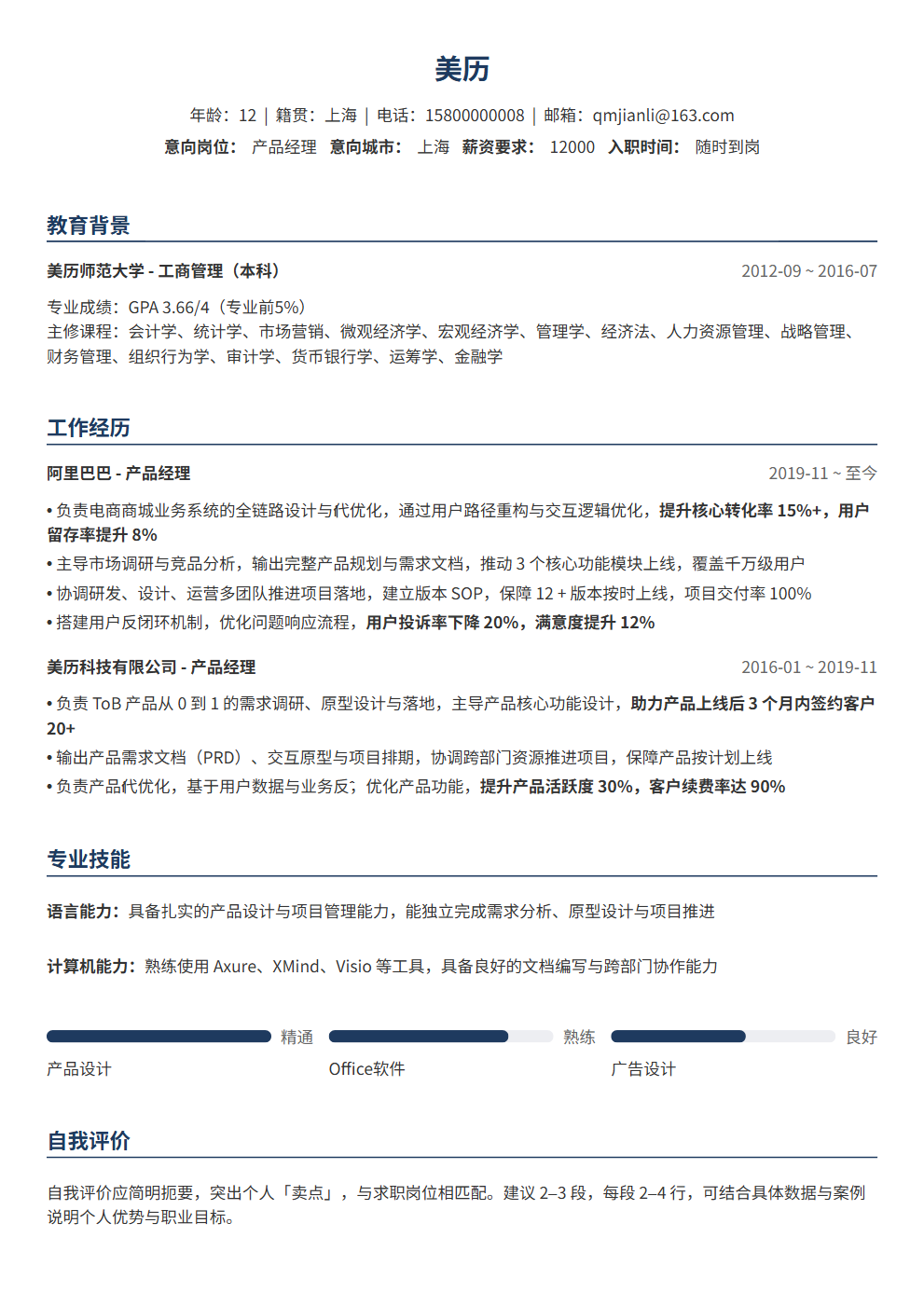
This is the most persuasive basis for a raise. Every achievement should include "what you did + result numbers":
- "Led X project, generating Y million in revenue/saving Z million in costs"
- "Managed a team of X, with team performance ranking in the top Y% company-wide"
- "Optimized X process, improving efficiency by Y%, saving Z work-hours annually"
Quantification strategies differ by role:
- Product Managers: Feature launch drove 30% DAU growth, paid conversion from 2.1% to 3.8%, 7-day retention improved by 15 percentage points
- Backend Engineers: API response time reduced from 800ms to 120ms, system concurrency scaled from 500 to 5,000 QPS, production incident rate dropped 70%
- Marketing & Operations: Customer acquisition cost cut from $15 to $8.50, campaign participation exceeded 100K, brand search index grew 200% quarter-over-quarter
- HR Professionals: Hiring cycle shortened from 45 to 22 days, key role retention improved to 92%, per-capita training cost reduced 40% while satisfaction increased
- Financial Analysts: Identified and recovered $500K in overpayments, budget variance controlled from 12% to 3%, tax optimization plan saved $280K
Leverage 2: Expanded Scope of Responsibility
If you've gone from executor to decision-maker, from managing 1 person to 10, from 1 product line to 3 — these are hard evidence for raises:
- Clearly document the evolution of your responsibilities in your resume
- Use "from X to Y" comparative phrasing to highlight growth
- Note the timeline of each scope expansion so interviewers see your growth velocity
Leverage 3: Scarce Skills and Industry Recognition
If your skills are in high demand or you've earned industry-recognized awards and certifications, these prove scarcity:
- Industry awards, patents, publications
- High-difficulty certifications (CPA, CFA, PMP)
- Invitations to speak at industry events or serve as a judge
- Open-source contributions or technical community influence
3. The "Salary Anchor" Strategy in Your Resume
In salary negotiations, there's a psychological technique called anchoring — the first number thrown out becomes the negotiation anchor. In your resume, you can set anchors through:
- Imply your value tier in your summary: e.g., "5 years of deep experience in X, having led 8-figure projects" — "8-figure" is a value anchor
- Highlight the scale of resources you've managed: Budget size, client volume, team size are all anchors
- List high-value skills in your skills section: AI, big data, cross-border — hot skills carry a premium
Anchors should feel natural, not forced. The best anchors are real scales you've worked with — ones you can elaborate on confidently when interviewers probe. Fabricated anchors, once exposed, will severely damage your credibility.
4. Resume Focus by Industry
- Technical roles: Emphasize tech stack breadth and depth, system architecture capabilities, technology selection decisions
- Sales roles: Emphasize performance rankings, key account development, revenue growth
- Operations roles: Emphasize user growth data, conversion rate improvements, cost optimization
- Management roles: Emphasize team size, business metric achievement, organizational transformation
- Creative roles: Emphasize work impact, awards, brand value enhancement
Regardless of industry, the core principle is speak the language of your target field. Engineers talk QPS and availability; sales professionals discuss deal size and sales cycle; operators focus on DAU and ROI. Present your value using the metrics interviewers care about most.
5. Preparation Beyond the Resume
A great resume alone isn't enough — salary increases through job-hopping require additional preparation:
- Know the market: Research target role salary ranges through job sites, recruiters, and peers
- Prepare negotiation scripts: "Based on my experience in X and achievements in Y, my expected salary is Z."
- Get multiple offers before negotiating: Having competitive offers completely changes your negotiation leverage
- Don't show your cards first: Let HR state the budget range, then negotiate from there
6. Overlooked Details That Affect Salary Perception
Many job seekers focus on the big picture but miss small yet impactful details that shape how interviewers assess your value:
Job Title Accuracy
Your job title is the first filter in recruiter screening. "Senior Product Manager" and "Product Manager" match differently in applicant tracking systems. If your actual responsibilities exceed your current level, note "(equivalent to Senior)" or let your responsibility descriptions speak for themselves. Never inflate titles, but let your scope of work communicate your true seniority.
Reporting Line Indication
Who you report to defines your organizational position. Reporting to the CEO versus a department manager signals entirely different decision-making authority and strategic visibility. Noting "Direct report to CEO/VP" on your resume helps interviewers quickly gauge your organizational tier and influence.
Budget and Resource Scale
The budget you control and resources you manage define your capability boundary. Someone managing a $500K budget operates at a different scale than someone managing $5M. Specify your budget range, team headcount, and number of business lines covered.
Cross-Department Collaboration Scope
The breadth of your cross-functional coordination reflects your influence and communication skills. "Coordinated Product, Engineering, Operations, and Legal to launch X project" is far more compelling than simply writing "cross-functional collaboration."
7. Timeline Strategy for Salary-Increase Resumes
Your resume timeline isn't just a list of jobs — it tells your career story. How you present this timeline directly shapes how interviewers perceive your growth trajectory.
Showcasing Career Progression
Interviewers want to see an upward curve. Use expanding scope and escalating results to demonstrate growth, not just job descriptions. Each role should show clear advancement over the previous one — in scope, depth, or impact. If a role lacks obvious growth, consider condensing it and giving more space to more compelling experiences.
Handling Multiple Roles at the Same Company
Promotions or transfers within the same company are strong evidence for salary increases. Two approaches: if the promotion jump is significant, list them as separate entries to highlight the level change; if responsibilities shifted gradually, combine into one entry and show the expansion timeline within the description. The key is letting interviewers see the company's recognition of you — internal promotions are their own form of endorsement.
Addressing Demotions or Lateral Moves
Career paths occasionally include lateral moves or apparent step-backs. The principle: focus on value, not titles. Moving to a core business line is a strategic choice; choosing a smaller team for greater autonomy signals growth. Define these experiences by outcomes and learnings, not by title. Interviewers care more about what you accomplished than what label you were given.
Summary
The core of salary increases through job-hopping: use quantified results as ammunition, expanded responsibilities as leverage, and scarce skills as premium. Your resume is the source of confidence in salary negotiations — every line should say "I'm worth more." From building your evidence chain to setting salary anchors, from overlooked details to timeline strategy, every element adds leverage to your negotiation. While optimizing your resume, do your market research and negotiation preparation. A 30% raise isn't an unreachable goal — it's a reasonable return on your demonstrated value. Start reviewing your resume now, identify the value points you can quantify and amplify, and let a professionally crafted resume give you the confidence to negotiate the salary you deserve.