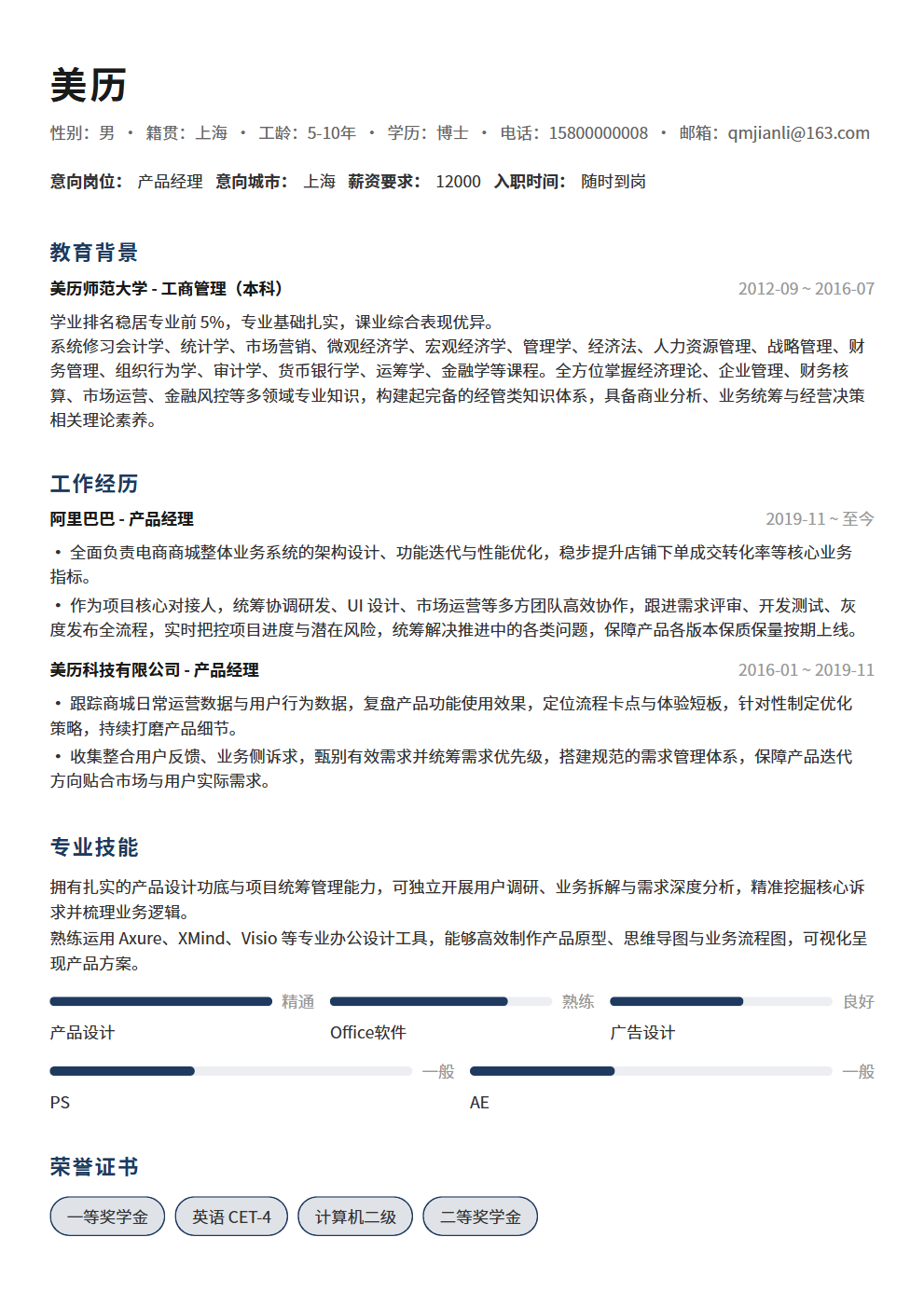
Resume Keyword Optimization: The Secret to Getting High Scores from ATS Systems
Large companies screen resumes with machines before humans. ATS keyword matching determines whether HR ever sees your resume. Learn to extract keywords from job descriptions and naturally integrate them.
1. What Is ATS and Why Does It Decide Your Resume's Fate?
ATS (Applicant Tracking System) is software used by most mid-to-large companies to automatically screen resumes. Its logic is simple: scan your resume, extract keywords, and score them against the job description. Resumes scoring below the threshold are never seen by HR.
Statistics show that over 75% of resumes are rejected by ATS before reaching human eyes. This means no matter how well-written your resume is, if keywords don't match, it's all wasted effort.
More specifically, ATS typically works like this: first it parses the resume file to extract text content, then matches and scores against a predefined keyword list, and finally ranks by score. HR usually only reviews the top 10-20% of resumes — the rest, no matter how excellent the content, go unread. So keyword optimization isn't a nice-to-have — it's your admission ticket.
2. A 4-Step Method for Extracting Keywords from JDs
Keywords aren't guessed — they're systematically extracted from the target job description:
- Read the JD thoroughly: Mark all skills, tools, and certification-related terms
- Categorize: Group keywords into hard skills (Python, SQL, Figma), soft skills (cross-functional collaboration, project management), and industry terms (SaaS, B2B, DAU)
- Prioritize: Words appearing repeatedly in the JD have highest priority; "bonus" items come second
- Expand synonyms: The same skill may have different names — "data analysis" = "Data Analysis" = "data mining" — cover them all
A practical tip: compare JDs from 3-5 similar roles side by side and extract high-frequency co-occurring keywords. These are industry-standard terms almost every company uses for screening. Cover these keywords, and your resume will pass most companies' ATS.
Another easily overlooked keyword source: implicit keywords in JDs. For example, if the JD says "drive business growth," implicit keywords include "growth strategy," "user growth," and "revenue growth." You need to infer the underlying skill requirements from JD descriptions and respond with corresponding keywords in your resume.
3. Three Positions to Integrate Keywords
Keywords shouldn't be stuffed in one place — distribute them across key resume sections:
- Summary/Objective: Include 2-3 core role keywords, e.g., "3 years of SaaS product operations experience, specializing in user growth and retention strategies"
- Work experience descriptions: Naturally weave skill keywords and industry terms into STAR descriptions
- Skills section: Order skills to match the JD, prioritizing explicitly required ones
Key principle: Keywords should be naturally embedded, not awkwardly stuffed. ATS can detect keyword stuffing — over-optimization can actually lower your score.
In practice, keyword density in each section should be reasonable. Place 2-3 core keywords in your summary, naturally integrate 1-2 skill or industry terms in each work experience bullet point, and order skills to match JD requirements. This ensures even keyword distribution across your resume, satisfying ATS matching needs without making HR feel you're stuffing keywords.
4. ATS-Friendly Resume Format Requirements
Even with keyword matches, wrong formatting can prevent ATS from reading your resume correctly:
- Use standard headings: "Work Experience," "Education," "Skills" — not creative headings like "My Journey" or "Growth Footprints"
- Avoid tables and text boxes: ATS has limited ability to parse text within tables
- Consistent date formats: Use either "2023.06-2024.03" or "June 2023 - March 2024" consistently
- Export as text-based PDF: Scanned/image PDFs can't be read by ATS — use selectable-text PDFs only
- Avoid headers and footers: Some ATS can't parse content in headers/footers
Another easily overlooked formatting issue: special characters and icons. ATS may not correctly parse bullet points (like ●, ►), dividers, or decorative icons. Use standard ASCII characters — for example, "-" or "•" for list markers, avoiding special Unicode characters.
Regarding file format, some companies accept Word documents while others only accept PDF. Prioritize PDF format as it ensures layout consistency. But always confirm the exported PDF is text-based — open the PDF and try selecting text. If text is selectable, it's text-based; if not, it's image-based and needs to be re-exported.
5. Testing Whether Your Resume Is ATS-Friendly
Before submitting, quickly test with these methods:
- Plain text test: Copy your resume content into Notepad — if information is complete and in correct order, ATS can read it too
- Keyword density check: Core keywords for the target role should appear at least 2-3 times
- Format simplification test: After removing all formatting, is the core information still clear and readable?
If your resume passes the plain text test, it's ATS-friendly enough. Optimizing keyword density on this foundation will significantly boost your pass rate.
Another testing method: cross-reference your resume against the target JD's keywords, checking each JD keyword for presence in your resume. If any are missing, add them in appropriate places. But remember, added keywords must be supported by your real experience — never fabricate qualifications.
6. ATS Keyword Characteristics by Industry
Different industries have very different keyword preferences — understanding these differences makes your optimization more precise:
- Internet/Tech: Emphasizes tech stack keywords (React, Kubernetes, microservices) and data metric terms (DAU, conversion rate, A/B testing)
- Finance/Consulting: Emphasizes professional terminology and certification keywords (CPA, CFA, due diligence, financial modeling)
- FMCG/Retail: Emphasizes brand and marketing keywords (brand positioning, channel management, consumer insights)
- Manufacturing: Emphasizes process and standards keywords (Six Sigma, lean production, supply chain management)
When optimizing keywords, first determine your target industry's keyword characteristics, then adjust your resume accordingly. A "generic" resume rarely achieves high match rates across all industries — industry-specific keyword customization is the efficient approach.
7. Common Keyword Optimization Mistakes
While keyword optimization is important, avoid these pitfalls:
- Don't fabricate skills: Don't write skills you don't have — being exposed in an interview is worse than not passing the resume screen
- Don't stuff keywords: Adding a long keyword list at the end of your resume (keyword stuffing) is an old trick — modern ATS detects and penalizes it
- Don't ignore context: Keywords should be embedded in meaningful sentences — "Proficient in Python for data analysis" is more valuable than just "Python" alone
- Don't optimize without validating: After each modification, run the plain text test to ensure formatting hasn't been broken
The essence of keyword optimization is making your resume match job requirements more precisely, not gaming the system. Your goal isn't to trick ATS but to let it correctly identify your real capabilities. An honest and well-optimized resume gives you confidence in interviews too.
Summary
The core of ATS keyword optimization: extract keywords from JD → distribute naturally → ensure parseable format. Don't treat keyword optimization as gaming the system — it's fundamentally about making your resume match job requirements more precisely. Understand keyword characteristics by industry and customize your optimization strategy accordingly. Avoid mistakes like fabricating skills or keyword stuffing, and validate with plain text tests after each modification. An ATS-friendly resume ensures your capabilities are actually seen by HR. Spend 5 minutes tweaking keywords before each submission — this habit delivers returns far beyond what you'd imagine.