Rejected as a Fresh Grad? 5 Steps to Bounce Back and Land Your Offer
Job rejection isn't the end. 5 steps to bounce back: allow yourself to feel upset, analyze rejection reasons, optimize your resume and interview skills, expand your application scope, and reset your mindset. Plus psychological adjustment methods after rejection.
You sent out 50 resumes, interviewed at 8 companies, and got rejected by all of them—this isn't a rare case, it's the darkest moment most fresh grads go through. Job rejection isn't terrifying—what's terrifying is collapsing in place and giving up after being rejected. Here are 5 steps to help you climb out of the low point and land the offer you want.
1. Step One: Allow Yourself to Feel Upset—Don't Pretend You're Fine
Many fresh grads' first reaction after rejection is "It's fine, I don't care"—then they stay up until 3 AM scrolling through their phone, rereading that rejection email. Pretending to be strong isn't real strength. Allowing yourself to feel upset is the first step toward bouncing back.
- Give Yourself a "Grief Period": Feeling upset after rejection is normal—don't suppress it. Give yourself 1-2 days as a "grief period"—cry, vent, do nothing if you want. But this period needs a deadline, and when it's up, you must take action. Treat emotions like a cold: rest is necessary, but you can't stay in bed forever
- Talk to the Right People: Don't carry it alone. Reach out to friends who've been through job hunting, seniors, or family members you trust—they may have experienced the same rejections and understand that frustration. Venting isn't about getting solutions; it's about knowing "I'm not alone." But be careful: don't vent to someone who's also in peak job-hunting mode and anxious themselves—negativity is contagious
- Avoid Social Media's "Survivor Bias": The worst thing to do after rejection is scroll through social media watching others post their offers. The people posting offers are the minority; the silent majority is just as anxious as you. Don't punish yourself with other people's highlight reels. If you can't resist, temporarily mute your feeds and leave job-hunting groups—this isn't avoidance, it's protecting your mindset
- Write It Down Instead of Ruminating: Write down how you feel about being rejected—"I got rejected by XX company today, I'm really upset, I feel like I'm not good enough." Writing serves two purposes: it externalizes chaotic emotions, and once written, you'll realize rejection isn't as terrifying as it seems when swirling in your head. Emotions on paper stop circling in your mind
2. Step Two: Analyze Why You Were Rejected—Rejection Is Information, Not a Verdict
After processing your emotions, the most important thing isn't to keep sending resumes—it's to analyze why you were rejected. Every rejection contains valuable information. If you only focus on being upset and ignore that information, you'll be rejected for the same reasons next time.
- Distinguish Between "Resume Stage Rejection" and "Interview Stage Rejection": Different rejection reasons require completely different solutions. If your resume didn't pass screening, it means your resume didn't impress HR—perhaps your experience wasn't relevant enough, the layout wasn't professional, or keywords were missing. If you passed the resume stage but failed the interview, it means your resume was acceptable but your interview performance fell short—perhaps your self-introduction wasn't polished, you couldn't answer technical questions, or your communication lacked clarity. First figure out which stage you're stuck at
- Common Reasons for Resume-Stage Rejection: Career objective doesn't match the role (HR thinks you're "not a fit"); experience descriptions are too vague ("responsible for XX" without concrete results); resume is too long or messy (HR can't scan key points in 10 seconds); missing keywords (your resume doesn't include core skill terms from the job description); education or major doesn't meet hard requirements. Check your resume against these reasons one by one
- Common Reasons for Interview-Stage Rejection: Self-introduction has no highlights (can't explain who you are in 3 minutes); answers lack structure (saying whatever comes to mind, logically disorganized); insufficient knowledge of the company and role (freezing when asked "what do you know about us"); lack of confidence in expression (quiet voice, avoiding eye contact, frequently saying "maybe" or "probably"); unreasonable salary expectations (far above market rate or unable to articulate clearly). Recall each interview and check against these points
- Proactively Seek Feedback: If possible, reach out to the interviewer or HR and politely ask about the rejection reason. Not all companies will respond, but some HR professionals are willing to give brief feedback—this feedback is 100 times more valuable than your own speculation. Suggested approach: "Thank you for your time. I really value this interview opportunity. If it's convenient, could you share any improvement suggestions? It would be very helpful for my ongoing job search." Be sincere—don't be confrontational
3. Step Three: Optimize Your Resume and Interview Skills—Rejection Is a Signal to Improve
After analyzing the reasons, the next step is targeted optimization. Being rejected doesn't mean you're not capable—it means your resume and interview skills haven't reached the "passing standard" yet. Every rejection is a free diagnosis telling you where to improve.
- Resume Optimization: Improve Based on Rejection Reasons: If the issue is "not a match," adjust your career objective and experience descriptions to better align with the target role; if "too vague," rewrite experiences using the STAR method with quantified data; if "too messy," restructure the layout, highlight key points, and keep it to one page; if "missing keywords," study the target role's JD and naturally weave in core skill terms. A resume isn't written once and done—it should be iteratively optimized after every rejection
- Interview Optimization: Target Your Weaknesses: If your self-introduction lacks impact, redo it—use 1 minute to clearly explain "who I am + what I've done + why I'm a fit for this role"; if your answers lack structure, practice using the "point-evidence-conclusion" framework; if you lack company knowledge, spend 2 hours before the interview researching the company website, products, and recent news; if you lack confidence, practice in front of a mirror, record yourself, do mock interviews with friends—confidence can be trained
- Build a "Rejection-Optimization" Iteration Loop: After each rejection, record the reason → make targeted improvements → validate the improvements at the next interview → record and optimize again. This isn't mindless repetition—it's directed iteration. After 3-5 rounds, you'll notice significant improvements in both resume pass rates and interview performance. Job hunting is fundamentally a process of continuous trial, error, and correction
- Don't Change Too Much at Once: When optimizing your resume and interview, change only 1-2 things at a time—this way you know which change was effective. If you change 5 things at once and succeed next time, you won't know which change worked; if you fail, you won't know which change didn't help. Take small steps, iterate quickly
4. Step Four: Expand Your Application Scope—Don't Put All Eggs in One Basket
Many fresh grads keep grinding at the same few "big tech" companies after being rejected—rejected 3 times, applying a 4th time. Persistence is good, but persistence isn't stubbornness. Expanding your application scope isn't lowering your standards—it's increasing your probability.
- Expand Your Industry Range: If you're only applying to tech, try fintech, enterprise SaaS, or smart manufacturing—many traditional industries' digital roles offer comparable pay and growth to tech, but with far less competition. Don't be limited by the "industry prestige hierarchy"—any role that helps you grow is a good role
- Expand Your Company Size Range: Big tech is fiercely competitive—hundreds of applicants per role. Smaller companies may lack brand prestige, but new hires get more hands-on experience, faster growth, and flatter communication. Many industry leaders' first jobs weren't at big companies—getting on the train first and switching seats later is more practical than waiting at the platform for first class
- Expand Your City Range: If you're only applying to Beijing, Shanghai, Guangzhou, and Shenzhen, try new tier-one cities—Hangzhou, Chengdu, Wuhan, Xi'an, Suzhou. These cities have increasingly high-quality employers, lower living costs, and friendlier hukou policies. The same role may have half the competition in a new tier-one city compared to a traditional one
- Expand Your Role Range: If you're only applying for product manager roles, try product operations, user research, or data analysis—these roles share significant overlap with product management in their skill models, and internal transfers are common after joining. Don't be limited by job titles—skills are transferable; job labels are temporary
- Set Daily Application Targets: After rejection, it's easy to fall into the psychological trap of "being afraid to apply." Set a daily application target—say, 5-10 companies per day, rain or shine. Applying is itself an action, and action is the best antidote to anxiety. Don't wait until you're "fully prepared" to apply—you'll never be 100% ready
5. Step Five: Reset Your Mindset and Start Again—Rejection Is a Process, Not an Ending
The first 4 steps are about methods and actions. Step 5 is about mindset—and it's the most important one. Job rejection isn't a denial of who you are as a person; it's a signal that "you and this role aren't currently a good match." Only by adjusting your mindset can you sustain your efforts.
- Redefine "Rejection": Being rejected doesn't mean "I'm not good enough"—it means "this role isn't right for me right now." Interviewing is a two-way street—you're also choosing the company. Rejection means this company isn't your optimal match, not that you're inadequate. Replace "I was rejected" with "this company and I aren't a match right now"—same outcome, different interpretation, completely different mindset
- Use Data to Counter Anxiety: Anxiety comes from uncertainty—"Will I ever find a job?" Use data to answer this question. Track your application volume, interview count, and pass rate, then compare with your peers' averages. You may discover your pass rate isn't as low as you think—you simply haven't applied enough. The average number of rejections before landing an offer for most fresh grads is 10-20—how many have you had?
- Focus on "Controllable Factors": Many factors in job hunting are uncontrollable—competitors' levels, headcount numbers, interviewers' preferences. Anxiety often stems from over-focusing on uncontrollable factors. Shift your attention to controllable ones: resume quality, interview preparation, application volume, mindset management. You can't control outcomes, but you can control the process—and a good process generally leads to good outcomes
- Set a "Stop-Loss Line": If you've been continuously rejected for 3+ months, it may be time to reassess your job search strategy—are you targeting the wrong roles? Is there a fundamental flaw in your resume you haven't noticed? Are there systematic issues with your interview performance? Find a professional career coach or experienced mentor to help diagnose the problem—don't struggle alone. Stopping your loss isn't giving up; it's finding a more effective path
- Remember: Job Hunting Is a Marathon, Not a Sprint: Didn't get an offer in fall recruitment? There's spring recruitment. Missed spring? There's always social recruitment. Many successful professionals' first jobs weren't their ideal ones—but they grew quickly from less-than-ideal starting points and eventually went further. Job hunting isn't a one-shot deal—it's a continuous matching process. In the long run, today's rejections may be just a minor episode
6. Psychological Adjustment Methods After Rejection
Beyond the 5 steps, these psychological adjustment methods can help you maintain a stable mindset after rejection and avoid falling into a vicious cycle of self-doubt.
- Exercise Is the Best Anti-Anxiety Medicine: After rejection, don't just sit around scrolling through your phone—go for a run, play sports, swim, or even take a 30-minute walk. Exercise triggers dopamine and endorphin release—natural "happiness hormones." Many successful job seekers share a common habit: exercising to de-stress before interviews and to decompress after rejections
- Build a "Small Wins List": After rejection, it's easy to feel like "I can't do anything right." Take out a piece of paper and write down your small wins during the job search: sent 50 resumes (action-oriented), interviewed at 8 companies (someone validated your resume), received 2 second-round invitations (your interview skills are improving). These small wins are real—rejection doesn't erase them
- Talk to People Who've Been There: Reach out to alumni or seniors who are already working and ask about their job hunting experiences—you'll find that many people who are doing well now were rejected left and right back then. Their stories are the best "psychological vaccine": rejection is normal, it's not your exclusive problem
- Maintain Your Daily Routine: The biggest risk after rejection is "giving up"—sleeping in until noon, scrolling through your phone all afternoon, staying up late with anxiety, and repeating the cycle. Maintain a normal routine: wake up on time, eat regular meals, send resumes daily, exercise daily, study daily. A stable routine is the foundation of a stable mindset
7. Conclusion: Rejection Is a Required Course in Job Hunting, Not Your Final Destination
Fresh grads facing job rejection can bounce back in 5 steps: allow yourself to feel upset (don't pretend you're fine, set a grief period), analyze rejection reasons (rejection is information not a verdict—distinguish resume vs. interview stage), optimize your resume and interview skills (make targeted improvements, build an iteration loop), expand your application scope (don't put all eggs in one basket—expand across industries, company sizes, cities, and roles), and reset your mindset to start again (rejection is a process not an ending—use data to counter anxiety). Combined with psychological adjustment methods like exercise, small wins lists, learning from others' experiences, and maintaining your daily routine—rejection isn't scary. What's scary is stopping all action after being rejected. Every rejection tells you where you can improve; every optimization brings you one step closer to your offer.
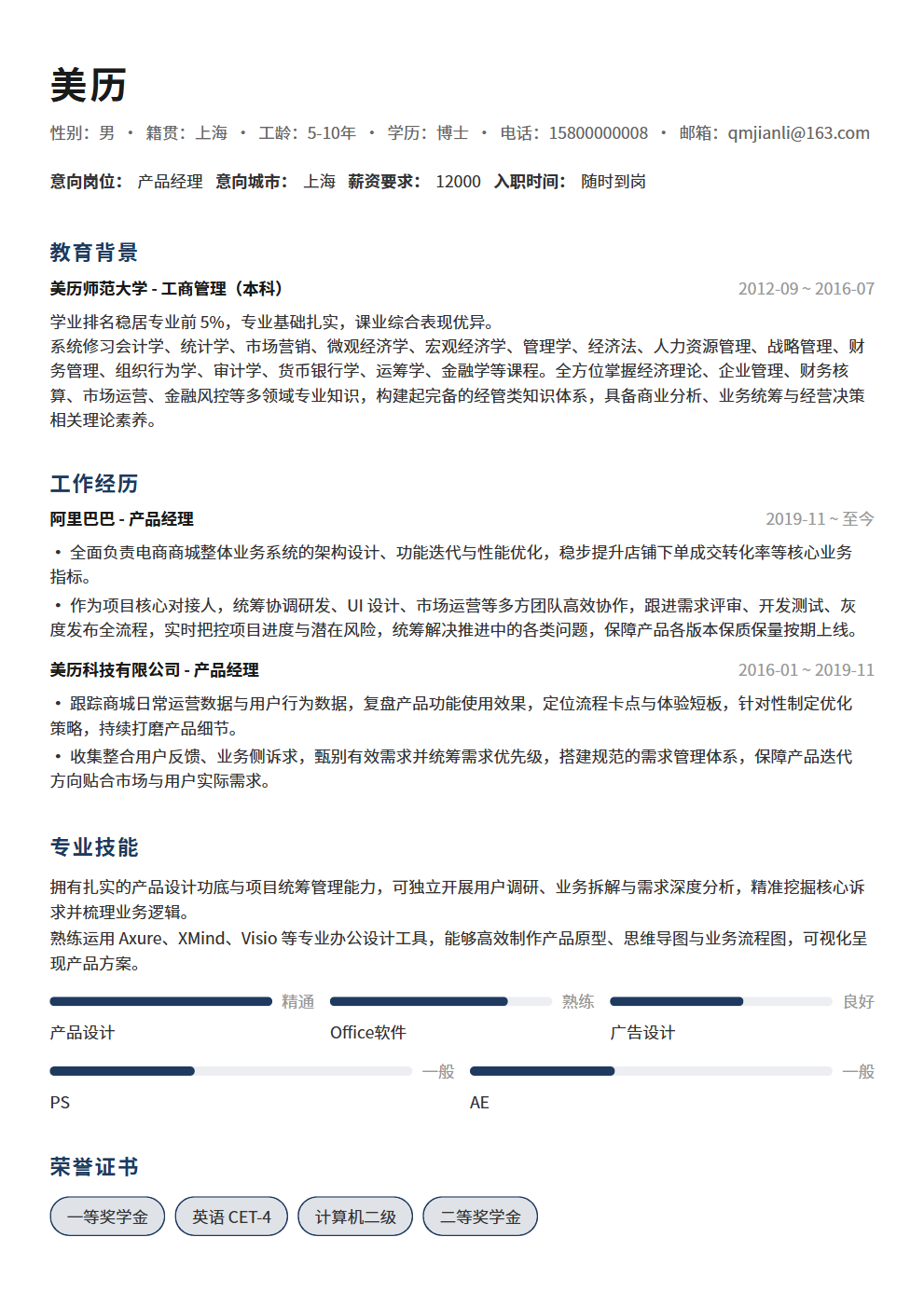
The very first thing you should do after rejection is optimize your resume. BeautyResume Editor provides smart resume diagnostics and professional templates, helping you quickly identify weak spots and optimize layout and content with one click—dramatically boosting your pass rate on the next application. Rejection isn't the end—optimize your resume and start fresh. Use BeautyResume to craft a more professional resume, and the next offer could be just around the corner!