One Page or Two? A Resume Length Guide for Job Seekers at Every Career Stage
Is the one-page resume a golden rule? Not necessarily. Fresh graduates and professionals with 10 years of experience need completely different resume length strategies. This article provides resume length recommendations by career stage to help you create the most suitable resume.
You open Word, start writing your resume, and when you reach the second page, you hesitate — "Do HR professionals only read one-page resumes?" "Will a two-page resume get tossed immediately?" So you start frantically cutting content, shrinking the font to size 9, tightening line spacing to 1.0, and cramming two pages of content into one. The result? It's so densely packed it looks like ant trails, and HR closes it after three seconds. Resume length is a question that plagues too many job seekers. Some say one page is an iron rule; others say two pages are fine — who should you listen to? The answer: it depends on your career stage. Fresh graduates and professionals with 10 years of experience need completely different resume length strategies. Today, let's settle this topic once and for all.
When the One-Page Rule Applies
The "resume must be one page" rule originated from American campus recruiting. Nearly all top U.S. university career centers recommend one-page resumes because in campus recruiting, HR processes hundreds of resumes daily, spending only 6-10 seconds on each. In this scenario, one page is indeed optimal — high information density, key points don't get buried, and HR can quickly grasp the essentials. But this rule has an important prerequisite: your experience is concise enough to fit on one page. For fresh graduates and professionals with 1-3 years of experience, this prerequisite holds. But for those with 5+ years of experience, multiple projects, and team management roles, forcing everything onto one page is like cutting off your toes to fit into smaller shoes.
- Advantages of a one-page resume: Focused information, high reading efficiency, key highlights don't get buried in lengthy text, demonstrates your ability to be concise and impactful
- Disadvantages of a one-page resume: Limited information capacity, can't fully showcase complex project experience, may omit important achievements, can become a "compressed file" for experienced professionals
- The true meaning of the one-page principle: It's not "resumes must be one page" but "every line on your resume should add value." If you can present your core competitiveness completely on one page, use one page; if it takes two pages to explain clearly, use two. The key is — no filler
So, one page isn't a golden rule — it's a "default recommendation." Your resume length should be determined by your career stage and the richness of your experience, not by blindly following a fixed rule.
Why Fresh Graduates Must Use One Page
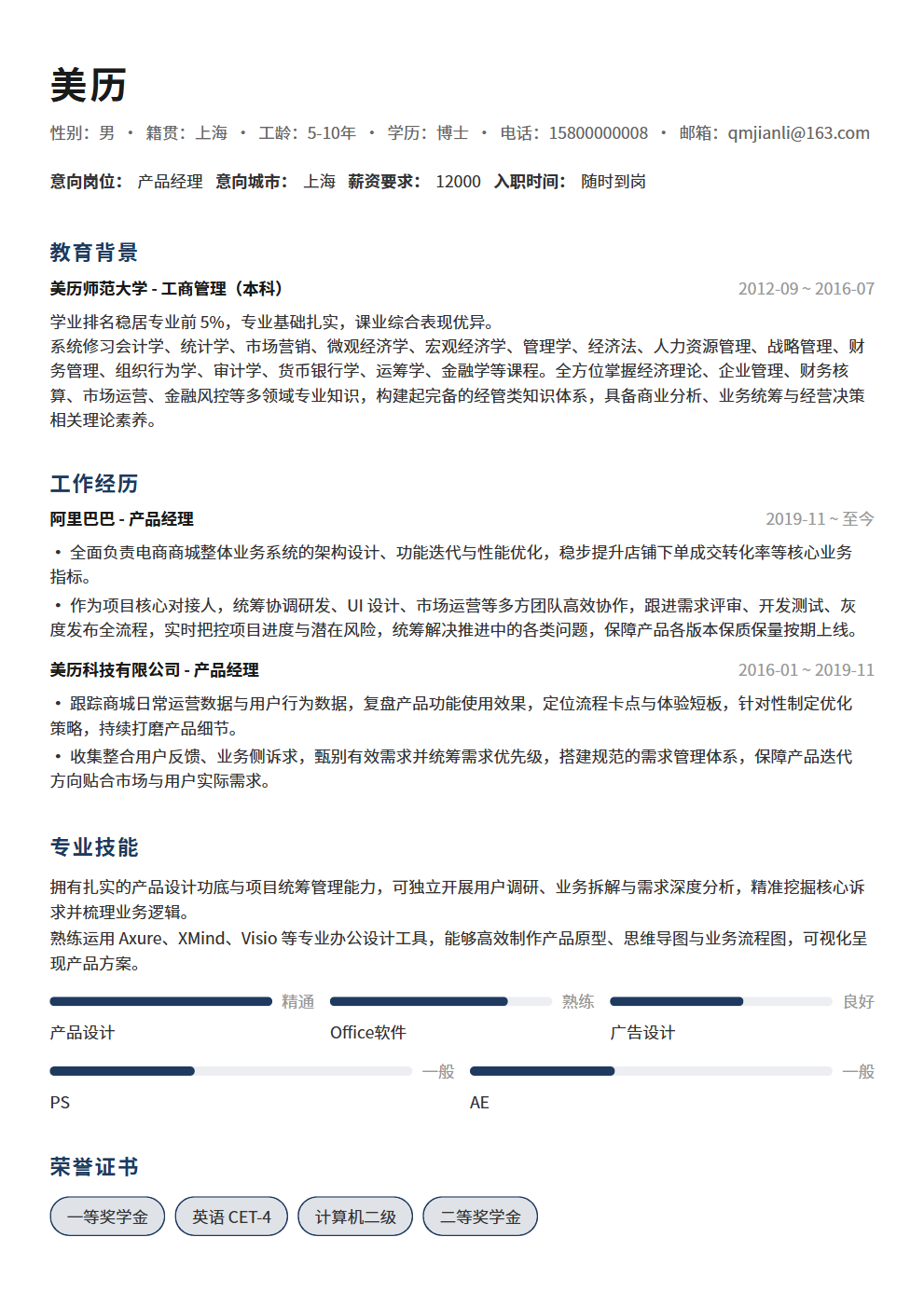
If you're a fresh graduate or a professional with 1-2 years of experience, your resume must be one page. This isn't a suggestion — it's a requirement. The reason is simple: your experience is limited, and one page is entirely sufficient. If you've written two pages, there are only two possibilities — either you're padding it, or you don't know how to be concise. Either way, it's a red flag for HR.
- Typical fresh graduate experience: Education background, 2-3 internships, campus activities, skills and certifications, awards. One page is more than enough for all of this. If you feel one page isn't enough, it's probably because you've included too much irrelevant content — like high school experiences, unrelated part-time jobs, or empty self-evaluations
- Common "padding" tactics for fresh graduates: Splitting one internship into three bullet points and repeating yourself, writing long self-evaluations to fill space, listing every course and certificate, using large fonts and wide spacing to stretch the layout. HR can spot all of these instantly
- One-page layout tips for fresh graduates: Basic info 2 lines, education 3-4 lines, internship/project experience 15-18 lines, skills and certifications 3-4 lines, self-evaluation 2-3 lines (optional). Total approximately 25-30 lines — a perfect fit for one A4 page
- Content prioritization for fresh graduates: Only include experiences relevant to the target position. Applying for product manager? Write about product internships and projects. Applying for operations? Write about operations internships and data achievements. Cut irrelevant experiences decisively, even if you feel "it's a shame to leave them out"
Remember, the core competitive advantage of a fresh graduate's resume isn't "lots of experience" — it's "precise expression." A one-page resume where every line tells HR: I know what matters, and I can identify key points. This ability itself is one of the most valued qualities in the workplace.
3-5 Years of Experience: 1.5 Pages Is Acceptable
Professionals with 3-5 years of experience are in an awkward transition period — their experience is significantly richer than a fresh graduate's, but not yet extensive enough to require two full pages. At this stage, 1.5 pages is a reasonable length. But 1.5 pages has a practical problem: it doesn't look great when printed, with the second page only half-filled, appearing top-heavy. So in practice, you need to make a choice: condense to one page, or expand to two.
- Typical content for 3-5 years of experience: Education background (can be condensed), 3-4 work experiences, 2-3 core achievements per role, skills and certifications. With concise expression, one page works; if each role needs detailed explanation, two pages may be necessary
- When to use one page: You have only 1-2 work experiences with minimal role changes. For example, if you've been a product manager at one company for 3 years with relatively concentrated experience, one page is sufficient
- When to use two pages: You have 3+ work experiences or significant role transitions. For example, transitioning from operations to product management, where each experience needs detailed explanation of your role and achievements — two pages is more appropriate
- The 1.5-page compromise: If you genuinely need 1.5 pages of content, it's better to expand to two full pages. The second page can include skill details, supplementary project descriptions, and certification lists. Don't leave the second page more than half empty — that's worse than one page
- Core principle for 3-5 year resumes: Every work experience must include specific achievements, not just responsibilities. "Responsible for user growth" is a responsibility; "grew DAU from 50K to 120K in 3 months" is an achievement. Achievements are 100 times more valuable than responsibilities
The 3-5 year mark is the transition stage where resumes shift from "one page" to "two pages." The deciding factor isn't how many years you've worked, but whether your core achievements need two pages to be fully explained. If one page suffices, use one; if not, use two. Don't pad for length, and don't cut key achievements to save space.
Two-Page Strategy for 5+ Years of Experience
For professionals with 5+ years of experience, a two-page resume is normal, reasonable, and even necessary. You've worked on multiple projects, led teams, and delivered significant results — cramming all of this onto one page only makes each point superficial, failing to reflect your depth and value. But two pages doesn't mean "write whatever" — it has its own strategy.
- Core principle of two pages: Place the most critical content on the first page (most recent 1-2 work experiences, most important achievements), and supplementary content on the second page (earlier experiences, project details, skills and certifications, education). If HR only reads the first page, they should still grasp your core competitiveness
- First page layout: Basic info 2 lines, professional summary 3-4 lines (2-3 sentences summarizing your core positioning and biggest achievements), most recent 1-2 work experiences 20-25 lines (3-5 quantified achievements per role). The first page must convince HR that "this person is worth interviewing"
- Second page layout: Earlier work experiences 10-15 lines (can be more concise than recent ones), key project supplements 5-8 lines, skills and certifications 3-4 lines, education 2-3 lines. The second page is a bonus, not a requirement — if HR doesn't turn to page two, page one must still be strong enough
- Common mistakes with two-page resumes: Putting education and skills on the first page (wasting prime real estate), no clear priority between the two pages (reads like a chronological list), only a few lines on the second page (better to condense to one page), repeating content across pages (listing the same achievement twice)
- Special strategy for 5+ years: If you have 15+ years of experience, you can appropriately condense early career experiences. Work from 10+ years ago can be summarized in one or two sentences. HR cares more about what you've done and achieved in the last 5 years. Early experiences serve to "prove your career trajectory has been upward"
The key to a two-page resume is "structural clarity" — let HR immediately see your career narrative, core achievements, and growth trajectory. It's not about listing all experiences flatly, but presenting them with focus and hierarchy. Page one is the "door opener," page two is the "bonus" — both must work together for maximum impact.
3 Criteria for Determining Resume Length
After all this, you might still be unsure how many pages your resume should be. Here are 3 criteria to help you make the best decision.
- Criterion 1: Content value density. Review your resume line by line and ask: if I remove this line, would HR's assessment of me decrease? If not, remove it. If more than 20% of your resume could be removed without affecting HR's judgment, your resume is too long. A good resume has irreplaceable value in every single line
- Criterion 2: Target position match. Your resume length should match the requirements of the target position. For entry-level roles, one page is sufficient; for senior management positions, two or even three pages are reasonable — because senior roles require seeing your strategic thinking, team management, and business results in depth. Don't use the same resume for all levels of positions
- Criterion 3: Reading experience. Print your resume and hand it to someone who doesn't know you. Ask them to identify your 3 core highlights within 30 seconds. If they can't, your resume is either too long (information is buried) or poorly structured (key points aren't prominent). The ultimate goal of a resume is to let HR grasp your core value in the shortest possible time
These 3 criteria aren't independent — they validate each other. If your resume passes all 3 tests, then whether it's one page or two, the length is appropriate. Remember: there's no standard answer for resume length — only the answer that's best for you.
Conclusion: Resume Length Is Determined by Career Stage, Not Rules
Back to the original question: how many pages should your resume be? The answer — one page for fresh graduates, one or two pages for 3-5 years of experience (depending on content volume), and two pages for 5+ years. But more important than page count: does every line on your resume add value? Are your core achievements fully showcased? Can HR grasp your core competitiveness in 30 seconds? If the answer to all three is "yes," then your resume length is appropriate. Don't cut key achievements to comply with the "one-page rule," and don't pad your resume to appear "experienced." A resume is a marketing document, not an autobiography — write what HR wants to see, not what you want to write. Make every inch of space count, and let every line speak for you.
Still struggling with resume formatting? Use BeautyResume's resume editor to instantly adapt to one-page and two-page templates, with smart layout and spacing adjustments — so your resume looks professional and polished no matter the length. Stop worrying about format and focus on what matters: your content.