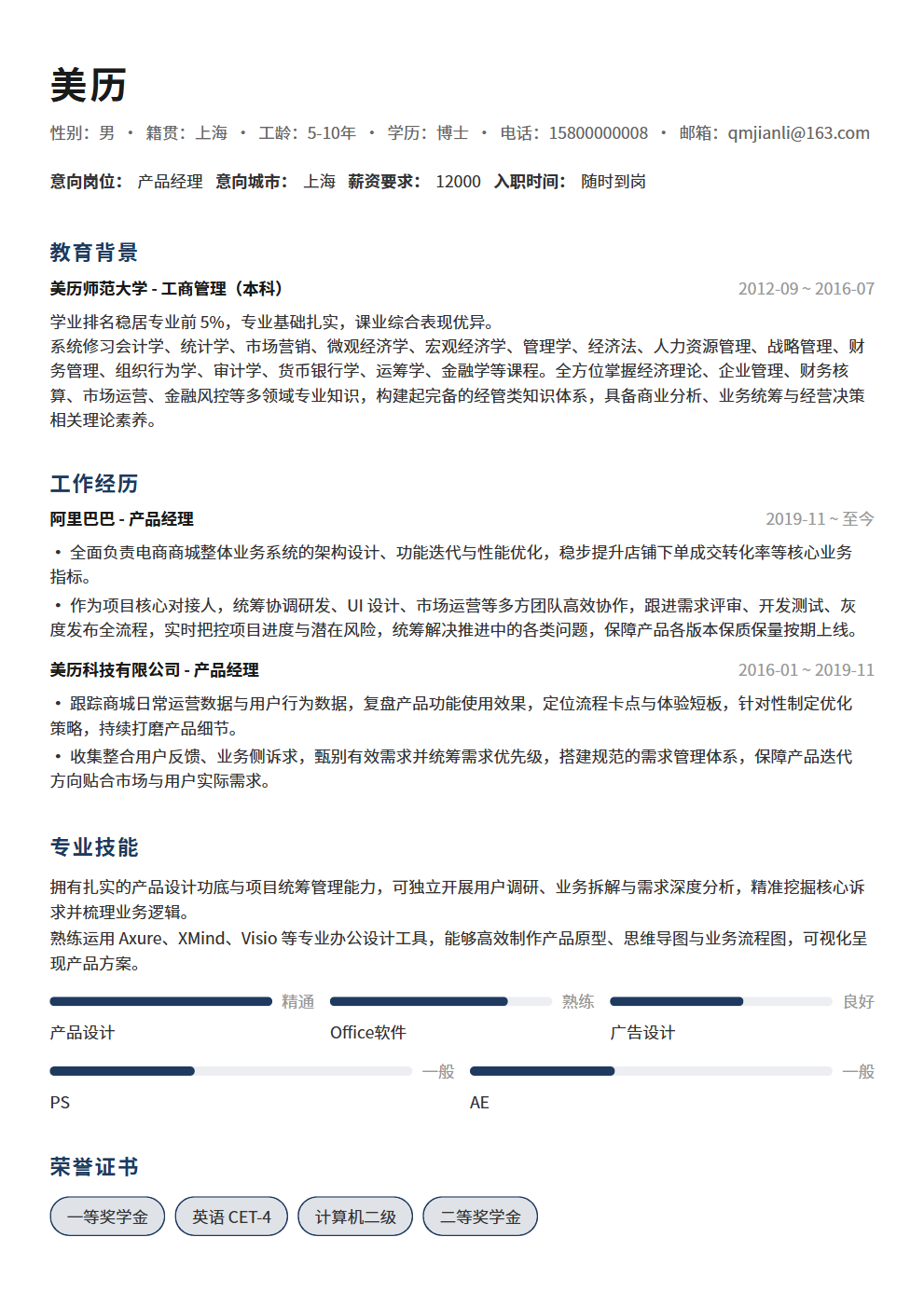
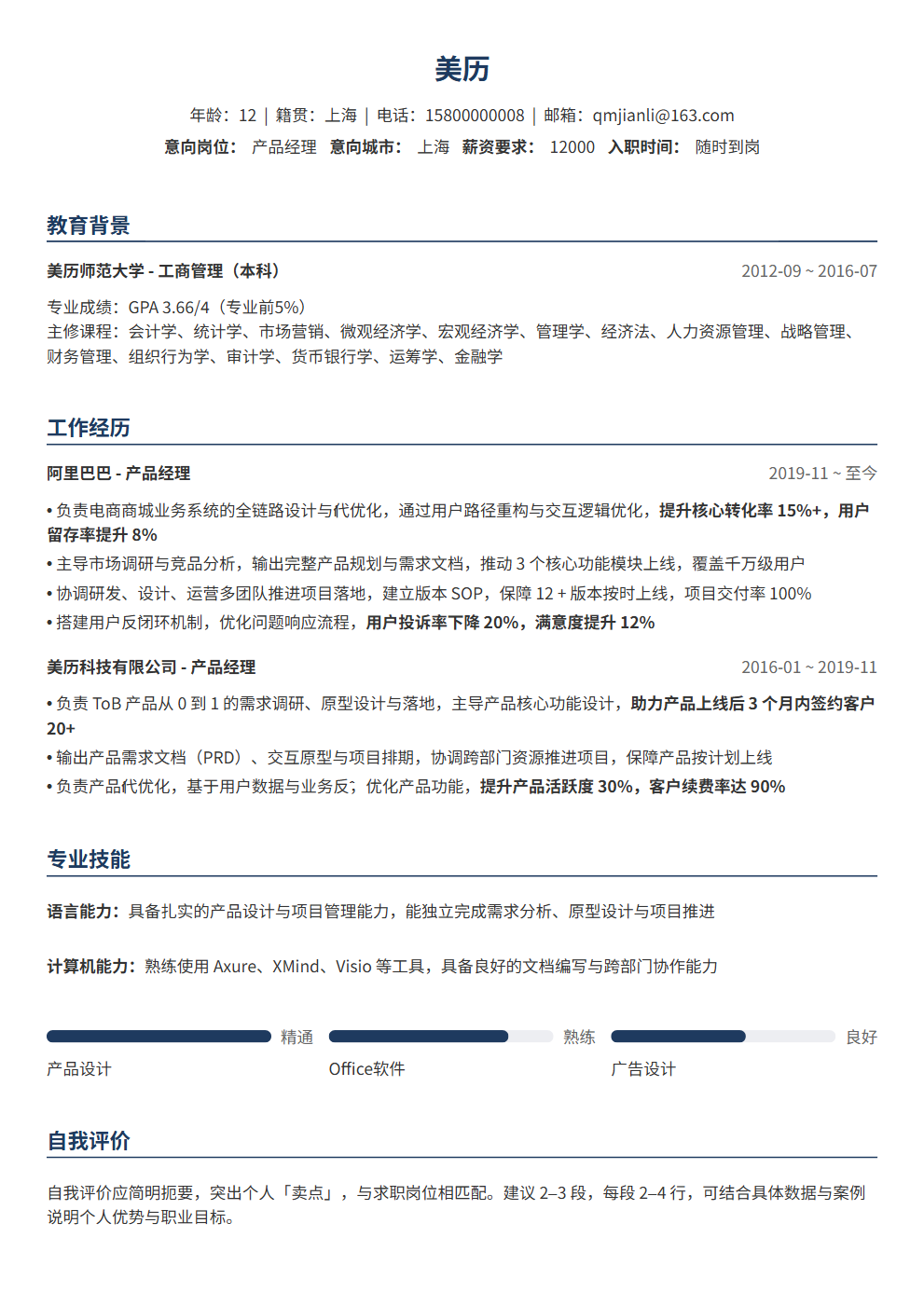
No Internship Experience? 4 Steps to Turn a Blank Resume into a Standout for Fresh Grads
No internship in four years of college? Learn 4 steps to uncover hidden experiences and turn coursework, competitions, and personal projects into HR-recognized job-hunting assets.
1. Redefine "Experience": Internships Aren't the Only Thing That Counts
Many fresh grads think they have "no experience," but that's because they define experience too narrowly. The essence of what HR looks for in experience is judging what capabilities you possess, not whether you clocked in at some company. These all count as valid resume experiences:
- Major course assignments: Independent or collaborative research projects, lab reports, design proposals
- Academic competitions: Math modeling, programming contests, business challenges — even without awards, they're worth including
- Social media operations: Public accounts, Xiaohongshu, Bilibili — consistent output proves capability
- Part-time work and tutoring: Don't underestimate these — managing clients and coordinating communication are workplace skills
The key isn't what you did, but how you articulate the value of what you've done.
When screening resumes, HR actually focuses on three signals: initiative (did you proactively seek opportunities?), execution (did you get things done?), and growth potential (did you learn from your experiences?). As long as you can prove these three points with specific examples, the presence or absence of internship experience isn't the deciding factor.
2. Mine Your Course Projects: Your Biggest Hidden Goldmine
You completed numerous course assignments over four years of college, but 99% of people never consider putting them on their resume. Here's how:
- Review your 3-5 best-graded courses and recall the specifics of each major assignment
- Redescribe them using "project" language: Project objective → Your role → Execution process → Quantified results
- Example: "Independently completed a consumer behavior research project, designed 10 interview questions, conducted in-depth interviews with 15 users, produced an 8,000-word analysis report, rated as outstanding assignment"
The advantage of course projects is that you have complete participation and controllable narrative, unlike internships where you might have just done grunt work. Treat them as your "quasi-work experience" — the results are surprisingly good.
An advanced technique: string multiple related course projects into a "capability storyline." For example, if you've done consumer research, market analysis, and brand planning projects, package them as "a complete marketing capability chain from user insight to brand execution." This串联 transforms scattered course projects into systematic capability proof, far more convincing than listing items individually.
3. Competitions and Certifications: Let Results Speak
Competition experience is one of the most powerful differentiators on a fresh grad's resume because it comes with third-party validation:
- With awards: Specify competition level, award tier, and participant scale, e.g., "Provincial First Prize, National Math Modeling Competition (1,200+ competing teams)"
- Without awards: Describe what problems you solved, methods used, and lessons learned — the process itself has value
- Professional certifications: CPA sections passed, bar exam qualified, CFA Level 1 — these are 10,000x more convincing than "passionate about learning"
If you have neither competitions nor certifications, start preparing for one now. Many competitions have cycles of just 1-3 months — plenty of time to include on your resume.
When writing competition experience, many students only write "participated in XX competition, won XX award" — too little information. The correct approach is to highlight your role and contribution within the team: How many team members? What part were you responsible for? What difficulties did you encounter? How did you solve them? What was the final outcome? Fill in these details and the full value of your competition experience can be unleashed.
4. Social Media and Personal Projects: The Modern Grad's Secret Weapon
Running a public account, creating short videos, writing tech blogs, developing personal mini-programs — these are all differentiated competitive advantages in modern job hunting:
- Social media metrics: Follower count, views, engagement rates — numbers are the best resume material
- Personal projects: Open source contributions on GitHub, independently developed apps or tools — especially valued for tech roles
- Content creation ability: People who can consistently produce high-quality content are rare talents in any position
When adding these experiences to your resume, emphasize data growth and user feedback. "Grew personal account to 3,000 followers in 6 months, with a single post reaching 12,000 views" is far more convincing than "passionate about writing."
Social media operations have a hidden value — they prove your user thinking and iteration ability. From topic planning to content creation to data review, this loop is essentially a micro version of product operations. During interviews, transfer your social media approach to the job context, and interviewers will feel you have "real-world practical sense."
5. Volunteer Work and Club Activities: Underestimated Proof of Soft Skills
Many students think volunteer and club experiences are "too lightweight" to include. But from another angle, these experiences prove the soft skills most needed in the workplace:
- Club leaders: Prove your organizational coordination and team management skills — specify how many people you managed, what events you planned, and what results you achieved
- Volunteer activities: Prove your service mindset and cross-cultural communication skills — especially suitable for foreign companies and non-profit positions
- Student union/committee: Prove your familiarity with process management and resource coordination — suitable for operations and administrative roles
Key writing tip: Don't just write "served as XX director" — write "organized 3 university-level events as XX director, with 500+ participants and 95% satisfaction rate." Transform "titles" into "results" with data.
6. Resume Structure Optimization for Zero-Experience Grads
When your experience is genuinely thin, resume structure becomes critical. Recommended layout strategies:
- Put "Education" first, highlighting GPA, core courses, and academic achievements
- Replace "Work Experience" with "Project Experience," making course projects and competitions the main body
- Add a "Skills" section listing hard skills and tools directly relevant to the target position
- Use "Summary" to concisely state core strengths in 3 sentences, compensating for the impression of insufficient experience
The core logic of resume structure is placing your most impressive content where HR sees it first. Having few experiences isn't scary — what's scary is HR reading your resume and thinking "this person has done nothing." The problem usually isn't the experience itself, but whether you've articulated its value clearly.
Summary
No internship doesn't mean no experience. Experience isn't about scale — it's about how you mine and present it. Course projects, competition certificates, social media operations, and club volunteer work can all become resume highlights. The key is seeing yourself from a different angle — you're not "blank," you're "undiscovered." A well-structured resume with clear highlights can make HR look past the internship gap and see your real capabilities. Don't let "no internship" become an excuse not to apply — writing your existing experiences well is the best start you can make.