New Resume Trends in the AI Era: 3 Resume Traits HR Wants Most in 2026
Resume writing is evolving. What does HR value most in 2026? This article analyzes 3 key resume traits — data-driven, ATS-friendly, and personalized expression — to help you craft a high-quality resume that meets the latest trends.
Have you noticed that people landing great offers write their resumes completely differently from a few years ago? Previously, writing "responsible for X project" was enough — now HR wants to see "responsible for X project, achieving 30% user growth." A one-page resume used to be standard — now if you're missing the keywords ATS systems require, your resume can't even pass the machines. In the AI era, the "rules of the game" for resumes have changed. If you're still using writing methods from 3 years ago, you might not even get interview opportunities. Let's discuss the 3 resume traits HR wants most in 2026 and how to bring your resume up to date.
Trait 1: Data-Driven — Speak with Numbers, Not Adjective Piles
In 2026, HR's biggest fear is resumes full of adjectives — "excellent communication skills," "outstanding teamwork," "significant performance growth." To HR, these phrases say nothing. Data-driven means using specific numbers to prove your capabilities rather than empty adjectives to describe yourself.
- The core of data-driven: Every achievement has numerical support. Not "improved user engagement" but "increased daily active users from 50K to 80K within 3 months, a 60% growth." Not "optimized operations processes" but "reduced content review cycle from 48 hours to 12 hours, improving efficiency by 75%"
- Why HR values data: Numbers are the most objective proof. Adjectives can be fabricated; numbers are much harder (and riskier) to fake. Numbers let HR quickly judge your capability level — "60% growth" and "5% growth" represent completely different skill levels
- Specific manifestations of data-driven: Work outcomes quantified with numbers (X% growth, X hours saved, team of X managed, X million users covered); project scale described with numbers (budget of X million, X-month timeline, across X departments); efficiency improvements proven with numbers (from X to Y, reduced by X%, increased by X times)
- How to turn "non-data" into "data": Many feel their work "can't be quantified" — actually, it can. Customer service: "handled 300+ tickets monthly, 98% customer satisfaction." Administration: "managed daily operations for 3 offices with 200 people, saved 15% on annual budget." Teaching: "taught 3 classes with 150 students, improved excellence rate by 20%." Every job has findable data
- Data-driven pitfalls: Don't fabricate numbers — HR will probe details in interviews; don't pile on irrelevant data — only include what relates to the target role; don't only show result data — process data matters too. "Optimized landing page through A/B testing, improving conversion from 2.1% to 3.8%" is more convincing than just "3.8% conversion rate"
Data-driven isn't just "adding more numbers to your resume" — it's a mindset. Speaking with results, proving with evidence, quantifying with numbers. This mindset not only makes your resume more persuasive but also influences your work approach — you'll focus more on outcomes than processes, more on output than input.
Trait 2: ATS-Friendly — Let the Machine Score You High First
In 2026, over 70% of companies use ATS (Applicant Tracking Systems) for initial resume screening. What does this mean? Your resume's first hurdle isn't HR — it's a machine. If the machine can't understand your resume, HR never sees it. An ATS-friendly resume is one that machines can correctly read, accurately match, and score highly.
- How ATS works: ATS scans your resume, extracting keywords, skills, and experience, then matches them against the job description, generating a match score. High-scoring resumes get pushed to HR; low-scoring ones are eliminated automatically
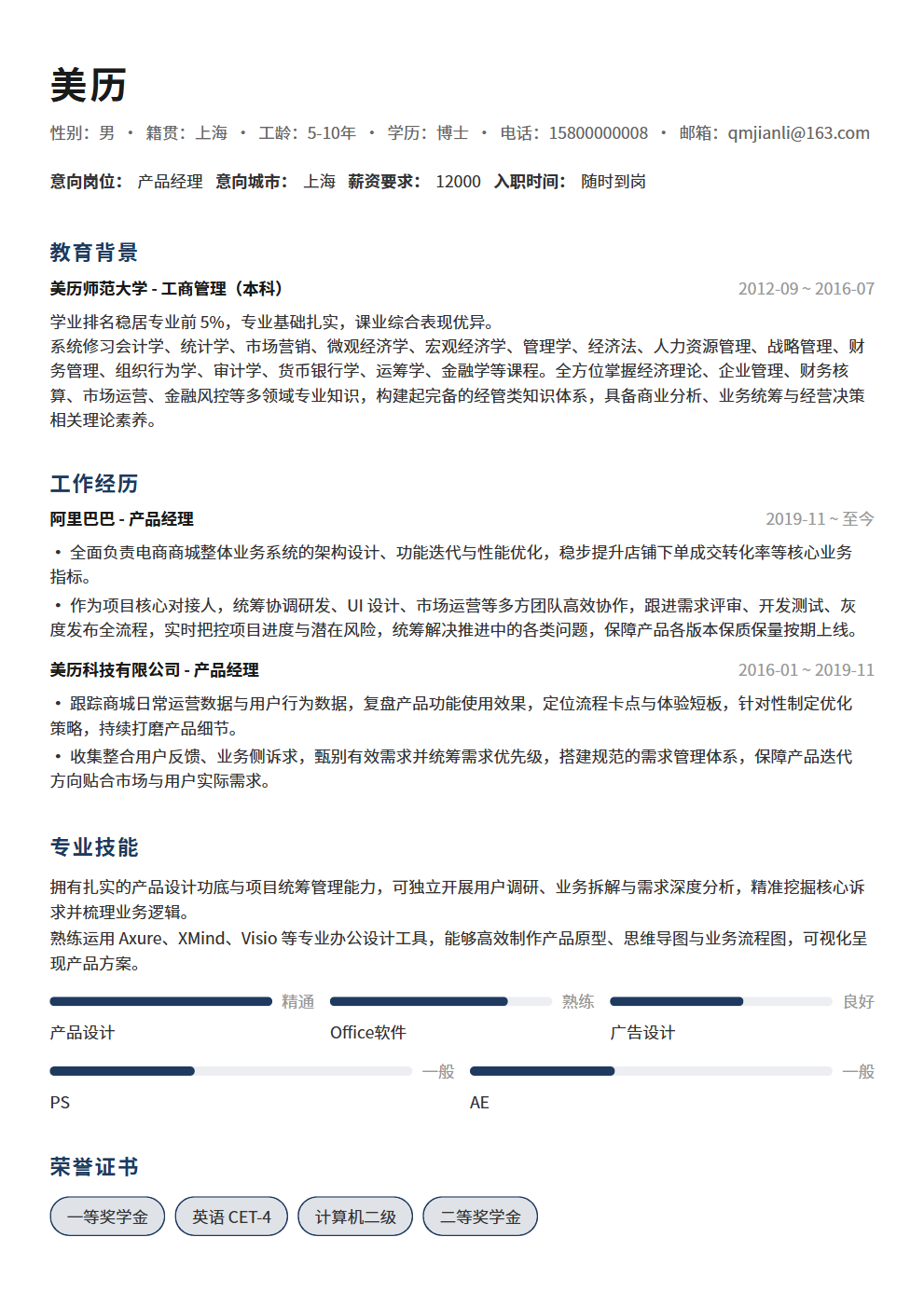
- Specific manifestations of ATS-friendly: Keyword matching — your resume contains core keywords from the job description; standard formatting — use standard fonts and layouts, avoid tables, images, and special characters; clear structure — use standard resume sections (personal info, work experience, education, skills) for easy ATS extraction; file format — PDF or DOCX, never image-based resumes
- Formats ATS hates most: Two-column layouts (ATS may read left-to-right across columns, mixing content); nested tables (ATS can't properly parse table contents); text within images (ATS can't read image text); fancy icons and decorations (may interfere with ATS parsing)
- Keyword optimization tips: Carefully read the target job description, extract core keywords (skills, tools, methodologies), and ensure they appear in your resume. But don't stuff keywords — ATS is increasingly smart and can detect keyword stuffing. Naturally incorporate keywords into experience descriptions
- ATS detection tools: After writing your resume, use ATS detection tools (like BeautyResume's built-in ATS detection) to check your score and identify missing keywords and formatting issues
ATS-friendly isn't "pleasing the machine" — it's "letting the machine understand you correctly." Your experience and abilities are real; ATS-friendly just ensures this information reaches HR accurately. Like following grammar rules in writing — grammar doesn't limit your expression; it helps others understand you.
Trait 3: Personalized Expression — Stand Out from the Sea of Sameness
The AI era has a paradox: AI makes writing resumes easier, but also makes them more homogeneous. When everyone uses AI to optimize, AI optimization becomes the new "cookie-cutter approach." In 2026, HR can identify "AI-flavored" resumes — perfectly worded but lacking personality, neatly structured but without warmth. Personalized expression means adding your own voice and story on top of AI optimization.
- The core of personalized expression: After reading your resume, HR should remember "who you are," not just "another similar candidate." Personalization isn't about being unconventional — it's about authentically showcasing your unique value
- Specific manifestations: Open with a distinctive self-positioning statement, not generic filler like "cheerful personality, diligent worker"; include your unique contributions and thinking in experience descriptions, not just "responsible for what"; use your own language style, not AI-generated standard phrasing; highlight 1-2 differentiators (cross-domain experience, unique projects, special achievements)
- Personalization ≠ randomness: Personalization doesn't mean writing however you want. A resume is still a professional document requiring professionalism and standards. Personalization means showcasing your uniqueness within a professional framework, not breaking the framework
- Balancing AI optimization and personalization: Use AI to optimize structure and expression, but write core content in your own words. AI polishes but doesn't replace your voice. Specific approach: write the first draft yourself (in your own language), then use AI to refine grammar and expression, finally manually review to preserve your personal style
- Example of personalized expression: Generic: "Responsible for company WeChat account operations, significant follower growth." Personalized: "Built the company's WeChat content system from scratch, growing followers from 800 to 50K in 6 months, creating 3 viral articles with 100K+ reads each, reprinted by industry media 12 times." The latter not only has more specific data but also demonstrates the initiative of "building from scratch" and the results of "viral content"
Personalized expression is the "differentiating competitive advantage" of 2026 resumes — when everyone uses AI to write resumes, your personalization becomes your moat. HR reads hundreds of resumes; they remember not the most perfect one, but the most distinctive one.
3 Outdated Resume Writing Methods — Drop Them Now
New trends mean old methods should go. These 3 approaches are seriously outdated in 2026 — if you're still using them, change immediately.
- Outdated method 1: Adjective piling. "Excellent communication skills, outstanding leadership, strong sense of responsibility" — these adjectives might have worked in 2015, but in 2026 they just make HR roll their eyes. Replace adjectives with data and facts; prove capabilities with results
- Outdated method 2: Chronological laundry list. Listing "what I did" in chronological order with no highlights, no results, no logic. HR doesn't want to see your daily to-do list — they want to see impactful things you accomplished. Pick 2-3 standout achievements per role and emphasize them; briefly mention or omit the rest
- Outdated method 3: One-size-fits-all resume. Submitting the same resume for every role without any customization. In 2026, this is self-sabotage — low ATS match scores, and HR can't see your connection to the role. Prepare at least 2-3 resume versions for different role types
5 New Resume Standards for 2026
To summarize, a good resume in 2026 should meet these 5 standards.
- Standard 1: Every experience has data support. Not "responsible for what" but "responsible for what, achieved what results, results quantified with numbers"
- Standard 2: ATS detection score above 80. Use ATS detection tools to ensure keyword coverage, proper formatting, and clear structure
- Standard 3: Customized for the target role. Different resume versions for different roles, highlighting experiences and skills most relevant to each target
- Standard 4: A personalized self-positioning statement. Open with 1-2 sentences precisely defining who you are, what you excel at, and your unique value
- Standard 5: One page, high information density. In 2026, HR spends an average of 6-8 seconds per resume — one page is enough for the most essential information. Remove everything irrelevant; make every line valuable
Conclusion: Follow Trends, But Don't Blindly Chase Them
Resume trends in the AI era are changing, but the core hasn't — the essence of a resume is "showcasing your value in the most effective way." Data-driven makes value quantifiable, ATS-friendly makes value identifiable, and personalized expression makes value memorable. All three traits are indispensable. But remember, trends are directions, not dogma — don't chase trends for their own sake. If your work is genuinely hard to quantify, emphasize your impact and methodology; if your industry rarely uses ATS, focus on personalized expression. The key is understanding the logic behind trends and flexibly applying it to your resume. In 2026, the winning resume isn't the most "AI" one — it's the most "authentic + effective" one.
Want your resume to align with 2026 trends? Use BeautyResume — with built-in ATS detection and data-driven templates, it helps you write the kind of resume HR wants to see most.