Laid Off? 3 Steps to Bounce Back and Land a New Offer
Being laid off isn't your fault — 3 steps to bounce back and land a new offer: handle emotions and compensation (N+1/2N calculations), reposition and package your resume (how to write about layoff experience), efficient job search strategies, and avoid 3 psychological traps after being laid off.
HR calls you into a meeting, slides a separation agreement across the table, and says "the company is restructuring, your position has been eliminated" — at that moment, your mind might go completely blank. Anger, injustice, self-doubt, fear — all these emotions hit you at once. Being laid off might be one of the last things any professional wants to experience. But let me tell you a fact first: being laid off isn't your fault. Often, layoffs have nothing to do with your ability and everything to do with the company's business situation. Here are 3 steps to help you bounce back and land a new offer.
Being Laid Off Isn't Your Fault — Get Past the Mental Hurdle First
The hardest part after being laid off isn't finding a new job — it's getting past the mental block. Many people's first reaction is "am I not good enough?" and then spiral into self-doubt. But the truth is: layoffs are business decisions, not judgments of your personal ability.
- Common reasons for layoffs: business line contraction or shutdown, department mergers creating redundant positions, failed funding rounds or blocked IPOs requiring cost reduction, industry-wide downturns leading to mass layoffs, strategic pivots changing direction. Which of these has anything to do with your personal ability?
- Being laid off doesn't mean being eliminated: many outstanding people have been laid off — at big tech companies, P7 and P8 level employees get laid off all the time. Being laid off only means your company or department had problems, not that you lack competitiveness in the market
- Give yourself 3-7 days as an emotional buffer: don't start editing your resume and applying on the day you're laid off. Let yourself process the news first. Allow yourself to feel upset, angry, wronged — these emotions are normal, and suppressing them will only prolong your recovery
- Talk to friends who've been through layoffs: you'll find that many people actually found better jobs after being laid off. Sometimes a layoff is a "forced exit from the comfort zone" that turns out to be a catalyst
Once you've gotten past the mental hurdle, here are the 3 practical steps: handle emotions and compensation, reposition and package your resume, and execute an efficient job search. Each step has specific methods and considerations — just follow along.
Step 1: Handle Emotions and Compensation (How to Calculate N+1/2N)
The first thing to do after being laid off isn't updating your resume — it's negotiating your severance properly. Many people, either because they're too emotional or don't know the law, sign agreements they shouldn't and lose months or even a year's worth of severance. This money is yours — don't leave a single cent on the table.
- Legal severance standard — N+1: N is your years of service. For each full year, you get 1 month's salary; 6 months to less than 1 year counts as 1 year; less than 6 months gets half a month's salary. The "+1" is payment in lieu of notice — if the company didn't give you 30 days' written notice, they must pay an additional month's salary. Monthly salary standard: calculated as your average salary over the 12 months before departure, including base salary, performance bonuses, allowances, etc.
- Compensation for illegal termination — 2N: If the company terminates your contract without legal grounds (e.g., didn't follow proper procedures, can't prove you were incompetent), it's an illegal termination, and you can claim 2N severance. 2N = double the economic compensation, meaning 2 months' salary for each year of service
- Negotiation tips: don't sign on the spot — when HR gives you the separation agreement, you have the right to ask for time to consider, at least take it home overnight; don't be pressured by "sign today and get an extra X" limited-time offers — this is often a tactic to clear headcount quickly; confirm the specific calculation method and payment timeline for severance; confirm the final month for social insurance and housing fund contributions; check for non-compete clauses and corresponding compensation; keep all written evidence — emails, chat records, recordings (where legally permitted)
- Common traps: company says "we'll give you N, sign and leave" — the law requires N+1, N is the minimum standard not the company's generosity; company says "if you don't sign, you get nothing" — this is intimidation; if you don't sign, you can go to labor arbitration, which usually favors employees; company says "severance is taxable" — economic compensation up to 3 times the local average annual salary is exempt from individual income tax
- Emotional processing methods: talk to trusted friends or family, don't carry it alone; if low mood persists for more than 2 weeks, consider seeking professional counseling; schedule one "accomplishment" activity daily (exercise, cooking, organizing) to avoid lying in bed scrolling all day; journal — writing out emotions is more effective than bottling them up
With compensation sorted and emotions stabilized, it's time for the most critical step — repositioning and packaging your resume.
Step 2: Reposition and Package Your Resume (How to Write About Layoff Experience)
One of the biggest headaches after being laid off: how do you write about this experience on your resume? Should you mention being laid off? How do you answer when asked in interviews? Handle it well, and the layoff won't be a negative; handle it poorly, and it becomes your biggest obstacle.
- How to write layoff experience on your resume: don't write "laid off" on your resume — a resume showcases your achievements and value, not explains why you left. Write your work experience, project outcomes, and skills normally. Save the reason for leaving for the interview
- End date for work experience: write the actual departure month, no need to add "left due to layoff." If HR asks "why did you only work X months," answer honestly then
- How to answer "why did you leave" in interviews: be honest but not self-deprecating. Recommended phrasing: "The company restructured and my entire department was eliminated — XX colleagues were laid off along with me." — emphasize department/business line adjustment, not personal issues. "The company shifted strategic direction and my project was cut." — emphasize project changes, not your capability. Never say "maybe I wasn't good enough" — self-deprecating statements make interviewers genuinely think you're not capable
- Repositioning yourself: a layoff is an opportunity to reassess your career direction. Ask yourself 3 questions — what did I enjoy most in my last job? What skills am I best at? What roles in the market need these skills? If your last job left you exhausted and unfulfilled, maybe it's time for a change
- Resume packaging priorities: quantify your achievements from your last job — "led XX project, driving XX% growth/saving XX cost/serving XX users." Data and results are 100x more persuasive than job descriptions. Highlight transferable skills — communication, project management, data analysis, cross-functional collaboration — these are valuable at any company
Remember: the core function of a resume is to show "what value you can create for the company," not to explain "why you left your last one." Focus your energy on showcasing achievements, not explaining departures.
Step 3: Efficient Job Search Strategy
With compensation negotiated and resume updated, it's time for an efficient job search. The biggest difference between job hunting after a layoff versus a normal job change: you may not have income, so time pressure is greater. Your strategy needs to be more efficient and targeted.
- Job search channel priority: Priority 1 — referrals. Ask former colleagues, managers, and industry friends for referrals — referral pass rates are 5-10x higher than cold applications. Priority 2 — recruiters. If you have 3+ years of experience, register on Liepin, Maimai, and similar platforms to let recruiters find opportunities for you. Priority 3 — direct applications. Submit daily on Boss Zhipin, Lagou, Zhaopin, etc., but don't rely solely on this channel
- Application strategy: submit at least 10 resumes daily, but don't blindly mass-apply — tailor each resume to the JD, highlighting matching skills and experience. Follow up after 3 days if no response. Keep 5-10 interview processes moving simultaneously — don't put all your eggs in one basket
- Interview strategy: the biggest psychological barrier after being laid off is feeling "eliminated." But interviewers don't see it that way — they only care whether you can do the job. In interviews, showcase your achievements and learning ability from your last role, not dwell on the layoff. If interviewers press for layoff details, say "company restructuring" briefly, then pivot to the value you can bring to their company
- Salary negotiation strategy: don't lower your salary expectations just because you were laid off — your market value doesn't change because of one layoff. When asked about expected salary, state the market rate; don't volunteer a discount. If they push back, respond with "my previous salary was XX, and considering market conditions, my expectation is XX"
- Time management: set a job search timeline — find a job within 3 months. Month 1: mass apply + interview + gather feedback. Month 2: adjust strategy based on feedback + targeted applications. Month 3: sprint + offer selection. If you haven't found anything after 3 months, reassess your direction and strategy
The core of efficient job searching: parallel channels, multiple processes in progress, rapid iteration. Don't wait for one result before applying to the next — keep multiple opportunities moving simultaneously, using volume to hedge against uncertainty.
3 Psychological Traps After Being Laid Off
Beyond the practical challenges, the bigger enemy after a layoff is psychological traps. Fall into any of these 3, and your job search efficiency and outcomes will be severely impacted.
- Trap 1: Self-negation — "Being laid off means I'm not good enough." This is the most dangerous psychological trap. Once you start negating yourself, you'll lack confidence in interviews, underplay your achievements on your resume, and voluntarily accept lower salaries. Self-negation creates a vicious cycle: the more you doubt yourself → the worse you perform → the worse the results → the more you doubt yourself. Solution: decouple "being laid off" from "ability" — layoffs are business decisions, not ability assessments. List your 3 biggest work achievements to remind yourself of your value
- Trap 2: Rushing — "Just find any job quickly." With financial pressure after a layoff, many people rush into any job they can get. But a "settled" job often creates bigger problems — low pay, poor growth, unfulfilling work — and 3 months later you want to leave again, adding another short stint to your resume. Solution: give yourself a 3-month job search window. Don't settle in the first 2 months; you can moderately relax standards in month 3. But "not settling" doesn't mean "only big tech with high pay" — it means not accepting less than your previous salary and growth trajectory
- Trap 3: Self-isolation — "I don't want anyone to know I was laid off." Many people avoid telling friends, posting on social media, or attending events after being laid off, shutting themselves off. But isolation means cutting off your most important job search channel — your network. Over 40% of job opportunities come through connections; not telling people you're looking means giving up nearly half your chances. Solution: selectively tell trusted friends and industry peers you're exploring new opportunities. You don't need to broadcast it, but there's no need to hide it either. Being laid off isn't shameful — staying stuck is
The essence of all 3 traps is "post-layoff trauma response" — self-negation is internalized shame, rushing is a product of anxiety, and self-isolation is avoidance. Recognizing these traps is the first step to escaping them.
Conclusion: A Layoff Is a Turning Point, Not an End
Being laid off isn't your fault, and it's not the end of your career. 3 steps to bounce back: Step 1 — handle emotions and compensation to protect your legal rights; Step 2 — reposition and package your resume, turning the layoff into a catalyst for career transition; Step 3 — execute an efficient job search with parallel channels, multiple processes, and rapid iteration. Meanwhile, avoid 3 psychological traps — self-negation, rushing, and self-isolation. Life after a layoff isn't a downhill slide — it's a different path. Many people who've been laid off end up finding better-fitting directions, higher salaries, and stronger teams. The key: don't let one layoff define your career — use action to redefine yourself.
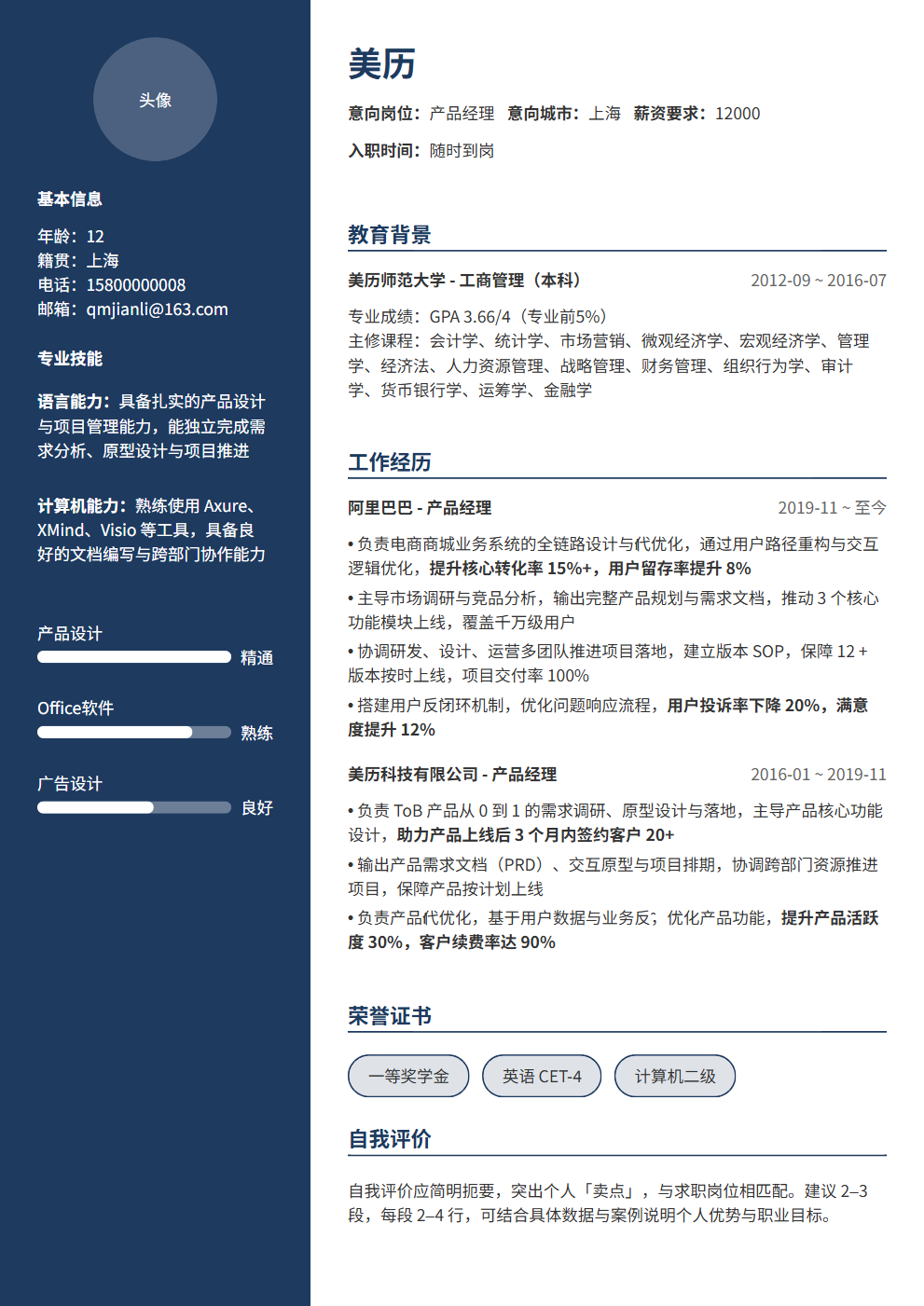
The first step to starting fresh is updating your resume — use BeautyResume resume editor to professionally present your achievements and value, so the layoff experience becomes a new starting point rather than a stumbling block in your job search.