Job-Hopping Within 3 Years? How to Package Your Resume So HR Doesn't Reject You
Changed 3 jobs in 3 years and HR passes immediately? 3 packaging strategies (merge short stints, highlight legitimate reasons, prove value with results), 3 interview scripts for explaining frequent job changes, and 3 things you must never do.
You sent out 50 resumes and only got 3 interview opportunities — not because you lack ability, but because your resume shows 3 jobs in 3 years, and HR passes immediately. Frequent job-hopping is one of the biggest "red flags" on a resume, even worse than lacking experience. No experience can be developed, but frequent job-hopping signals "this person probably won't stay long" — who wants to invest time and energy training someone who might leave at any moment? But the reality is, many instances of frequent job-hopping aren't your fault — company bankruptcy, department layoffs, toxic bosses, roles vastly different from what was promised — every departure has a compelling reason. The question is how to package these reasons into a story HR can accept, rather than making your resume look like "an unstable person." Here are 3 packaging strategies to help you overcome the red flag of frequent job changes.
Strategy 1: Merge Short Stints — Integrate Fragmented Experiences into a Coherent Story
If you have several very short work experiences (e.g., 3 months, 4 months), the most effective strategy is to merge them. Merging isn't fabrication — it's reorganizing fragmented experiences with reasonable logic so your resume presents a coherent career trajectory.
- 3 ways to merge: First, short stints in the same industry and role can be merged into one "project-based/contract work experience." For example, 3 months at Company A + 4 months at Company B can be written as "June 2023 - January 2024: Project-based work in [industry], successively taking on XX responsibilities at Company A and Company B" — this isn't fabrication, it's reorganizing experience from a project-based perspective; Second, if several experiences show progression, they can be merged into a "career exploration phase," e.g., 3 months as operations assistant + 4 months as operations specialist can become "March 2023 - January 2024: Operations role, growth phase from assistant to specialist"; Third, outsourced/dispatched work can be listed under the client company name
- The bottom line for merging: Don't force-merge short stints across different industries and roles — the logic won't hold up, and you'll be exposed when asked in interviews. The prerequisite for merging is that the experiences genuinely have logical connections
- Focus after merging: Not "I changed several companies," but "I accumulated XX experience in this field." After merging, highlight your specific achievements in each experience rather than the timeline
- How to explain merging in interviews: If the interviewer asks "Why were you at both Company A and Company B?", you can say "At that time, I participated in projects at Company A and Company B sequentially on a project basis, and naturally transitioned to the next project after completion" — this sounds much more reasonable than "I left Company A after 3 months"
- Applicable scenarios for merging: Short stints under 6 months each, same industry/role experiences, outsourced/dispatched/project-based work. Not applicable: Stints over 1 year each, cross-industry/cross-role experiences
Example: Xiao Zhao changed 3 jobs in 3 years — Company A for 4 months (operations assistant), Company B for 5 months (operations specialist), Company C for 1.5 years (operations supervisor). He merged A and B, writing only two entries on his resume: First, "March 2023 - December 2023: Operations growth period, progressing from assistant to specialist across two companies"; Second, "January 2024 - present: Operations Supervisor." HR sees "a person continuously growing in operations," not "someone who changed 3 companies in 3 years."
Strategy 2: Highlight Legitimate Reasons for Each Departure — Help HR Understand Why You Left
What HR fears most isn't that you job-hopped, but "not knowing why you job-hopped." Departures without reasons make HR default to "this person is unstable/difficult/demanding." But if you can provide legitimate reasons, HR's understanding changes completely — "company went bankrupt" and "I just didn't want to work anymore" are two very different things.
- 5 job-hopping reasons HR accepts: Company bankruptcy/business line layoffs (objective reasons unrelated to personal ability), role vastly different from interview promises (the company shares responsibility), salary significantly below market rate (reasonable financial needs), family reasons (relocation, caregiving — force majeure), career direction adjustment (clear logic in transitioning from industry A to B)
- 3 job-hopping reasons HR rejects: Bad relationships with bosses/colleagues (HR assumes poor interpersonal skills), work too tiring/stressful (HR assumes poor stress tolerance), felt bored/uninteresting (HR assumes lack of career planning)
- How to hint at departure reasons on your resume: You don't need to write "left because of XX" directly, but you can imply it through experience descriptions. For company bankruptcy, add "(dissolved/laid off)" after the company name; for department layoffs, write "Due to company strategic adjustment, XX department was entirely eliminated" in the experience description
- How to explain departure reasons in interviews: Use the "objective reason + positive attitude" formula. For example: "The company's business line was eliminated and the entire department was laid off. I used that time to reassess my career plan and decided to move toward XX direction" — explains the objective reason while demonstrating a positive attitude
- Most importantly: Whatever the reason for leaving, never badmouth your previous company. Even if the company genuinely had problems, speaking ill only makes HR think you're unprofessional. Use "it wasn't a mutual fit" instead of "the company was terrible," use "different career directions" instead of "the boss was incompetent"
Example: Xiao Qian changed 2 jobs in 2 years — the first for 8 months because the startup went bankrupt; the second for over a year because he was reassigned to a role he didn't like. He didn't write departure reasons on his resume, but explained in interviews: "The first company was a startup that went bankrupt after 8 months due to funding issues — this experience taught me to drive projects forward with limited resources; the second company restructured and my role shifted from product operations to sales operations, which didn't align with my career plan, so I decided to find a better match." HR hears "a person with clear career planning who can objectively face setbacks," not "a frequent job-hopper."
Strategy 3: Prove Value with Results — Job-Hopping Isn't Scary, Lack of Results Is
The core concern behind HR's wariness of frequent job-hopping is "this person's tenure at each company was so short, what results could they have achieved?" If you can demonstrate clear results at each company, HR's concerns diminish significantly — "Although each stint was short, this person genuinely delivered results, showing their ability and execution are solid."
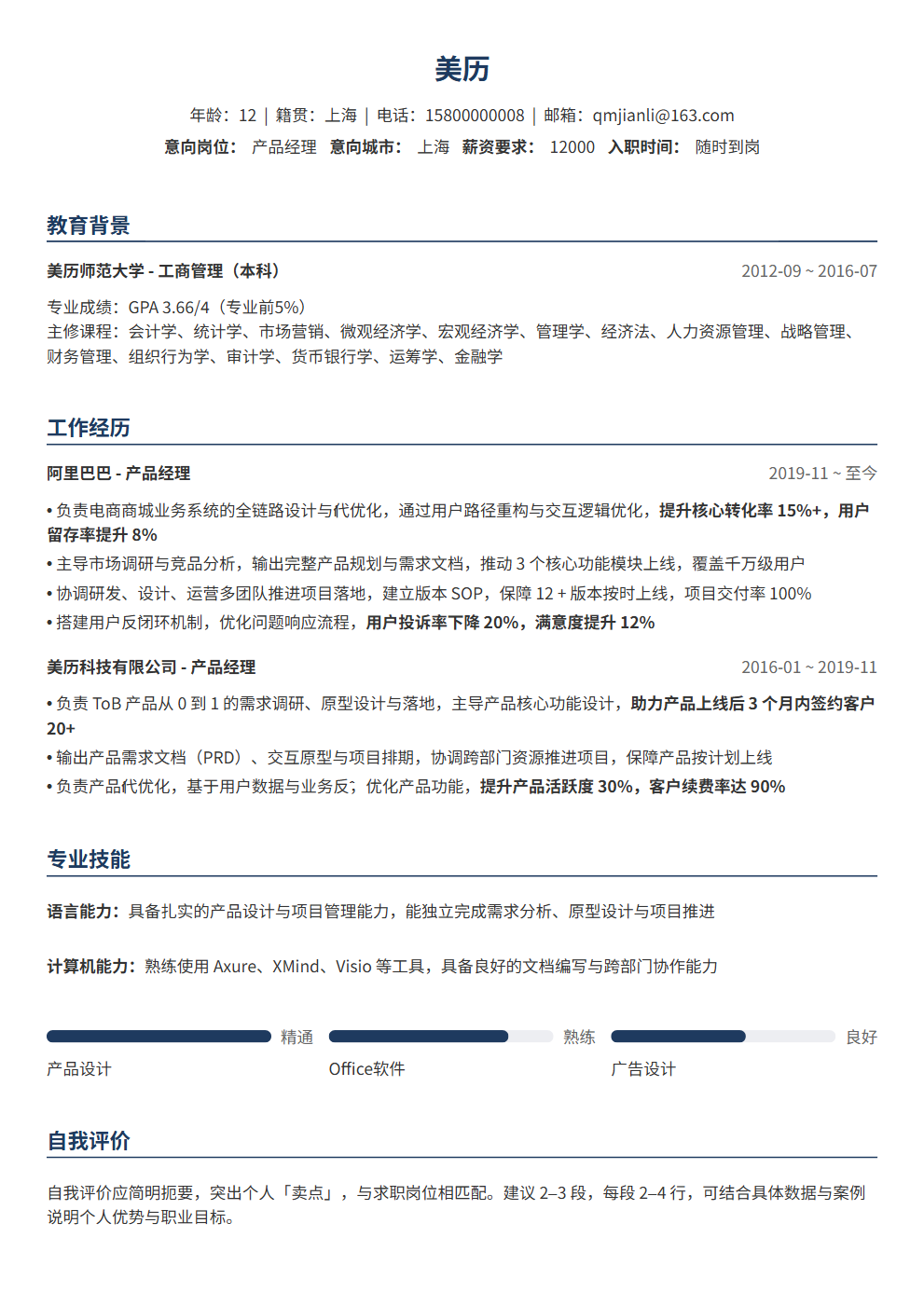
- Every experience must have results: Whether you stayed 3 months or 3 years, you must write what you achieved. For 3 months: "Completed the 0-to-1 setup of XX project within 3 months, achieving XX metrics"; for 1 year: "Led XX project over 1 year, improving XX metric by XX%." An experience without results means "you wasted your time there"
- Results for short stints should be more focused: Don't try to write "fully responsible for XX work" for a 3-month stint — focus on 1-2 core achievements. For example: "Launched XX system within 3 months of joining, processed XX data records with 95% accuracy" — one specific result is 100x more powerful than vague descriptions
- Results must be quantified: Don't write "improved performance" — write "increased monthly active users from 50K to 80K, a 60% growth"; don't write "optimized processes" — write "reduced approval process from 5 days to 2 days, a 60% efficiency improvement." Quantified data makes results convincing
- Results should demonstrate your irreplaceability: Not "the team did XX," but "I led/was responsible for XX — without me, this project might not have achieved XX results." In short stints, highlighting your personal contribution is more important than highlighting team achievements
- If you truly have no quantifiable results? Write qualitative descriptions — "Independently drafted XX proposal, which was adopted by leadership and promoted department-wide" or "Optimized XX process, receiving unanimous praise from colleagues." Something is better than nothing; vague results are better than no results
Example: Xiao Sun changed 3 jobs in 3 years, none lasting over a year. But every experience on his resume had clear results — First: "Built a data analysis system within 3 months, reducing report production time from 2 days to 2 hours"; Second: "Led a user growth project within 6 months, increasing monthly new users from 3,000 to 8,000"; Third: "Optimized 3 core business processes within 10 months, saving the company 500K yuan annually." HR sees "a person who delivered results at every experience," not "a frequent job-hopper."
3 Interview Scripts for Explaining Frequent Job Changes
Even with a well-packaged resume, you'll still face the "why do you change jobs so frequently" question in interviews. Here are 3 scripts to help you respond confidently.
- Script 1 (Objective reasons): "I understand your concern about my work history. The first company eliminated its business line and the entire department was laid off; the second company restructured and my role no longer aligned with my career plan. These changes were beyond my control, but I gave my full effort at each position and achieved XX results. I now value long-term development and hope to find a platform where I can build deep expertise." — Emphasize objective reasons + showcase results + express desire for stability
- Script 2 (Growth & reflection): "My career exploration in recent years did involve some detours. I didn't have a deep enough understanding of the industry and roles, leading to suboptimal choices. But each experience made me clearer about what I want — I'm now very certain about building a long-term career in XX, and your company's XX role is exactly what I'm looking for." — Honest reflection + demonstrate growth + express certainty
- Script 3 (Value proof): "Although each experience was relatively short, I delivered clear results at every one — XX project improved XX metric, XX solution was adopted company-wide. I believe ability matters more than tenure, and through these experiences, I've become clearer about what environment lets me deliver maximum value — your company is that environment." — Let results speak + express fit
3 Things You Must Never Do
For resumes with frequent job changes, some actions are worse than inaction. Never do these 3 things.
- Never do 1: Fabricate or extend work periods. Writing 3 months as 1 year, merging 2 experiences into 1 with mismatched dates — background checks will expose this, and the consequences of fabrication are 100x worse than frequent job-hopping. Frequent job-hopping might get you rejected; fabrication could get you blacklisted in the industry
- Never do 2: Badmouth previous companies. No matter how bad they were, never speak ill in interviews. "The company was chaotic," "the boss was incompetent," "colleagues were backstabbing" — these comments only make HR think you're unprofessional and worry you'll say the same about them after leaving
- Never do 3: Show a "might leave again anytime" attitude. Saying "I want to try it out" or "I'll see how it goes" in interviews — this attitude scares HR more than frequent job-hopping itself. Even if you are genuinely still evaluating, you must express "I want to develop long-term" during interviews
When Should You Settle Down?
Frequent job-hopping isn't an original sin, but if you've already changed jobs 3+ times, it's time to seriously consider settling down. Not because "HR dislikes frequent job-hopping," but because — it's not good for you either. Every time you change jobs, you need at least 3-6 months to fully adapt to the new environment, build new relationships, and start producing core results. If you always leave during the "adaptation period," you'll never accumulate deep experience and core competitiveness. When should you settle down? When you find a "three-match" environment — the role matches your abilities, the direction matches your plan, and the culture matches your personality. After finding this environment, stay at least 2-3 years, giving your resume a sufficiently long "anchor experience" that proves you can not only jump but also stay.
Conclusion: Frequent Job-Hopping Isn't a Death Sentence — Proper Packaging Still Lands Offers
Frequent job-hopping is indeed a red flag on your resume, but a red flag isn't a death sentence. Merge short stints to turn fragmented experiences into a coherent story; highlight legitimate departure reasons so HR understands why you left rather than guessing you're "unstable"; prove value with results so HR sees your ability rather than fixating on your tenure. In interviews, use scripts combining objective reasons + result showcases + stability intentions to address HR's concerns. Remember: the biggest risk of frequent job-hopping isn't HR rejecting you — it's that you haven't accumulated enough results from each experience. If every experience has clear output, job-hopping isn't "instability" — it's "efficient accumulation." But if you've already changed 3+ times, it's time to find a platform worth building on and settle down.
Frequent job-hopping resumes need professional packaging even more. Use BeautyResume to clearly present the achievements and highlights of each experience — let HR see your ability, not your job-hopping count.