How to Write Work Experience on Your Resume: A Practical Guide to the STAR Method and Data Quantification
Work experience is the soul of your resume, but most people only write 'responsible for X.' Master the STAR method and data quantification to turn your resume from a task list into an achievement report.
1. Is Your Work Experience Just a Job Description?
Open your resume and check your work experience section — does it look like this?
- Responsible for daily operations of company social media accounts
- Responsible for client communication and coordination
- Responsible for project progress tracking and management
This isn't work experience — it's a job description. It tells HR "what this role should do," not "what you accomplished in this role." HR doesn't want duty descriptions — they want proof of results.
A simple test: replace every "responsible for" with "achieved." If the sentence doesn't make sense, you're describing duties, not results. "Responsible for user growth operations" → "Achieved user growth from 80K to 140K" — the latter is what HR wants to see.
2. The STAR Method in Practice
STAR is the classic methodology for writing work experience, but many people use it wrong. The correct approach isn't mechanically filling in a template — it's telling each work achievement as a micro-story:
- S (Situation): What was the context and challenge? One sentence is enough
- T (Task): What was your specific task and goal?
- A (Action): What key actions did you take? This is the focus — be specific
- R (Result): What was the final outcome? Must include numbers
Key principle: A and R are the core; S and T should be brief. HR cares most about how you did it and what you achieved, not how complex the background was.
The most common STAR mistake is making S and T too long, A too vague, and R missing numbers. The correct ratio should be: S+T at 20%, A at 50%, R at 30%. Remember, HR spends an average of 6 seconds per resume — put the most critical information in the most prominent positions.
Another practical tip: in the A section, start descriptions with action verbs. "Designed," "built," "optimized," "drove" carry more weight than "participated in" or "assisted with," highlighting your leadership role.
3. Five Dimensions of Data Quantification
Not every job can be measured with direct revenue numbers, but almost every role can find quantifiable points across these 5 dimensions:
- Efficiency: How much time was saved? How much did process optimization improve efficiency?
- Scale: How large was the team you managed? How many clients served? How many orders processed?
- Growth: How much did users grow? Revenue increase? Market share change?
- Cost: How much did costs decrease? Budget saved? Waste reduced?
- Quality: How much did error rates drop? Customer satisfaction increase? System availability reached?
Even if your work seems hard to quantify, you can always find angles from these 5 dimensions. For example, an admin role could write: "Optimized office supply procurement process, reducing annual procurement costs by 15%."
When quantifying, pay attention to data comparability. "Served 500 clients" alone is meaningless; adding "200% increase over predecessor" makes it persuasive. Similarly, "reduced response time from 2.3s to 0.4s" is far more powerful than "optimized response time." Use comparative data to let HR intuitively feel your work's value.
4. Before & After: From Task List to Achievement Report
Sales role:
- ❌ Responsible for client development and maintenance in East China
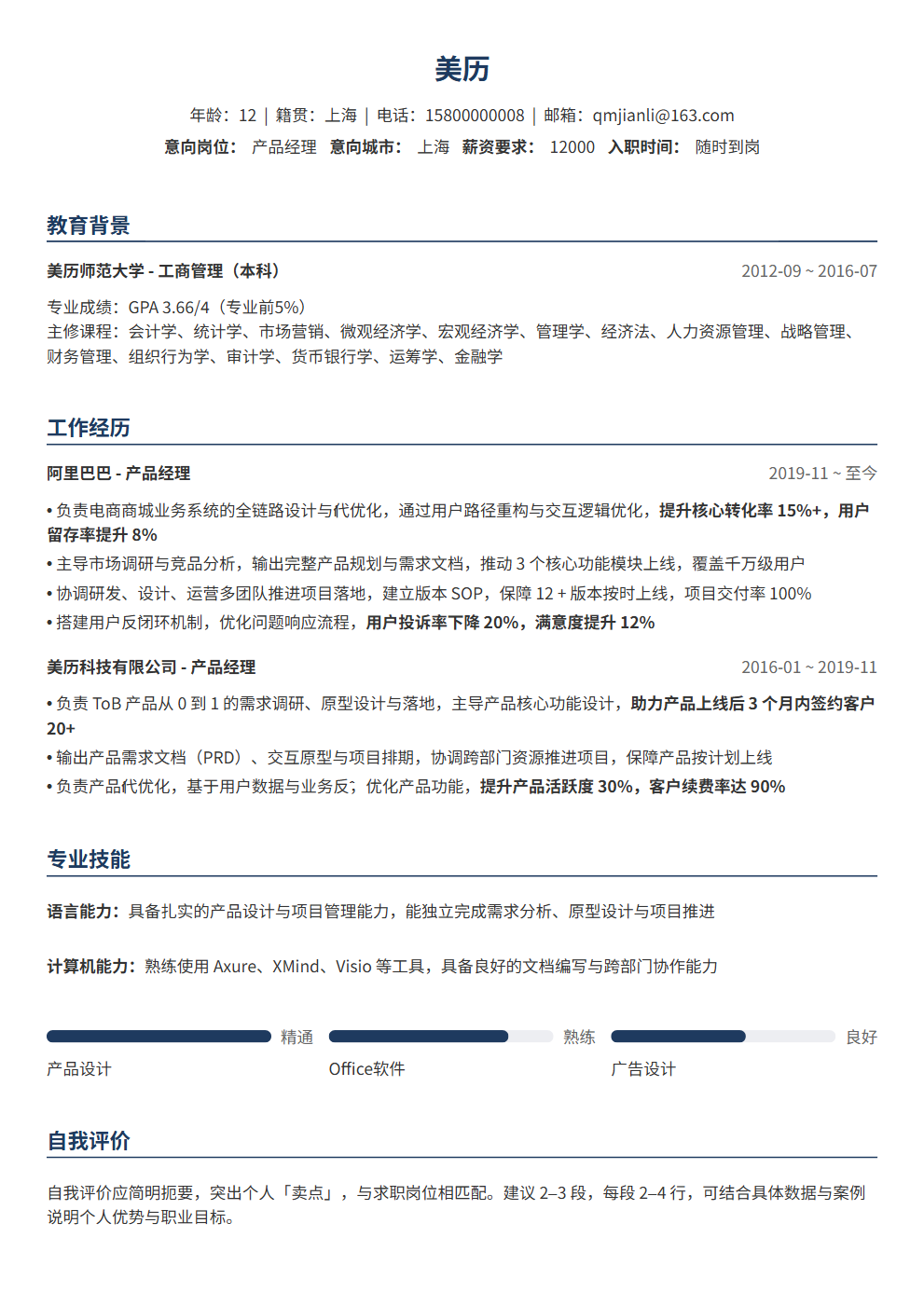
- ✅ Developed 47 new clients in East China, maintained 120+ existing clients, grew annual sales from 8M to 15M RMB, an 87.5% YoY increase
Technical role:
- ❌ Responsible for development and maintenance of the company's core system
- ✅ Led microservices refactoring of the order system, reducing API response time from 2.3s to 0.4s, increasing daily system capacity from 100K to 500K orders
Operations role:
- ❌ Responsible for user growth and retention operations
- ✅ Designed and executed 3 rounds of user reactivation strategies, achieving 18% dormant user activation rate, growing MAU from 80K to 140K, improving retention by 22 percentage points
Admin role:
- ❌ Responsible for company administrative affairs and office environment management
- ✅ Restructured office supply procurement process, introduced 3 new suppliers for competitive bidding, reducing annual procurement costs by 15%; implemented 5S office management, improving employee satisfaction from 72 to 89 points
As shown above, all rewritten versions follow one formula: action + object + data result. This formula works for any role — the key is finding your data entry points.
5. Ordering and Length Control
Content is ready — now focus on presentation:
- Reverse chronological order: Most recent experience first — HR cares most about your current capability level
- 3-5 bullet points per role: Not everything is worth including — pick the most impressive achievements
- Most detail for recent roles: Older experiences should be briefer — jobs from 3+ years ago can be one line
- Length control: Under 5 years experience: max 1.5 pages; under 10 years: max 2 pages
The core logic of length control is information density. HR doesn't have time for lengthy descriptions — every line should carry valuable information. If you can't write 3 data-supported bullet points for a role, it may not be worth listing separately and could be merged into another experience with a brief mention.
6. Writing Work Experience for Career Changers
The biggest challenge for career changers is that past experience seems unrelated to the target role. The solution is to extract transferable skills and achievements:
- Teacher to corporate trainer: Don't write "taught classes" — write "designed and delivered 50+ training sessions with 95% participant satisfaction"
- Sales to operations: Don't write "sold products" — write "optimized product recommendation strategies through user needs analysis, increasing conversion rate by 40%"
- Traditional industry to tech: Drop industry jargon and redescribe your work using universal tech language
Key principle: Describe your past work using the target industry's language. HR cares about what you can do, not which industry you came from. Translate industry-specific terminology into universal skill descriptions so HR sees your transferable value.
7. Handling Timeline in Work Experience
Timeline is the backbone of work experience — poor handling raises HR's questions:
- Consistent date format: Use either "2023.06-2024.03" or "June 2023 - March 2024" throughout — don't mix
- No unexplained gaps: If there's a 3+ month gap between roles, prepare an explanation
- Short-term roles: Positions under 3 months can be omitted unless they have particularly impressive results
- Label part-time and internships: Clearly mark these — don't mix them with full-time experience
Timeline clarity directly affects your resume's professionalism. A resume with confusing timelines, no matter how good the content, will make HR question your attention to detail.
Summary
Work experience is the most persuasive part of your resume. The keys to writing it well: use the STAR method to tell achievement stories, use 5-dimension data quantification to prove value, use reverse chronological order to highlight recent accomplishments. Every line of work experience should answer one question: "So what?" If it can't, that line doesn't belong on your resume. Career changers should extract transferable skills and redescribe experience in the target industry's language. Keep timelines clear and consistent with no unexplained gaps.