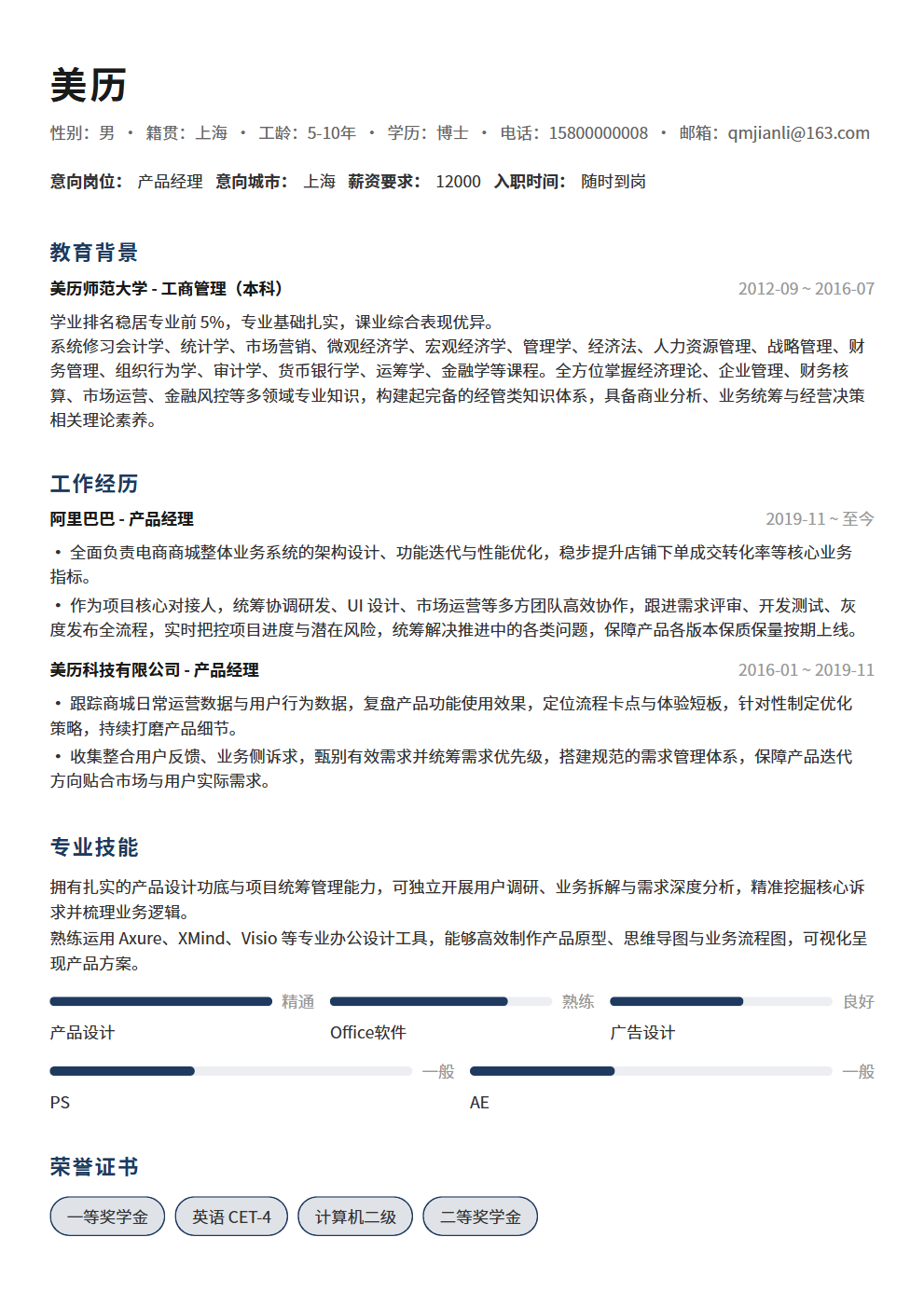
How to Write the Education Section on Your Resume: 3 Methods to Make Your Degree Your Biggest Highlight
How to write the education section without it looking thin? Three approaches for three situations: top school graduates, average school graduates, and career changers. Learn to maximize the value of your degree through course selection, GPA, awards, and projects.
1. A Poorly Written Education Section Makes Your Entire Resume Look Thin
The education section is the most overlooked part of a resume. Many people think: my degree is set, what's there to write? But the same degree, written differently, produces vastly different results. A graduate from a top university who only lists the school name and major wastes the prestige advantage; a graduate from an average school who only lists the school name and major has no competitive edge at all.
The core principle of the education section: it's not about showing what degree you have, but showing what value lies behind your degree. Below are three different writing strategies for three different situations.
2. Method 1: Top School Graduates — Amplify Your Advantage with Details
The biggest advantage for top school graduates is the school brand itself, but many don't know how to leverage it — they just write the school name and major and call it done. Prestige needs details to support it, otherwise it's an empty shell.
Elements top school graduates should include:
- GPA: If your GPA is above 3.5/4.0 (or top 20% in your major), definitely include it — direct proof of learning ability
- Honors and awards: National scholarships, outstanding student awards, Dean's List — each is a screening signal
- Core courses: List 3-5 courses directly relevant to the target position; don't list a pile of unrelated ones
- Academic projects: Thesis, research topics, published papers — demonstrate your research depth
- Exchange programs: Overseas exchange, joint training programs — reflect international perspective
Common mistakes top school graduates make:
- Only writing the school name without any details — prestige advantage wasted
- Listing too many courses — HR won't read them one by one, and it looks unfocused
- Writing a low GPA anyway — a GPA below 3.0 is better left off
The core of writing for top school graduates: use specific achievements to give substance to the "prestigious school" label. Not "I graduated from XX University," but "what I did and achieved at XX University."
3. Method 2: Average School Graduates — Compensate for Brand Gap with Relevance
The biggest anxiety for average school graduates writing the education section is: the school name isn't impressive enough, so anything I write seems weak. But think about it differently — when HR reads the education section, they're not looking at school rankings; they're looking for evidence of your ability. What average school graduates need to do is transform the education section from "brand display" to "ability display."
Strategic focus for average school graduates:
- Highlight major ranking: If you rank high in your major, definitely include it — "top 5% in major" is more convincing than the school name
- Select relevant courses carefully: Only list courses strongly related to the target position, showing your knowledge direction
- Emphasize practical projects: Course designs, internship projects, competition entries — prove ability through practical results
- Include self-study experience: Online course certifications, tech community contributions, open-source projects — demonstrate self-drive
Comparison for average school graduates:
- Weak: XX University, Computer Science, Bachelor's
- Strong: XX University, Computer Science, Bachelor's | Top 10% in major | Core courses: Data Structures, Operating Systems, Computer Networks | Thesis: Microservices-based E-commerce System Design (rated Excellent)
Key principle: every line should answer HR's question — "does this person have sufficient ability?" When the school name isn't strong enough, compensate with major ranking, course depth, and project quality.
4. Method 3: Career Changers — Connect Your Degree to the Target Role with Bridge Logic
The most awkward situation for career changers writing the education section: your major doesn't match the target position, making education a liability instead of an asset. But changing fields isn't a disadvantage — the key is how you present it.
The "bridge logic" for career changers:
- Find the intersection between your major and target role: Math majors pivoting to data analytics should emphasize statistical foundations; literature majors pivoting to product management should emphasize user insight skills
- List cross-field courses: If you've taken courses in the target field, definitely include them — evidence of proactive learning
- Showcase self-study achievements: Online course certificates, personal projects, tech blogs — prove you've already built expertise in the target field
- Leverage double majors or minors: A second degree or minor is the best endorsement for career changers
The core of the career changer approach: don't try to hide your major — show how it becomes a unique advantage for the target role. Career changers often bring broader perspectives, which many teams need.
Comparison:
- Weak: XX University, Chinese Language and Literature, Bachelor's
- Strong: XX University, Chinese Language and Literature, Bachelor's | Minor: Computer Science | Relevant courses: Python Programming, Database Principles, Data Visualization | Completed Data Analytics specialization (Coursera certified) | Personal project: NLP-based news classification system
5. Five Universal Writing Standards for Education Sections
Regardless of your situation, these five standards apply:
- Reverse chronological order: Most recent education first
- Complete but concise information: School name, major, degree, dates — all four elements are essential
- Standardized GPA format: Include the scale, e.g., "GPA: 3.7/4.0" or "GPA: 92/100"
- No more than 5 courses: Select only the most relevant to the position; quality over quantity
- Placement varies by experience level: Fresh grads should place it in the top third; those with 3+ years of experience should place it in the latter half
6. When to Downplay Your Education Section
Not every resume needs to emphasize education. Downplay it in these situations:
- 5+ years of work experience: Work experience matters far more than education at this point; compress education to 1-2 lines
- Education clearly below position requirements: Don't try to mask shortcomings with fancy formatting; focus on work experience and project achievements instead
- You have more impressive credentials: If you have internships at well-known companies or outstanding project results, education can take a back seat
Summary
The education section isn't a "fill-in-the-blank" exercise on your resume — it's a capability showcase you can actively design. Top school graduates amplify advantages with details, average school graduates compensate for brand gaps with relevance, and career changers connect their degree to the target role with bridge logic. The core logic across all three methods is consistent: don't show what you have — show what you can do with it. Optimizing your education section follows the same logic as optimizing your entire resume — transforming static information into dynamic value expression. When you learn to examine your degree this way, you'll discover: behind every degree, there's value worth being seen.