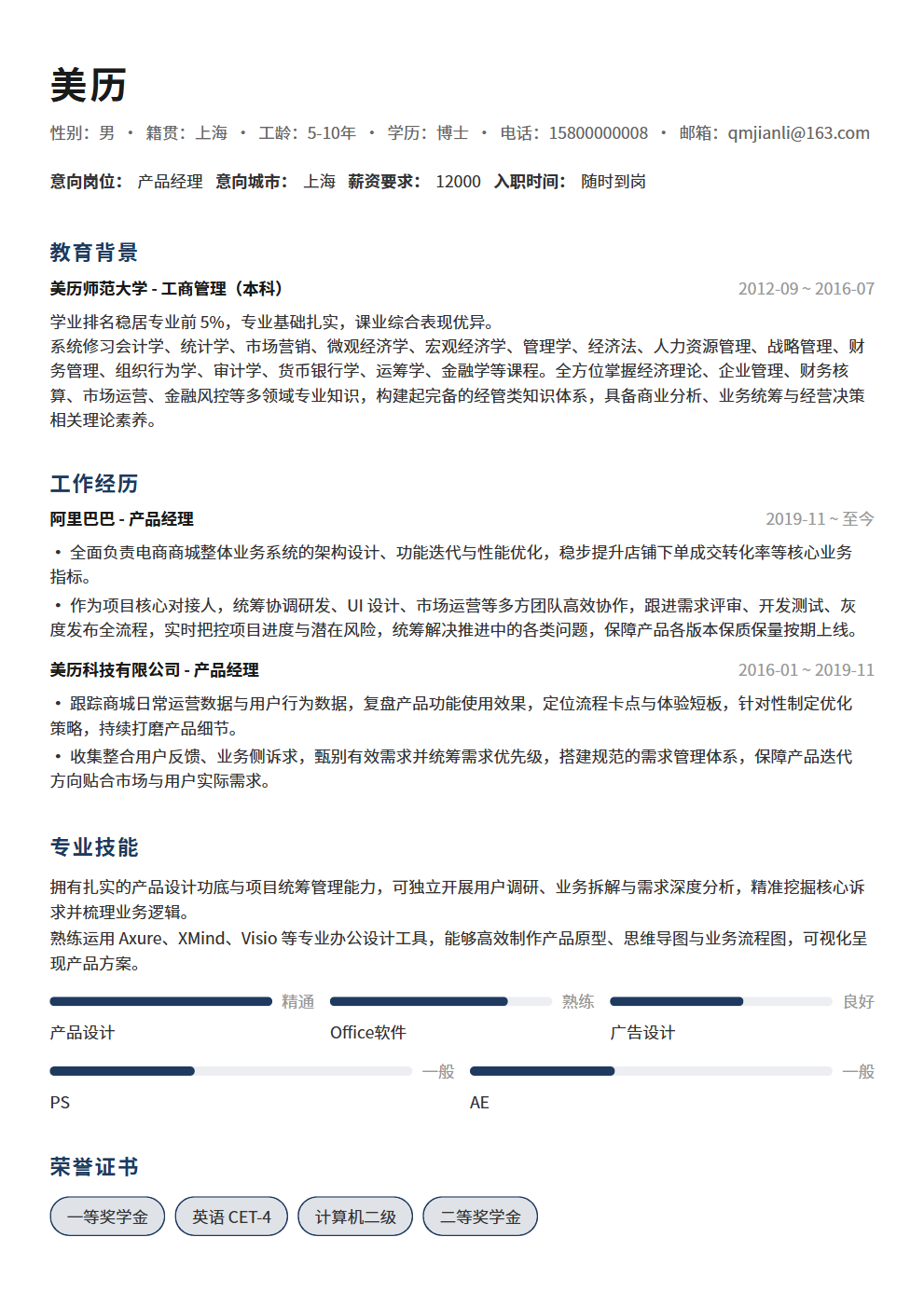
How to Write Quantified Achievements on Your Resume? Even Without Data, You Can Be Persuasive
"Managed company's official account, improved brand influence" — when HR reads this on a resume, their reaction is: improved by how much?
"Managed company's official account, improved brand influence" — when HR reads this on a resume, their reaction is: improved by how much? What does "brand influence" mean? Is there specific data? If instead you wrote "Managed company's official WeChat account, grew followers from 3,000 to 15,000 in 6 months, increased average article reads from 800 to 5,000," HR's reaction would be completely different — this person thinks in terms of results, has data awareness, and is worth interviewing. That's the power of quantification. But many job seekers say: "My work really can't be quantified! I do admin/HR/design/teaching..." Today I'll tell you: any job can be quantified — you just haven't found the right method yet.
Why Quantification Is So Important
Let's start with a harsh reality: HR spends an average of only 6-10 seconds on each resume. In those 6-10 seconds, what do they most want to see? Not your job responsibilities, not your years of experience, but your achievement data. There are three reasons: First, data is the most objective evaluation standard. "Improved user experience" is a subjective judgment; "increased user satisfaction from 72% to 91%" is an objective fact. Second, data quickly builds trust. When you say "significantly improved sales performance," HR wonders how "significant" that really is; when you say "sales grew 47% year-over-year," HR believes you immediately. Third, data demonstrates your thinking style. Someone who can speak with data shows results-oriented thinking and data-driven awareness — exactly what most companies value most.
- HR's perspective: They read hundreds of resumes daily, most filled with "responsible for XX," "participated in XX," "assisted with XX" — all the same, zero differentiation. Suddenly a resume full of data appears, and HR's eyes light up — this person is different
- Interview pass rate for quantified resumes: According to recruitment platform statistics, resumes with 3+ quantified achievements have a 40%-60% higher interview pass rate than purely descriptive resumes. That's not a small number — it's the critical gap that determines whether you get an interview
- The essence of quantification: It's not about showing off numbers, but proving your value. Behind every data point is a problem you solved, value you created, or change you drove. Data simply makes that value visible, credible, and comparable
So quantification isn't "icing on the cake" — it's an essential skill. A resume without data is like a dating profile without a photo — all the information is there, but nobody's interested.
5 Quantification Methods Explained
Many people think "my work can't be quantified," but that's because they only think of "direct data." There are 5 quantification methods, and at least one will work for you.
Method 1: Direct Data — The Most Intuitive Approach
Direct data uses specific numbers to describe your work achievements. This is the most common and intuitive quantification method, suited for roles with clear business metrics — sales, operations, marketing, product, etc.
- Bad example: "Managed community operations, significantly improved user engagement" — how "significant"? HR has no idea
- Good example: "Managed 3 WeChat communities, grew total users from 2,000 to 8,000, increased daily interactive messages from 50 to 300" — data is clear, achievements are obvious at a glance
- Common direct data metrics: Revenue (sales, GMV, revenue), Users (DAU, MAU, registrations, retention rate), Efficiency (processing speed, response time, completion rate), Cost (savings amount, reduction percentage, optimization efficiency)
- Direct data formula: Action + Object + Data + Timeframe. For example: "Increased customer conversion rate from 12% to 28% within 3 months," "Led supply chain optimization, reducing annual procurement costs by 3.2 million RMB"
The key to direct data is "specificity" — avoid vague words like "significantly," "substantially," or "noticeably." Replace them with precise numbers. If you're unsure of the exact figure, use modifiers like "approximately," "over," or "nearly" — they're still 100 times better than vague words.
Method 2: Comparative Data — Prove Value Through Change
Some work is hard to express in absolute numbers, but you can express the "change" — how much better than before, how much stronger than peers, how much beyond expectations. The core of comparative data: use reference points to give your achievements meaning.
- Bad example: "Optimized the recruitment process, improved hiring efficiency" — improved by how much? Compared to what?
- Good example: "Optimized recruitment process, reduced average time-to-hire from 45 days to 28 days, cut recruitment costs by 35%" — there's comparison, there's change, value is clear
- 3 types of reference points for comparative data: Time comparison (YoY/MoM, like "30% year-over-year growth"), Benchmark comparison (vs. industry standard/target, like "exceeded annual KPI by 15%"), Group comparison (vs. control group, like "A/B test experimental group conversion rate 22% higher than control")
- Comparative data formula: From A to B (change magnitude). For example: "Reduced customer complaint rate from 3.2% to 0.8%," "Shortened project delivery cycle from average 6 weeks to 4 weeks"
The advantage of comparative data: even if absolute numbers aren't large, the magnitude of change can demonstrate value. "From 5% to 15%" might only be a 10-percentage-point change, but a 200% growth rate is enough to show your work had a massive impact.
Method 3: Proportional Data — Give Small Numbers Persuasive Power
Some roles have small absolute numbers, but proportions can be very persuasive. For example, if you're responsible for training a small team of 20 people, the absolute number isn't impressive. But if you say "training pass rate 100%, far exceeding the company average of 72%," that proportion is compelling.
- Bad example: "Organized employee training, received good feedback" — how "good"? How many people?
- Good example: "Organized 3 rounds of employee skills training, 120 participant-sessions, 95% assessment pass rate (company average 78%), learner satisfaction score 4.8/5.0" — proportional data gives achievements a reference frame
- Common proportional data metrics: Growth rate, conversion rate, completion rate, pass rate, satisfaction rate, retention rate, coverage rate, accuracy rate
- Proportional data formula: Metric + Percentage + Reference. For example: "Client renewal rate 92% (industry average 65%)", "Code review defect detection rate 87%, ranked #1 in team"
The essence of proportional data is "reference" — saying "conversion rate 25%" alone is meaningless because HR doesn't know if 25% is high or low. But saying "conversion rate 25%, 2x that of similar campaigns" immediately highlights the value. So when writing proportional data, always provide a reference point.
Method 4: Frequency Data — Prove Capability Through Volume
Some work is hard to measure in monetary terms or percentages, but can be quantified through "frequency." Roles like admin, customer service, design, and teaching may lack clear business metrics, but your workload and efficiency can be expressed through frequency.
- Bad example: "Handled customer complaints, resolved issues promptly" — how many? How promptly?
- Good example: "Processed 150+ customer complaints monthly, average response time under 2 hours, customer satisfaction score 4.7/5.0, zero escalated complaints" — frequency data makes both workload and quality clearly visible
- Common frequency data metrics: Completion count, processing volume, number of people served, output quantity, meetings/training sessions, project count
- Frequency data formula: Time period + Count/Volume + Quality indicator. For example: "Completed 12 brand design projects annually, 100% client satisfaction," "Organized 4 cross-departmental training sessions per quarter, covering 500+ participant-sessions cumulatively"
The key to frequency data is "density" — don't just say "did a lot," but use time dimensions like "monthly average," "daily average," or "per quarter" to demonstrate your work pace and efficiency. 150 items processed monthly versus 150 items processed annually are entirely different concepts.
Method 5: Indirect Data — Prove Value Through Impact
Some work's value is genuinely hard to quantify directly — strategic planning, institutional development, culture building, brand shaping, etc. In these cases, you can use "indirect data" — proving value through the impact your work has had on others or other things.
- Bad example: "Promoted company culture building, enhanced team cohesion" — how did you promote it? Where does enhanced cohesion show up?
- Good example: "Led company values implementation project, designed 3 culture toolkits covering 600+ employees company-wide, employee engagement survey score rose from 68 to 82, annual turnover rate dropped from 18% to 11%" — indirect data chain: your actions → others' changes → organizational improvements
- 3 paths for indirect data: Downstream impact (how much your work improved others' efficiency), Organizational impact (how much your work improved team metrics), External impact (how much your work improved client/partner evaluations)
- Indirect data formula: Action → Impacted object → Change data. For example: "Created new employee onboarding manual, reduced new hire ramp-up time from 3 weeks to 1 week, increased probation pass rate from 75% to 92%"
Indirect data requires the most "storytelling" ability among quantification methods — you need to clearly explain the causal relationship: what you did, what changes resulted, and where those changes show up in data. The clearer the chain, the stronger the persuasiveness.
No Data? 3 Alternative Strategies
If you truly can't find any data, don't panic. These 3 alternative strategies can help you write persuasive achievements even without precise numbers.
- Strategy 1: Use "ranges" instead of "exact values." If you're unsure of the exact number, provide a reasonable range. For example, "processed 100-150 customer inquiries monthly," "project cycle approximately 2-3 months." Ranges are far better than vague words because they give HR a reference interval
- Strategy 2: Use "rankings" instead of "absolute values." If you don't know your exact numbers but know your relative position in the team, use rankings to quantify. For example, "performance ranked top 3 in team (out of 20)," "customer satisfaction score ranked #1 in department." Rankings are a form of quantification in themselves
- Strategy 3: Use "feedback" instead of "metrics." If even rankings aren't available, use positive feedback from supervisors, colleagues, or clients to prove value. For example, "received department quarterly outstanding employee award (3/50)," "received 3 written commendation letters from clients," "project results specifically praised by CEO at all-hands meeting." Feedback isn't hard data, but it's objective evidence
The core thinking behind these 3 strategies: even without precise data, make HR feel your value is "perceivable" rather than " unverifiable." Ranges, rankings, and feedback are all ways to make value perceivable.
Quantified Achievement Self-Check List
After writing your resume, check each item against this list to ensure your quantified achievements hold up to scrutiny.
- Does each work experience have at least 1 quantified achievement? If not, go back and add one
- Are your quantified data points specific? Have you used vague words like "significantly" or "substantially" instead of specific numbers?
- Do your quantified data points have reference points? A standalone number (like "sales of 5 million") is less persuasive than a number with comparison (like "sales of 5 million, 35% year-over-year growth")
- Are your quantified data points truthful and verifiable? Don't fabricate data — HR may probe for details during interviews, and fabricated data won't hold up
- Are your quantified data points relevant to the target position? For operations roles, highlight operations data; for product roles, highlight product data. Don't include irrelevant data no matter how impressive
- Are your quantified achievement descriptions concise? Keep each quantified achievement to 1 line — don't write mini-essays. The power of data lies in being concise and impactful
After passing this self-check list, your resume's quantification level will exceed 80% of job seekers. Quantification isn't the goal — making HR see your value is. Data is just a tool to help you express your value more clearly, powerfully, and credibly.
Conclusion: Any Job Can Be Quantified — The Key Is Finding the Right Method
"My work can't be quantified" — it's time to retire this phrase. Direct data, comparative data, proportional data, frequency data, and indirect data — 5 quantification methods cover every type of work. Even if you truly can't find precise data, the 3 alternative strategies of ranges, rankings, and feedback can help you write persuasive achievements. Remember: quantification isn't about showing off numbers — it's about making your value visible. HR reads hundreds of resumes daily, and only data can make them remember you in 6 seconds. So starting today, re-examine every work achievement through the lens of data — you'll discover your value is far greater than you thought.
Want to make your resume achievements more persuasive? Use BeautyResume's resume editor with built-in quantified achievement templates and examples, helping you transform vague descriptions into precise data-driven expressions — making every one of your achievements shine.