How to Write an English Resume? 5 Key Differences Between Chinese and English Resumes Plus Writing Templates
An English resume is NOT a translation of your Chinese one! 5 key differences (format, content focus, wording, privacy, references), writing templates for 5 sections, 3 common mistakes, and an English resume self-check list to help you write a resume that meets foreign company standards.
Many job seekers write their English resume by translating their Chinese resume and adjusting the format. After submitting, they either hear nothing back or get stumped in interviews—because to a foreign HR professional, your English resume reads like a foreigner using translation software to write a Chinese resume: it's "unnatural" everywhere. An English resume is NOT a translation of your Chinese one—it has its own format standards, content focus, vocabulary conventions, and privacy boundaries. If you don't understand these differences, your English resume may be "correct" but still a "correct mistake."
An English Resume Is NOT a Translation of Your Chinese Resume
Let's start with the most common misconception: English resume = Chinese resume translated into English. This misconception causes many problems—you copy the Chinese resume format, but English resumes have completely different formatting standards; you translate the Chinese content sentence by sentence, but English resumes have different content priorities; you directly translate Chinese terms, but English resumes have their own verb system; you include age, gender, and marital status, but in English resumes these are private information that shouldn't appear.
The deeper issue is that Chinese and English resumes reflect different hiring cultures. Chinese resumes emphasize "completeness"—HR wants to see your full profile, including age, gender, photo, and political affiliation. English resumes emphasize "relevance"—HR only wants to see information directly related to the position; anything irrelevant should be omitted. The subtext of a Chinese resume is "please understand me fully"; the subtext of an English resume is "please see what I can do for this role." Understanding this fundamental difference is the key to writing an English resume that meets foreign company standards.
Difference 1: Format
The format differences between Chinese and English resumes are the most visible and the easiest to get wrong. From page layout to information arrangement, there are significant differences.
- Page count: Chinese resumes are typically 1-2 pages, and many people think longer is better. English resumes are strictly limited to 1 page (fresh graduates and under 5 years experience) or 2 pages (5+ years experience)—exceeding 2 pages is considered unprofessional. If you have 10+ years of experience, 2 pages is still enough—the key is selecting and condensing, not piling on
- Photo: Chinese resumes typically require a photo, and some companies even ask for an ID photo. English resumes do NOT include photos—in Western countries, including a photo on a resume may violate anti-discrimination laws, and HR may reject resumes with photos because keeping them exposes the company to legal risk
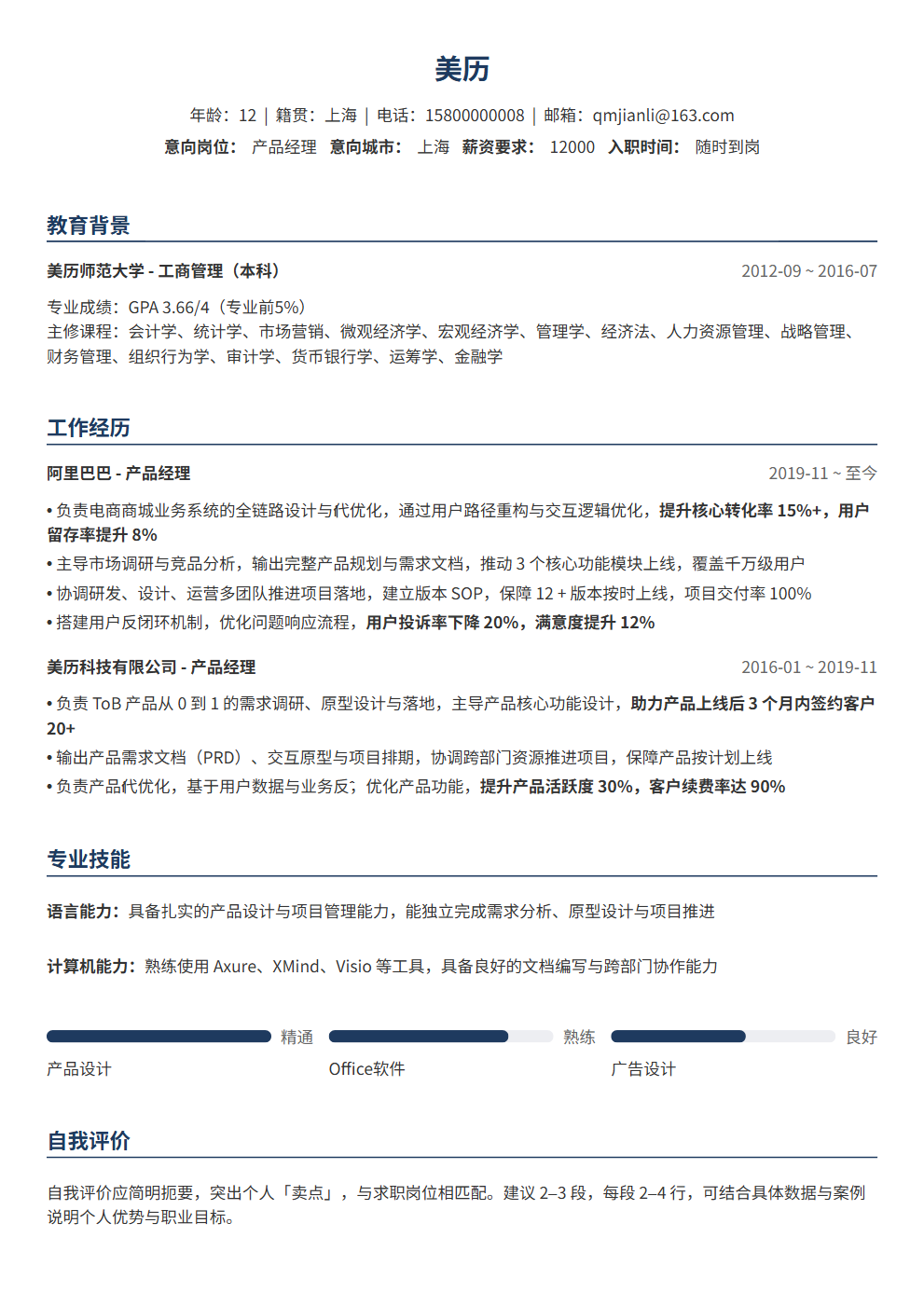
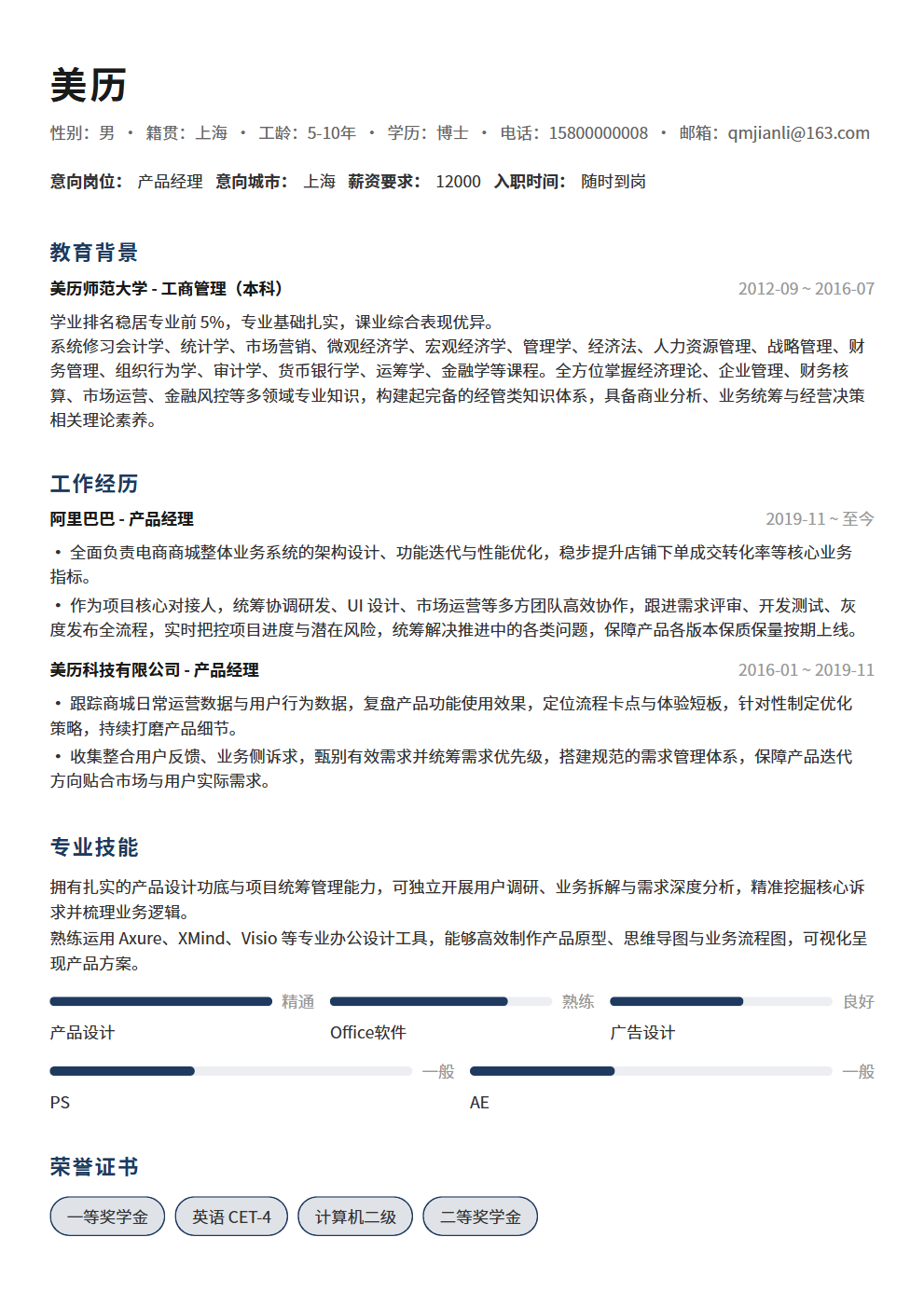
- Personal information: Chinese resumes require gender, age, marital status, political affiliation, and hometown. English resumes only include name, phone, email, and LinkedIn URL—all other personal information is omitted. Age, gender, marital status, religion, and race are protected categories in Western countries; including them on a resume is a major professional taboo
- Layout style: Chinese resumes often use table layouts, flashy templates, and colorful designs. English resumes pursue clean professionalism—plain text layout, black and white, no tables, no decorations. Common fonts are Arial, Calibri, and Times New Roman, size 10-12pt, line spacing 1.15-1.5. Remember: the English resume layout principle is "content is king, form serves content"
Difference 2: Content Focus
Chinese and English resumes have fundamentally different content focuses—Chinese resumes lean toward "description," while English resumes lean toward "results." This difference shows in every section.
- Work experience: Chinese resumes tend to describe "what you did"—"responsible for requirement analysis, solution design, and progress management of Project X." English resumes emphasize "what you achieved"—"Led a cross-functional team of 8 to deliver Project X 2 weeks ahead of schedule, resulting in 30% increase in user engagement." The former is a duty description; the latter is a results showcase—every bullet point on an English resume should start with a verb and end with a result
- Education: Chinese resumes include major courses, thesis titles, and GPA (if high). English resumes for those with work experience only include school, degree, major, and graduation year—no courses, no thesis, no GPA (unless you're a fresh graduate with GPA 3.5+/4.0). The more work experience you have, the more concise the education section should be
- Self-evaluation: Chinese resumes commonly have a "self-evaluation" section with a paragraph of self-introduction. English resumes don't have "self-evaluation"—instead, they use a "Professional Summary," 3-4 lines summarizing your core positioning and biggest highlights, not self-praise. For example: "Product Manager with 5+ years of experience leading 0-to-1 product launches in social media. Track record of growing DAU from 0 to 5M. Expert in user growth and data-driven decision making."
Difference 3: Vocabulary
English resumes have their own "verb system"—using strong action verbs at the beginning of each bullet point to give it impact. Chinese resume vocabulary is relatively casual, but English resume word choice directly affects HR's judgment of your professionalism.
- Strong verb openings: Each bullet point starts with a strong verb, not a weak verb or noun. "Led" is 100 times more powerful than "Was responsible for leading." "Spearheaded" is 100 times more professional than "Helped with." Common strong verbs: Led, Spearheaded, Orchestrated, Architected, Pioneered, Optimized, Streamlined, Accelerated, Revamped, Cultivated
- Avoid weak verbs: Don't use "Helped," "Assisted," "Participated," "Was involved in"—these weak verbs suggest you were a supporting character, not the lead. If you participated but didn't lead, use "Contributed to" or "Collaborated on"—at least these show you were a contributing collaborator, not a passive participant
- Quantify results: English resume bullet points must include quantified data—numbers, percentages, dollar amounts, timeframes. "Increased revenue" isn't enough; write "Increased revenue by 35% ($2M) within 6 months." "Managed a team" isn't enough; write "Managed a team of 12 engineers across 3 time zones." Results without data equal no results on an English resume
- Consistent tense: Current positions use present tense (Lead, Manage, Develop), past positions use past tense (Led, Managed, Developed). Within the same position, tense should be consistent—don't mix tenses under the same company
Difference 4: Privacy Boundaries
This is the most easily overlooked and most dangerous difference between Chinese and English resumes. In Western countries, employment discrimination laws strictly prohibit discrimination based on age, gender, race, religion, marital status, and disability, so resumes cannot include any information that could trigger discrimination.
- Absolutely never include: Age/date of birth, gender, marital status, race/ethnicity, religion, political affiliation, ID number, height/weight, photo. These items are standard in Chinese resumes but including them in English resumes is "career suicide"—HR may reject your resume outright to avoid potential legal risks
- No need to include: Hometown/birthplace, family background, parents' occupations, household registration (hukou) information. These occasionally appear in Chinese resumes but are completely irrelevant in English resumes—foreign HR doesn't care where you're from or what your family background is; they only care whether you can do the job
- Okay to include but be careful: LinkedIn profile URL (recommended, but ensure your profile is professional); personal website/portfolio link (include if relevant to the position); visa status (if you need visa sponsorship, mention it in the cover letter, not on the resume)
Difference 5: Reference Culture
In Western job searching, references are an important part of the hiring process, but they differ fundamentally from Chinese-style "references."
- How to handle references: Chinese resumes sometimes list references at the end with "Reference: XX Company XX Director, Phone XXX." English resumes do NOT list references on the resume—instead, write "References available upon request" at the end, or don't write anything (since this is assumed). Reference contact information is only provided when the employer actively requests it
- Choosing references: Don't choose family members or friends—choose former bosses, former colleagues, or former clients who can evaluate your work ability from a professional perspective. It's best to prepare 3-5 references and communicate with them in advance to ensure they're willing to vouch for you
- Reference timeliness: References should be people you've had a working relationship with in the past 3-5 years. A boss from 10 years ago may not remember your work performance well, making their reference less persuasive
Writing Templates for 5 English Resume Sections
After understanding the 5 key differences, here are writing templates for the 5 sections of an English resume. Fill in the content based on your situation.
- Contact Information: Full name (First Name Last Name), Phone (+86 138-XXXX-1234), Email (firstname.lastname@email.com, use a professional email), LinkedIn (linkedin.com/in/yourname), Personal website/portfolio (if applicable). Don't write full addresses—city + country is sufficient, e.g., "Beijing, China"
- Professional Summary: 3-4 lines summarizing your core positioning. Template: [Job Title] with [X]+ years of experience in [Industry/Domain]. Track record of [1-2 biggest achievements with numbers]. Expert in [2-3 core skills]. Example: Product Manager with 5+ years of experience in social media and consumer tech. Track record of leading 0-to-1 product launches growing DAU from 0 to 5M. Expert in user growth, data-driven decision making, and cross-functional team leadership.
- Professional Experience: Company Name | Position | Time Period. 3-5 bullet points per position, each starting with a strong verb and including quantified results. Template: [Strong Verb] + [What you did] + [Quantified Result]. Example: Spearheaded the redesign of the onboarding flow, reducing drop-off rate by 40% and increasing 7-day retention by 25% within 3 months of launch.
- Education: University Name | Degree + Major | Graduation Year. Fresh graduates can add GPA (3.5+/4.0), honors, and relevant coursework. Those with work experience only need school, degree, major, and year. Template: [University Name] | [Degree] in [Major] | [Graduation Year]. Example: Peking University | B.S. in Computer Science | 2020
- Skills: Divided into Hard Skills and Soft Skills (optional). Hard Skills include technical skills and tools; Soft Skills are not recommended as a standalone section—demonstrate them through specific examples in work experience. Template: Technical: [Skill 1], [Skill 2], [Skill 3]; Tools: [Tool 1], [Tool 2], [Tool 3]. Example: Technical: Product Strategy, User Research, A/B Testing, SQL; Tools: Figma, Jira, Google Analytics, Tableau
3 Common Mistakes
Chinese job seekers most commonly make the following 3 mistakes when writing English resumes.
- Mistake 1: Directly translating the Chinese resume. Translating the Chinese resume sentence by sentence into English is the most common mistake. Direct translation leads to grammar errors, unnatural expressions, and misplaced emphasis. For example, the Chinese "负责产品从0到1的搭建" directly translates to "Responsible for building the product from 0 to 1"—grammatically fine but unprofessional. The idiomatic version is "Spearheaded 0-to-1 product launch, growing DAU from 0 to 5M." The difference: the former is a duty description, the latter is a results showcase
- Mistake 2: Using Chinglish. Many Chinese job seekers' English resumes are full of Chinglish—"open the door of success," "step by step improve," "make a big progress." These expressions are natural in Chinese but awkward in English. Ways to avoid Chinglish: use simple, direct English without flowery rhetoric; use strong verbs instead of weak ones; use quantified data instead of vague descriptions. After writing, have a native English speaker or professional editor review it
- Mistake 3: Ignoring ATS systems. Most foreign companies use ATS (Applicant Tracking System) to automatically screen resumes—your resume is scanned by a machine first, and only if it passes will HR see it. ATS has strict format requirements: no images, tables, text boxes, or fancy fonts—these elements can't be read by ATS. Use standard section headers (Professional Experience, Education, Skills), don't create your own. Use standard date formats (Jan 2020 - Dec 2022), not Chinese-style formats like "2020.1-2022.12"
English Resume Self-Check List
After writing your English resume, check each item on this list to ensure nothing is missed.
- Format check: 1 page (under 5 years experience) or 2 pages (5+ years experience); no photo; no tables; black and white; standard fonts (Arial/Calibri/Times New Roman); font size 10-12pt; line spacing 1.15-1.5; submit in PDF format
- Personal information check: Only name, phone, email, LinkedIn; no age, gender, marital status, race, religion, political affiliation; professional email address (firstname.lastname format); LinkedIn profile updated and professional
- Content check: Has Professional Summary (3-4 lines); 3-5 bullet points per work experience; each bullet point starts with a strong verb; each bullet point includes quantified data; consistent tense (present for current, past for previous); concise education (experienced professionals only need school + degree + major + year)
- Language check: No grammar errors; no spelling errors; no Chinglish expressions; professional and idiomatic vocabulary; no redundant words; active voice rather than passive voice
- ATS compatibility check: No images, tables, or text boxes; standard section headers; standard date format; keywords match job description; standardized file name (FirstName-LastName-Position.pdf)
Conclusion: An English Resume Is Not a Translation—It's a Reconstruction
The biggest mistake in writing an English resume is treating it as a translation of the Chinese one—copying the format, directly translating content, using Chinglish, and including private information. These practices only make your English resume scream "unprofessional" to foreign HR. Remember the 5 key differences: format (1-2 pages, no photo, clean layout), content focus (results-oriented, not duty descriptions), vocabulary (strong verb openings, quantified results), privacy boundaries (no age/gender/personal info), and reference culture (don't list references on the resume). Build your English resume using the 5 section templates, avoid the 3 common mistakes, and verify with the self-check list—only then will your English resume truly meet foreign company standards. An English resume is not a translation; it's a reconstruction—reorganizing and presenting your professional experience using the logic and standards of English resumes.
Want to write a professional, idiomatic English resume? Use BeautyResume—built-in English resume templates and strong verb vocabulary, generate a foreign-company-standard English resume with one click.