How to Write a Resume for Remote Work? 5 Tips to Get Your Resume Noticed by Remote Teams
Want remote work but your resume doesn't match? 5 tips to build a remote-friendly resume — highlight self-management skills, showcase remote collaboration experience, emphasize async communication abilities, list remote tool proficiency, and prove independent work capability with results. Plus a remote resume template and 3 special preparations for remote interviews.
You want a remote job — no commute, flexible hours, working from a coffee shop. But after sending dozens of resumes for remote positions, all have disappeared into the void. You start wondering: do remote jobs only hire people who "already have remote experience"? No. The problem might be your resume — remote teams have completely different hiring logic than traditional offices. They don't care about "where you work" but "whether you can get things done without supervision." If your resume is still written with a traditional office mindset, remote teams will naturally pass on you. This article will help you use 5 tips to transform your resume into a "remote-friendly" version that catches remote teams' eyes at first glance.
Want Remote Work but Your Resume Doesn't Match: Where's the Problem
What do remote teams worry about most when hiring? Not your professional skills — those can be assessed through portfolios and projects. They worry most about: Can you self-manage? Can you complete tasks on time without a manager watching? Can you stay efficient in asynchronous communication? Can you independently solve unexpected problems? These "soft skills" aren't very important in traditional office environments — because there's a manager watching, colleagues helping, and instant communication. But in a remote environment, these skills are "survival skills" — without them, remote work is a disaster. So when remote teams review resumes, the first thing they look for isn't your skills list but evidence of "remote survival ability." If your resume has no information about self-management, independent work, or asynchronous communication, remote teams will pass immediately — not because you're incapable, but because you "don't look like someone who can work remotely."
Tip 1: Highlight Self-Management Ability
Self-management ability is the #1 requirement for remote work — without a manager watching you, can you arrange your own work, manage your time, and maintain output? If your resume has no information about self-management, remote teams will assume you "need to be managed" — which is a risk for them. You need to proactively showcase your self-management ability in your resume.
- Showcase independently-led project experience: Clearly write about projects you "independently led" or "autonomously drove" — "independently led XX project, from requirements analysis to delivery, managing progress and quality throughout." Independent leadership means you can get things done without someone watching
- Showcase time management results: If you have experience handling multiple projects simultaneously and delivering under tight deadlines, definitely include it — "managed 3 projects simultaneously, all delivered on time, 95%+ client satisfaction." This shows you can not only manage your own time but also stay efficient when multitasking
- Showcase self-driven work habits: For example, "proactively optimized XX process, improving efficiency by 30%," "self-taught XX skill, applied it to a project within 3 months and achieved results" — these show you can self-drive without external pressure
- Showcase remote/hybrid work experience: If you've had remote work, work-from-home, or hybrid work experience, clearly mark it in your resume — "2022-2024: hybrid work model, 3 days remote per week, project delivery quality and efficiency unaffected during this period." Direct experience is more persuasive than any description
- Showcase goal-oriented work style: Describe your work with results and data — "set quarterly goals → broke down into monthly tasks → reviewed progress weekly → achieved goals on time." Goal orientation shows you don't need others to tell you what to do; you know yourself
The core logic of highlighting self-management: let remote teams see "this person doesn't need to be managed; they can manage themselves." In a remote environment, self-management ability is more important than professional skills — because skills can be trained, but self-management is hard to train.
Tip 2: Showcase Remote Collaboration Experience
Remote work isn't "working alone" — it's "a group of people collaborating remotely." Remote collaboration is completely different from face-to-face collaboration — you can't walk over to a colleague's desk to discuss problems, can't draw on a whiteboard, can't sync information in the break room. You need to use tools, processes, and habits to achieve efficient collaboration. If you have remote collaboration experience, definitely showcase it in your resume.
- Cross-timezone collaboration experience: If you've collaborated with colleagues in different time zones, this is a "bonus" for remote teams — "collaborated with San Francisco and London teams, completing XX project through asynchronous communication." Cross-timezone collaboration shows you understand the core challenges of remote collaboration and know how to address them
- Cross-location team collaboration: Even if not cross-timezone, cross-location collaboration is worth showcasing — "collaborated with Beijing, Shanghai, and Shenzhen teams, maintaining real-time communication via Feishu/Slack, managing project progress through Notion"
- Remote project management experience: If you've managed remote teams or projects, definitely include it — "managed a 5-person remote team, maintaining team alignment through daily standups + weekly reports + monthly reviews, delivering projects on time." Remote project management is much harder than in-person management; people with this experience are scarce
- Remote collaboration tool proficiency: List the remote collaboration tools you're proficient with — Slack/Feishu (instant messaging), Zoom/Tencent Meeting (video conferencing), Notion/Confluence (knowledge management), Jira/Trello (project management), Figma (collaborative design), GitHub (code collaboration). Tool proficiency is a foundational skill for remote collaboration
- Remote team culture building experience: If you've participated in building remote team culture — like organizing virtual team-building, establishing remote communication norms, promoting asynchronous communication culture — these are also worth mentioning in your resume. Remote teams lack "belonging" the most; people who can help build remote culture are highly valued
The core logic of showcasing remote collaboration: let remote teams see "this person can not only work remotely themselves but also collaborate remotely with a team." The core challenge of remote work isn't "working independently" but "collaborating remotely" — many people can do the former, but few can do the latter well.
Tip 3: Emphasize Asynchronous Communication Ability
What's the biggest difference between remote teams and traditional teams? Communication style. Traditional teams primarily use "synchronous communication" — meetings, face-to-face discussions, instant replies. Remote teams primarily use "asynchronous communication" — writing documents, sending messages, recording videos — the other person doesn't need to reply immediately, but information must be clear, complete, and traceable. Asynchronous communication ability is the most core "soft skill" for remote work — people who can't communicate asynchronously will suffer greatly in remote teams.
- Showcase document writing ability: The core of asynchronous communication is "writing clearly" — your ideas, proposals, questions, and progress all need to be expressed clearly through text. Showcase your document writing ability in your resume — "wrote XX product requirements document (50-page PRD)," "authored XX technical proposal document," "maintained XX team knowledge base (200+ articles)"
- Showcase structured expression ability: Asynchronous communication requires "structured" information — the other person doesn't have the opportunity for face-to-face explanation; your text must be self-explanatory. Showcase your structured thinking in your resume — "broke down XX complex problem into 3 modules, developing solutions for each," "used mind maps to organize XX business process, producing standardized documentation"
- Showcase "write first, talk later" work habit: Remote team culture is "write the document first, then meet to discuss" — not "meet first, then write minutes." If you have this habit, reflect it in your resume — "promoted the team's adoption of 'document-first' workflow, improving meeting efficiency by 50%"
- Showcase cross-language/cross-cultural communication ability: If you have experience working in English or collaborating with overseas teams, definitely highlight it in your resume — many remote teams are international, and English communication ability is a bonus
The core logic of emphasizing asynchronous communication: let remote teams see "this person can collaborate efficiently without real-time communication." In a remote environment, asynchronous communication ability is more important than instant response ability — because remote teams can't have everyone online simultaneously; information must "carry its own context."
Tip 4: List Remote Tool Proficiency
Remote work relies on tools — communication tools, collaboration tools, project management tools, design tools, development tools. If you're not familiar with these tools, remote teams will worry about your "ramp-up speed." Clearly list the remote tools you're proficient with in your resume, letting remote teams know "this person can hit the ground running without training."
- Communication tools: Slack, Feishu, Microsoft Teams, Discord — list your most-used ones and note years of use. For example, "Slack 3 years (daily communication + channel management + integration configuration)"
- Project management tools: Jira, Trello, Asana, Linear, Notion — note your depth of use. For example, "Jira 2 years (requirements management + sprint planning + report configuration)" is more informative than "Jira 2 years"
- Collaboration tools: Notion, Confluence, Google Workspace, Figma, Miro — list what you've done with these tools. For example, "Notion 2 years (team knowledge base setup + project management + document collaboration)"
- Development/design tools: GitHub/GitLab (code collaboration), Figma (design collaboration), VS Code Live Share (real-time collaborative coding) — if you're in tech or design, proficiency with these tools must be showcased
- Automation tools: Zapier, Make (formerly Integromat), IFTTT — if you can use automation tools to improve efficiency, this is a "super bonus" for remote teams. For example, "used Zapier to build automated workflows, reducing repetitive work by 70%"
The core logic of listing remote tool proficiency: let remote teams see "this person can hit the ground running without spending time on tool training." In a remote environment, tool training is harder than in-person — you can't walk over to a colleague's desk for hands-on guidance. So remote teams prefer hiring people who "already know how to use the tools."
Tip 5: Prove Independent Work Ability with Results
What do remote teams fear most? Hiring someone who needs constant prodding, supervision, and guidance to complete work — in a remote environment, this type of person severely slows down team efficiency. You need to prove your independent work ability with results — "give me a task, and I'll handle it without you watching."
- Showcase "end-to-end" responsible projects: Clearly write about projects you independently completed "from 0 to 1" — "independently completed the design and development of XX product, from requirements analysis to deployment and operations, driving the entire process autonomously." End-to-end responsibility means you don't need others to "fill gaps" for you
- Showcase results achieved "without supervision": If you have freelance, independent consulting, or remote part-time experience, these are direct evidence of independent work ability — "as a freelancer, independently completed 15 projects over 2 years, 100% client satisfaction, zero delays"
- Showcase "proactively identifying and solving problems" experience: Remote teams need people who "know what to do without being told" the most — "proactively identified efficiency bottleneck in XX process, proposed optimization solution and independently implemented it, reducing processing time by 60%"
- Showcase "maintaining output in uncertain environments" ability: Remote work is full of uncertainty — unstable internet, timezone differences, changing requirements. Showcase your coping ability in uncertain environments — "despite 3 client requirement changes, still delivered the project on time, with final results exceeding client expectations"
- Prove independent work ability with data: Don't just write "can work independently" — prove it with data — "independently responsible for XX module, zero delayed deliveries," "autonomously optimized XX process, improving efficiency by 40%," "independently solved XX technical challenge, saving 50K in outsourcing costs"
The core logic of proving independent work ability with results: let remote teams see "this person can produce results without being managed." In a remote environment, independent work ability is the "1" and other abilities are the "0"s after it — without this "1," no matter how many other abilities you have, they amount to nothing.
Remote Resume Template
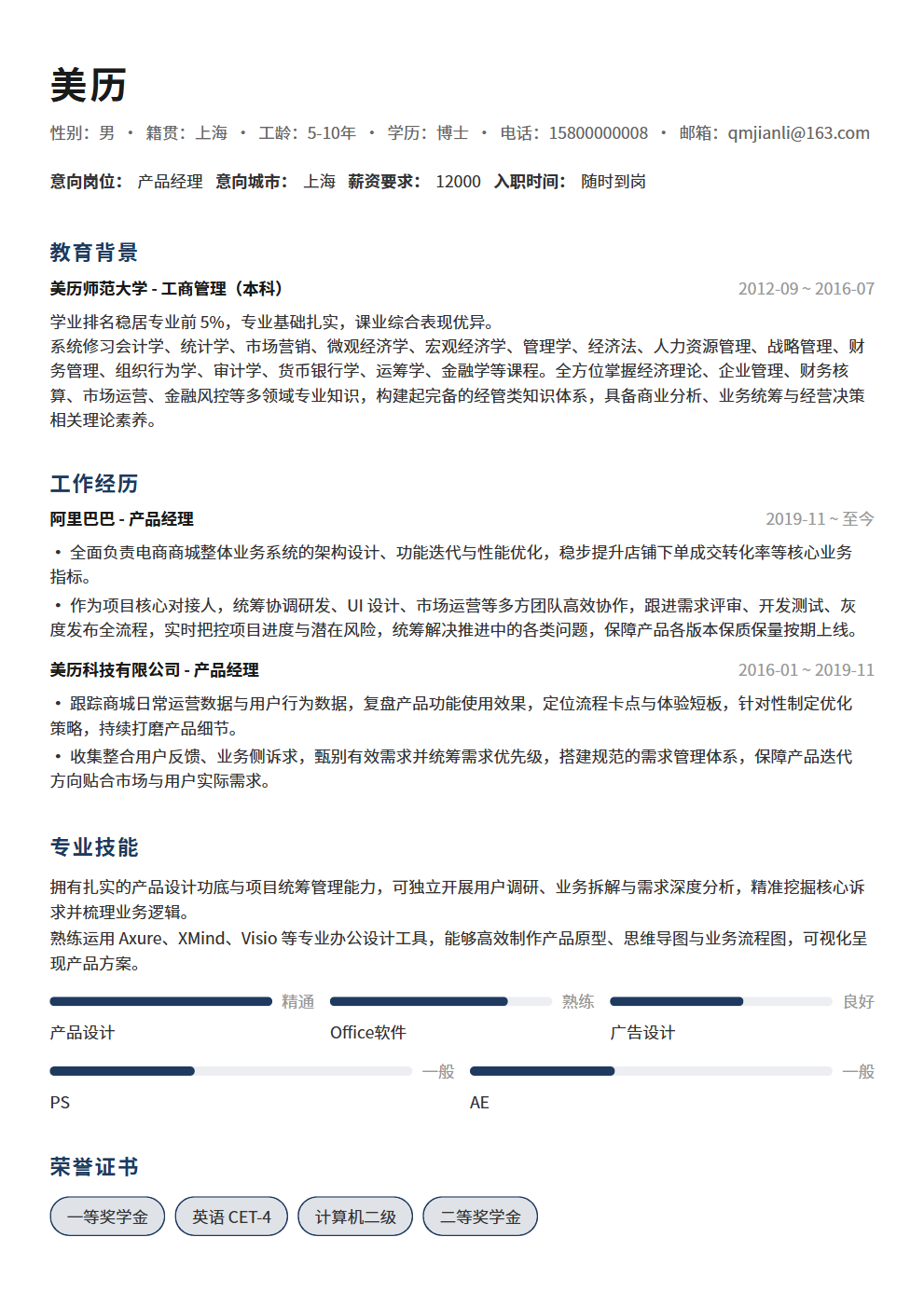
Here's a structural template for a remote-friendly resume that you can adjust based on your situation.
- Personal information: Name, contact info, timezone (a must-see for remote teams), available working hours (e.g., "UTC+8, flexible to accommodate UTC-8 to UTC+8 working hours")
- Personal summary: 1-2 sentences highlighting your remote work ability and core value — "5 years of product management experience, 3 years of remote work experience, skilled in asynchronous communication and independent project management, independently led 3 products from 0 to 1"
- Remote work capabilities: A dedicated section listing your core remote capabilities — self-management, asynchronous communication, remote collaboration, tool proficiency, independent work — each supported by 1-2 specific examples
- Work experience: Described with results + data, emphasizing keywords like "independently led," "autonomously drove," "remote collaboration"
- Project portfolio: List your project work with accessible links (GitHub, Figma, live demos, etc.)
- Tool skills: Categorize and list the remote tools you're proficient with, noting years of use and depth
The core of this template: turn "remote work ability" from "implicit information" to "explicit information" — let remote teams see at first glance that you're "someone who can work remotely," not "someone who might be able to work remotely."
3 Special Preparations for Remote Interviews
Remote interviews differ from traditional interviews in some ways — they assess not just your professional ability but also your "remote fitness." These 3 special preparations will help you stand out in remote interviews.
- Preparation 1: Test your remote work setup. Before the interview, test your internet, camera, microphone, and background — ensure clear video, clear audio, and a tidy background. Remote interviewers will judge your "remote maturity" through your setup — if you can't even handle the tech for an interview, how can they believe you can work remotely?
- Preparation 2: Prepare answers for "remote work scenarios." Interviewers will likely ask "How do you stay focused at home?" "How do you handle cross-timezone collaboration?" "How do you move work forward without instant feedback?" — prepare specific answers in advance, supported by real examples. For instance, "I use the Pomodoro technique to manage focus time — 4 Pomodoros daily for deep work, remaining time for communication and collaboration"
- Preparation 3: Demonstrate your asynchronous communication ability. After the interview, send a structured thank-you email — not just "thanks for the interview," but summarize key issues discussed, your thoughts on those issues, and your next steps. This email itself is a demonstration of asynchronous communication ability — clearly structured, complete information, thoughtful depth
The core of these 3 special preparations: let the interviewer feel during the interview process that "this person is truly suited for remote work" — not just saying so, but naturally demonstrated through your setup, answers, and follow-up.
Conclusion: A Remote Resume Isn't a Copy of a Traditional Resume — It's a Redefinition of How You Work
The biggest difference between a remote work resume and a traditional resume isn't the format but the "narrative logic" — traditional resumes tell "where you worked," remote resumes tell "how you work." The 5 tips — highlight self-management ability, showcase remote collaboration experience, emphasize asynchronous communication ability, list remote tool proficiency, and prove independent work ability with results — each helps your resume switch from "traditional office narrative" to "remote office narrative." The remote resume template makes your remote capabilities immediately clear, and the 3 special preparations for remote interviews let you demonstrate "remote fitness" during the interview. Remember, when remote teams hire, what they value most isn't "what you can do" but "whether you can do it well when nobody's watching" — prove this through your resume and interviews, and remote offers aren't far away.
For remote job seeking, your resume is your "remote business card." Use BeautyResume resume editor — professional templates + remote-friendly formatting — making your self-management ability and remote collaboration experience immediately clear. Let remote teams notice you at first glance.