How to Write a Career Change Resume? 4 Steps to Turn Your Previous Industry Experience into Your Next Industry Advantage
The biggest challenge in cross-industry job hunting is: HR thinks you lack experience. This article teaches you 4 steps to rewrite your career change resume — extract transferable skills, align with new industry keywords, prove cross-boundary capability through projects, and tell a compelling transition story, so HR sees your cross-industry value.
You've worked in education operations for 5 years and now want to transition into tech as a product manager. You've sent out 20 resumes and haven't gotten a single interview. HR's feedback is consistent: "No tech product experience." You're frustrated — operations and product management clearly have a lot in common, so why can't HR see it? The problem isn't your ability — it's your resume. You're still writing in "education operations" language, and all HR sees is the word "education" everywhere, so naturally they think you're not a fit. For a career change, your resume must "change its language." Today I'll teach you 4 steps to rewrite your career change resume so HR sees your cross-industry value, not your industry label.
3 Common Mistakes in Career Change Resumes
Before diving into the method, let's check if you've fallen into these 3 traps — most career changers make the same mistakes.
- Mistake 1: Copying your previous industry resume verbatim. If you wrote "managed K-12 online course operations" in education and apply for a tech product role, HR sees "education industry experience," not "product capability." The industry label is too strong, and HR filters you out immediately. Your resume must be rewritten for the target industry, not just have the job title swapped
- Mistake 2: Overemphasizing "willingness to learn" while neglecting "existing capabilities." "I'm passionate about the tech industry and willing to start from scratch" — to HR, this means "I don't know anything and need you to teach me." A career change isn't starting from zero. You have many transferable skills from your past experience — you just haven't extracted them. Your resume should showcase "what I can do," not "what I want to learn"
- Mistake 3: Using previous industry jargon in your resume. Every industry has its own "insider language" — education talks about "completion rates," "renewal rates," and "curriculum research"; finance talks about "risk control," "compliance," and "net asset value"; manufacturing talks about "yield rates," "lean production," and "supply chain." These terms are professional within the industry, but incomprehensible across industries. You must "translate" your previous industry's language into your target industry's language
The common thread in these 3 mistakes: you're writing from your own perspective, not HR's. The core principle of a career change resume — use the target industry's language to tell the story of your past capabilities. The following 4 steps will help you complete this "translation" and "reconstruction" process.
Step 1: Extract Transferable Skills
Transferable skills are the cornerstone of career change job hunting — they're the capabilities you've accumulated in your previous industry that you can directly bring to the next. No matter which industry you're transitioning from or to, there are always some universal capabilities. Your task is to identify them and "extract" them from your past experience.
- What are transferable skills: Not industry-specific knowledge (like K-12 curriculum systems or financial product structures), but cross-industry universal capabilities (like data analysis, user insight, project management, cross-departmental coordination, copywriting, process optimization). Industry knowledge is "hard skills"; transferable skills are "soft capabilities" — hard skills need to be relearned, soft capabilities can be brought along directly
- How to extract: Take out a piece of paper and write down the 5 things you do most often in your past work, then ask yourself: what's the core capability behind this? For example, "managed course launch processes" → core capability is "project management"; "analyzed student learning data to optimize course content" → core capability is "data-driven decision making"; "coordinated curriculum and tech teams to drive product iterations" → core capability is "cross-departmental collaboration"
- Extraction example: Education operations → Tech product management. Education's "design curriculum systems" = product manager's "plan product features"; "analyze student data to optimize experience" = "analyze user data to iterate products"; "coordinate curriculum and tech teams" = "coordinate design and development teams." The capabilities map perfectly — only the industry context differs
- Extraction example: Manufacturing quality engineer → Tech data analyst. "Statistical analysis of production line defect rates" = "data statistics and analysis capability"; "using SPC tools to monitor quality trends" = "data visualization and monitoring capability"; "proposing improvement plans to reduce defect rates" = "data-driven business optimization capability." Core capabilities overlap significantly
The key to extracting transferable skills is "de-industrializing" — abstracting your experience from specific industry scenarios to distill the underlying capability model. When you can describe your experience using universal language like "project management," "data analysis," and "user insight," HR won't be blinded by industry labels like "education" or "manufacturing" anymore.
Step 2: Align with New Industry Keywords
After extracting transferable skills, the next step is to repackage them using the target industry's "keywords." When screening resumes, HR's first round is typically keyword matching — does your resume contain the words they're looking for? If not, you won't even pass the first round.
- How to find keywords: Open the JD (job description) for your target position and circle the professional terms that appear repeatedly. For example, a product manager JD might include "requirements analysis," "PRD," "user personas," "A/B testing," "agile development" — these are keywords. Your resume must contain these words in the right context
- Keyword mapping table: Create a mapping between your previous industry's terms and the target industry's terms. For example: Education's "curriculum design" → Tech's "product planning"; "student feedback" → "user research"; "course iteration" → "product iteration"; "completion rate" → "retention rate"; "renewal rate" → "repurchase rate." Rewrite your previous industry experience using the target industry's terminology
- Alignment example: Original: "Managed the full lifecycle of K-12 online courses, from curriculum design to launch operations, continuously iterating and optimizing course content, completion rate improved to 85%." Rewritten: "Managed the full lifecycle of online products, from requirements analysis to launch operations, continuously iterating and optimizing product features, user retention rate improved to 85%." The content is nearly identical, but the keywords are completely different
- Alignment example: Original: "Used Excel to track production line defect rates, created daily and weekly reports, identified anomalies and escalated promptly." Rewritten: "Used data analysis tools to monitor core business metrics, built data dashboards, established anomaly alert mechanisms." Same work, different expression, completely different industry impression
Aligning keywords isn't "fabricating" — it's "translating." You're doing the same work, just describing it in the target industry's language. It's like the same concept being called "apple" in English and "manzana" in Spanish — the essence is the same, only the expression differs. A career change resume is this kind of "translation" work.
Step 3: Prove Cross-Boundary Capability Through Projects
After extracting transferable skills and aligning keywords, you need concrete project experience to prove: you don't just "talk the talk," you've actually "walked the walk." Projects are the most persuasive part of a career change resume — because projects are carriers of capability, and HR judges your actual level through projects.
- Project selection principle: Prioritize projects with "similar logic" to the target industry, not "same industry." For example, when transitioning from education to tech product management, choose the "built online curriculum system from 0 to 1" project over "daily course operations" — because the "0 to 1 building" logic is highly consistent with a product manager's "0 to 1 product building" logic
- STAR method for project descriptions: Situation → Task → Action → Result. But for career change resumes, make one adjustment — in the Action section, describe your actions using the target industry's language, and in the Result section, present outcomes using metrics the target industry cares about
- Project rewriting example: Original: "Led the 0-to-1 build of the company's new course line, coordinated 3 departments, launched 5 courses within 3 months, first-month revenue 500K RMB." Rewritten: "Led the 0-to-1 build of a new product line, coordinated product, design, and tech teams, launched 5 core feature modules within 3 months, first-month GMV reached 500K RMB." Same project, but the rewrite reads exactly like a tech product manager's project experience
- Supplementary cross-boundary projects: If your past experience truly lacks projects related to the target industry, you can create them proactively. For example, if you want to transition into data analysis, you can do your own data analysis project (analyze public datasets, write analysis reports, publish on Zhihu or GitHub); if you want to transition into product management, write your own product analysis report (deconstruct a target company's product, propose optimization suggestions). These "self-driven projects" aren't work experience, but they prove your capability and sincerity
The core of project proof is "logic transfer" — you don't need to have worked in the target industry, but you need to prove that what you've done in the past shares the same underlying logic as what the target role requires. HR doesn't need "industry experience" — they need "execution capability." Projects are the best evidence of your execution capability.
Step 4: Tell a Compelling Transition Story
The first three steps solve the "capability proof" problem, but HR still has one concern: why are you changing careers? Have you really thought it through? Or is it impulsive? Will you want to change again after 3 months? If this concern isn't addressed, even if your capabilities match, HR might reject you due to "stability concerns." So you need to tell your transition story well in your resume.
- Core logic of a transition story: Not "I'm tired of the old industry," but "I discovered my true passion and strengths in the old industry, and the new industry is the best stage for these passions and strengths." The former is escape; the latter is pursuit — HR likes pursuers, not escapees
- 3 elements of a transition story: Trigger (what event made you start considering a transition), Exploration process (what you did to verify this direction), Proof of commitment (what preparations you've already made for the new direction). All three are essential — no trigger seems impulsive, no exploration seems hasty, no preparation seems like empty talk
- Transition story example: "During my 3 years in education operations, I discovered that what I enjoy and excel at most isn't content operations, but data analysis and product optimization — every time I discovered user behavior patterns through data and optimized the learning experience accordingly, I felt a deep sense of accomplishment. To pursue this, I systematically studied product management methodology, completed 3 product analysis projects (see project experience), and obtained PMP certification. I want to bring my data-driven product optimization capabilities to the tech industry, creating value at larger scale and faster iteration pace"
- Where to place the transition story in your resume: It can go in the self-evaluation/professional summary section, told in 2-3 concise sentences. You can expand on it during interviews. The resume version should be concise and powerful; the interview version can be more detailed and emotional
A good transition story makes HR feel: this person isn't jumping blindly — they've made a thoughtful career upgrade. They're not escaping problems in the old industry; they're pursuing a direction that fits them better. This kind of person actually has stronger stability than someone who "never considered changing" — because they know what they want.
Career Change Resume Template
Integrating the 4-step method, here's the basic structure of a career change resume:
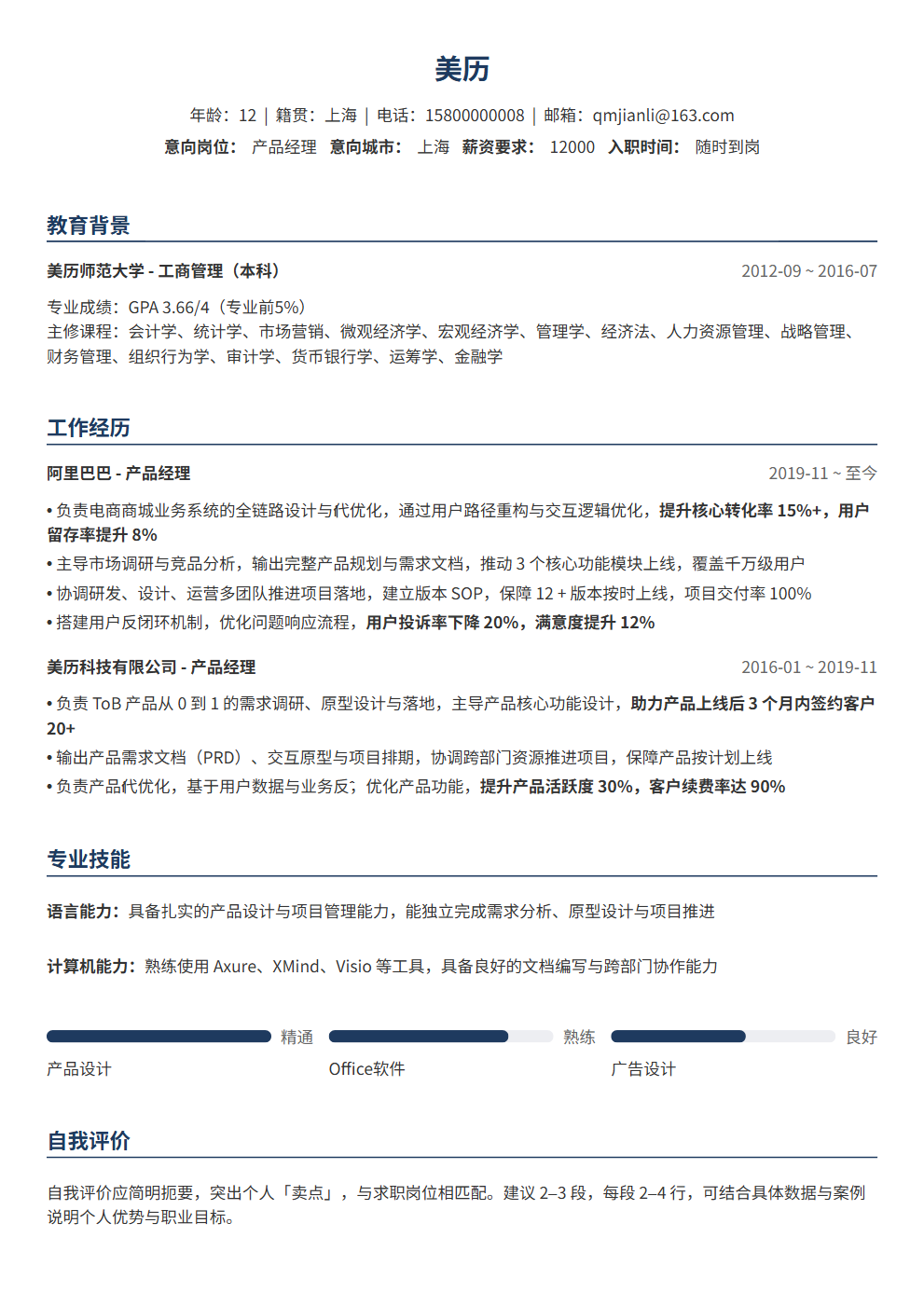
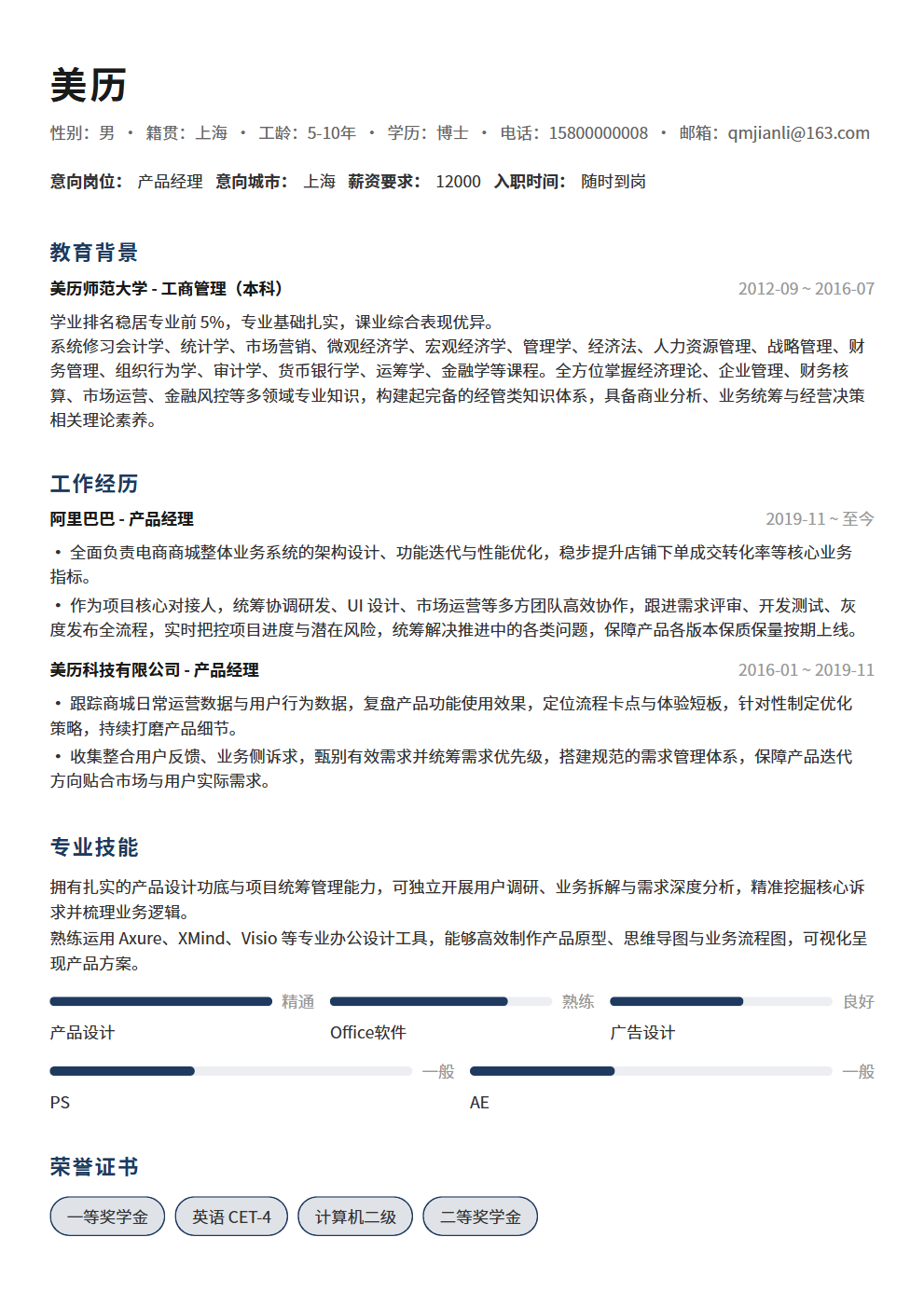
- Professional summary (3-4 lines): Summarize your core positioning + biggest achievement + transition logic using the target industry's keywords. For example: "3 years of education operations experience, skilled in data-driven product optimization, led 0-to-1 curriculum product line build with 500K first-month GMV. Systematically studied product methodology and completed 3 product analysis projects, seeking tech product manager opportunities"
- Core skills (5-6 items): List your transferable skills using the target industry's terminology. For example: Requirements analysis, user research, data-driven decision making, project management (PMP certified), cross-departmental collaboration, A/B testing
- Project experience (2-3 projects): Describe using STAR method + target industry language. Prioritize projects with similar logic to the target role
- Work experience: Simplify industry-specific content, highlight demonstrations of transferable skills. 2-3 achievements per role, presented using the target industry's metrics
- Supplementary evidence: Relevant certifications, self-study courses, personal projects, industry event participation. These are "proof of commitment," showing HR you're not just talking
The core principle of a career change resume: every line answers HR's 3 questions — Can you do this job? (capability match) Have you done similar things? (project proof) Do you really want this? (transition story). Answer all three well, and you're halfway to a successful career change.
Conclusion: A Career Change Isn't Starting Over — It's Switching Lanes and Keep Running
Many people fear career changes because they think "all my previous experience is wasted." But the opposite is true — your past experience is your greatest asset; it just needs to be "translated" and "repackaged." The 4-step rewriting method: Extract transferable skills so you see how many capabilities you can bring along; Align with new industry keywords so HR isn't blinded by industry labels; Prove cross-boundary capability through projects so HR believes you don't just "talk" but have "done"; Tell a compelling transition story so HR understands you're not impulsively jumping but thoughtfully transitioning. A career change isn't starting from zero — it's switching lanes and keep running. You're bringing not just luggage, but every capability you've accumulated along the way. Take that brave step, present yourself the right way, and you'll discover: HR in the new industry has been waiting for someone just like you.
Preparing for a cross-industry job hunt? Use BeautyResume's resume editor to switch keywords and expressions for different industries with one click, making your cross-boundary value crystal clear — no longer defined by industry labels, let your capabilities speak.