How to Run Meetings That Don't Waste Time? 4 Roles and 3 Principles
Meetings are the biggest time waster? 3 principles (clear agenda, 30-minute limit, conclusions and action items) + 4 roles (facilitator, note-taker, timekeeper, decision-maker) + 3 inefficient meeting makeovers + follow-up template for valuable meetings.
Another afternoon spent in meetings, back at your desk realizing you haven't touched your actual work and will need to work overtime tomorrow—this is the daily reality for most professionals. Statistics show that employees spend over 15 hours per week in meetings, yet over 60% of those meetings are considered "a waste of time." The problem isn't meetings themselves—it's that we don't know how to run them. No agenda, no time control, no conclusions, no action items—meeting as if you never met. Here are 3 principles and 4 roles to make every meeting valuable and stop wasting time.
Principle 1: Have a Clear Agenda — No Agenda, No Meeting
Have you ever attended a meeting where you only found out what was being discussed after arriving, then spent two hours going off on tangents with zero conclusions? The root cause is no agenda. An agenda is a meeting's "navigation map"—without navigation, you're just going in circles. Any meeting without a clear agenda should not be held.
- The agenda must be sent 24 hours before the meeting: Don't send it 10 minutes before—attendees won't have time to prepare and will show up "naked." Send it 24 hours in advance so everyone has time to think about what they want to say and ask
- The agenda must specify "what problem to discuss": Don't write "discuss project progress"—that's too broad. Write "discuss Project A's delay risks and response plans"—that has focus. Describe each agenda item's core question in one sentence so attendees know what needs to be solved
- Assign time to each agenda item: Don't list items without time allocations. Three items in 30 minutes—first item 10 minutes, second 15 minutes, third 5 minutes. With time constraints, discussion stays on track
- Mark the expected output for each item: What should result from this discussion? A decision? A plan? An information sync? Mark it clearly so attendees know their role—share opinions, make choices, or just listen
- Whoever initiates prepares the agenda: The meeting organizer is the first person responsible for the agenda. If you're the organizer, spend 10 minutes writing an agenda—it's infinitely better than a 2-hour themeless meeting. If you're an attendee receiving a meeting invite without an agenda, ask the organizer directly: "What's the agenda for this meeting? What should I prepare?"
Meetings with clear agendas are at least 50% more efficient—because everyone knows what to discuss, what to prepare, and what to do in the meeting. Meetings without agendas are just a group of people sitting in a room发散ing individually—that's not a meeting, that's chatting.
Principle 2: Limit to 30 Minutes — Short Meetings Are Good Meetings
Why do most meetings run over? Because nobody manages time. In a default 1-hour meeting, the first 40 minutes are spent "warming up" and "going off-topic," and only the last 10 minutes get to the point, ending hastily with nothing clearly resolved. The solution is simple—cut meeting time in half and limit to 30 minutes. Shorter time forces higher efficiency.
- 30-minute principle: Except for strategic planning and project reviews that require extended discussion, routine meetings should be 30 minutes maximum. What can be resolved in 30 minutes can also be resolved in 60; what can't be resolved in 30 minutes usually can't be resolved in 60 either—the issue isn't time length but discussion focus
- Stand-up meetings: A 15-minute daily standup is far more efficient than a 1-hour weekly meeting. Each person says three things: what they did yesterday, what they plan to do today, and what's blocking them. Then leave—no extended discussion. Items needing deeper discussion are handled 1-on-1 after
- End 5 minutes early: If a meeting is scheduled for 30 minutes, start summarizing and confirming action items at the 25-minute mark. Leave a 5-minute buffer to avoid running over. Never let a meeting "naturally end"—proactively ending is far more professional than passively running over
- Stop when time's up: If 30 minutes pass and discussion isn't complete, don't automatically extend. Two options: move unfinished items to the next meeting, or handle them 1-on-1 after. Don't let one item's overrun affect everyone's time
- Why not 60 minutes? Because of Parkinson's Law—work expands to fill the time allocated. Give 1 hour and discussion will stretch to 1 hour; give 30 minutes and discussion will compress to 30 minutes. Short time forces focus; long time encourages tangents
Limiting to 30 minutes isn't laziness—it's forcing efficiency. When you only have 30 minutes, you automatically cut the fluff, get straight to the point, and make quick decisions. Try it—change all your 1-hour meetings next week to 30 minutes. You'll find most meetings can be handled in 30 minutes.
Principle 3: Have Conclusions and Action Items — A Meeting Without Conclusions Equals No Meeting
What's the most frustrating type of meeting? Two hours of discussion ending with "Let's stop here for today and discuss next time"—essentially a waste. A meeting's value lies not in "what was discussed" but in "what was decided" and "who will do what." Meetings without conclusions and action items waste everyone's time.
- Every agenda item must have a conclusion: After discussing an item, the facilitator must summarize "Our conclusion is..." The conclusion could be "We'll adopt Plan A," "Further research is needed—Xiao Wang will handle it, results by next Friday," or "We won't address this for now." Even "not addressing it now" is a clear conclusion
- Action item three elements: Every action item must include "what to do," "who's responsible," and "when it's due." Missing any element makes the action item invalid. "Follow up later" isn't an action item—"Xiao Wang completes competitive analysis report by June 25" is
- Send meeting notes within 10 minutes after: Notes don't need to be lengthy—just include: meeting conclusions, action item list (what/who/when), and next meeting time (if any). Using a template, you can write them in 5 minutes and send within 10
- Action items must be tracked: Sending notes doesn't mean you're done. Action items need review at the next meeting—"How are last meeting's action items going? Any delays? Need adjustments?" Untracked action items are the same as no action items
Meetings with conclusions and action items are valuable meetings. Conclusions let everyone know "what we decided," and action items let everyone know "who does what next." Missing either one means the meeting was pointless.
Role 1: Facilitator — The Meeting's "Traffic Director"
The facilitator is the most important role—a meeting without a facilitator is like an intersection without traffic lights: chaos is inevitable. The facilitator's job isn't to "talk the most" but to "let the right people say the right things at the right time."
- 3-minute opening: Briefly state the meeting's purpose and agenda so everyone knows "what problem we're solving today." Don't assume everyone read the agenda—restate it at the opening, 30 seconds is enough
- Control the pace: When discussion goes off-topic, pull it back—"That's a valuable point, but it's not on today's agenda. Let's discuss it separately after." When someone speaks too long, politely interrupt—"Thanks for sharing, let's hear from others." When there's too much silence, call on someone—"Xiao Wang, what do you think about this?"
- Drive decisions: When discussion hits an impasse, the facilitator must push for a decision—"We have two options. Plan A's advantage is... Plan B's advantage is... We need to decide today—which do you lean toward?" Don't let the meeting end with "let's think about it" or "let's discuss more"
- Summarize and close: Before ending, take 2 minutes to summarize today's conclusions and action items. Don't wait until notes are sent for people to know the conclusions—confirm on the spot, correct on the spot
- Who should facilitate: Not necessarily the most senior person, but the one who best understands the topic and can manage the room. Facilitators can rotate—each meeting's topic initiator serves as facilitator, giving everyone a chance to develop this skill
Role 2: Note-Taker — The Meeting's "Memory Chip"
The note-taker is the most easily overlooked role—but also one of the most critical. Without a note-taker, discussion content is like writing in sand—forgotten as soon as the meeting ends. The note-taker's job isn't to "transcribe everything everyone says" but to "record conclusions and action items."
- Only record key information: Don't transcribe verbatim. Only record three types of information—decisions (what we decided), action items (who does what by when), and pending items (issues needing follow-up without clear action items). Other discussion processes don't need recording
- Share in real-time: Use a shared document or projector to display notes in real-time so attendees can see what you're recording. This has two benefits: attendees can correct immediately—"That's not what I meant, I was saying..."—and attendees feel the meeting is producing results, increasing engagement
- Post-meeting cleanup: Within 10 minutes after the meeting, organize notes into meeting minutes and send them out. Keep the format concise—conclusions as bullet points, action items in a table (what/who/when), clear at a glance
- Note-taker doesn't participate in discussion: The note-taker should focus on recording, not simultaneously recording and discussing. If the note-taker needs to speak, pause recording first, then resume after. Trying to do both usually results in incomplete notes and shallow contributions
Role 3: Timekeeper — The Meeting's "Time Police"
The timekeeper is the most "offensive" but most necessary role. Nobody likes being rushed, but meetings without time constraints always run over. The timekeeper's job is to make everyone aware that time exists—when time's up, it's up, regardless of where discussion stands.
- Advance warnings: Remind once when half the time for an item has passed—"5 minutes remaining on this item." Remind again when time is almost up—"2 minutes remaining, we need to start wrapping up." Two warnings give discussants adequate psychological preparation
- Stop when time's up: When time runs out, clearly call it—"This item's time is up, let's move to the next." If someone says "let me make one last point," the timekeeper says "We can continue this after the meeting. Now moving to the next item." Gentle but firm
- Record time allocation: Track how much time each item actually took versus the planned time. This data helps optimize future agenda planning—if a certain item consistently runs over, it means the allocated time is insufficient and needs adjustment next time
- Anyone can be the timekeeper: No need to designate a specific person—rotate the role. Even placing a phone timer on the table works—a physical time reminder is more effective than verbal reminders
Role 4: Decision-Maker — The Meeting's "Final Authority"
Many meetings end without results because there's no clear decision-maker—everyone shares opinions but nobody makes the call. Discussion is democratic; decision-making is centralized. Each agenda item must have exactly one decision-maker who makes the final call after discussion.
- Decision-maker determined before the meeting: Each item's decision-maker must be noted in the agenda. Don't wait until after discussion to ask "who decides?"—by then, people either pass the buck or nobody dares to decide
- Decision-maker isn't necessarily the most senior person: The decision-maker should be the person who best understands and is most accountable for the topic. Technical decisions by tech leads, product priority decisions by product leads—not everything needs the boss's approval
- Decision-maker must decide on the spot: After discussion, the decision-maker must give a decision immediately—"We'll go with Plan A" or "I need to think about this more, decision by Wednesday." "Let's discuss more" is not an acceptable response—either decide now or give a specific decision deadline
- Decision-maker is accountable for the outcome: Authority and responsibility go hand in hand. The decision-maker has the power to decide and must own the results. This avoids the trap of "collective decisions, nobody accountable"—when a decision goes wrong, you know who to find
3 Common Inefficient Meeting Makeovers
- Information sync meetings → Switch to document sync: Many "information sync meetings" don't need to be meetings at all—a document or email would suffice. If it's purely one-way information delivery (assigning tasks, project updates), use documents instead of meetings. Only hold meetings for two-way discussions. Makeover: Write sync content as a document sent in advance; the meeting only covers what needs discussion
- Brainstorming meetings → Switch to pre-meeting collection + in-meeting filtering: Many people's "brainstorming" in meetings is actually "brain-blanking"—ideas generated on the spot are usually low quality. Makeover: Have everyone submit 3 ideas before the meeting. The facilitator compiles them, and the meeting time is spent filtering and discussing rather than generating ideas
- Cross-department coordination meetings → Switch to 1-on-1 pre-communication + in-meeting confirmation: Cross-department meetings easily become "blame games"—departments point fingers at each other, 2 hours pass with no resolution. Makeover: Pre-communicate 1-on-1 with key departments before the meeting, understand each party's position and needs, find potential consensus points. The meeting only "confirms consensus" and "resolves differences" rather than starting from scratch
Post-Meeting Follow-Up Template
A standard meeting minutes should include the following—you can copy and use directly:
- Meeting basics: Topic, date/time, attendees, absentees
- Meeting conclusions: Each agenda item's conclusion (what was decided)
- Action item list: What/Who/When/Current status
- Pending items: Issues needing follow-up without clear conclusions
- Next meeting: Time, agenda items (if any)
Conclusion: Good Meetings Are Designed, Not Accidental
Efficient meetings aren't luck—they're design. 3 principles—clear agenda, 30-minute limit, conclusions and action items—ensure meetings have direction, rhythm, and results. 4 roles—facilitator controls the room, note-taker keeps records, timekeeper guards the clock, decision-maker makes the call—ensure meetings are managed, recorded, timed, and decided. Implement these 3 principles and 4 roles, and you'll find most meetings can be completed efficiently in 30 minutes. Your time is valuable—don't waste it on inefficient meetings.
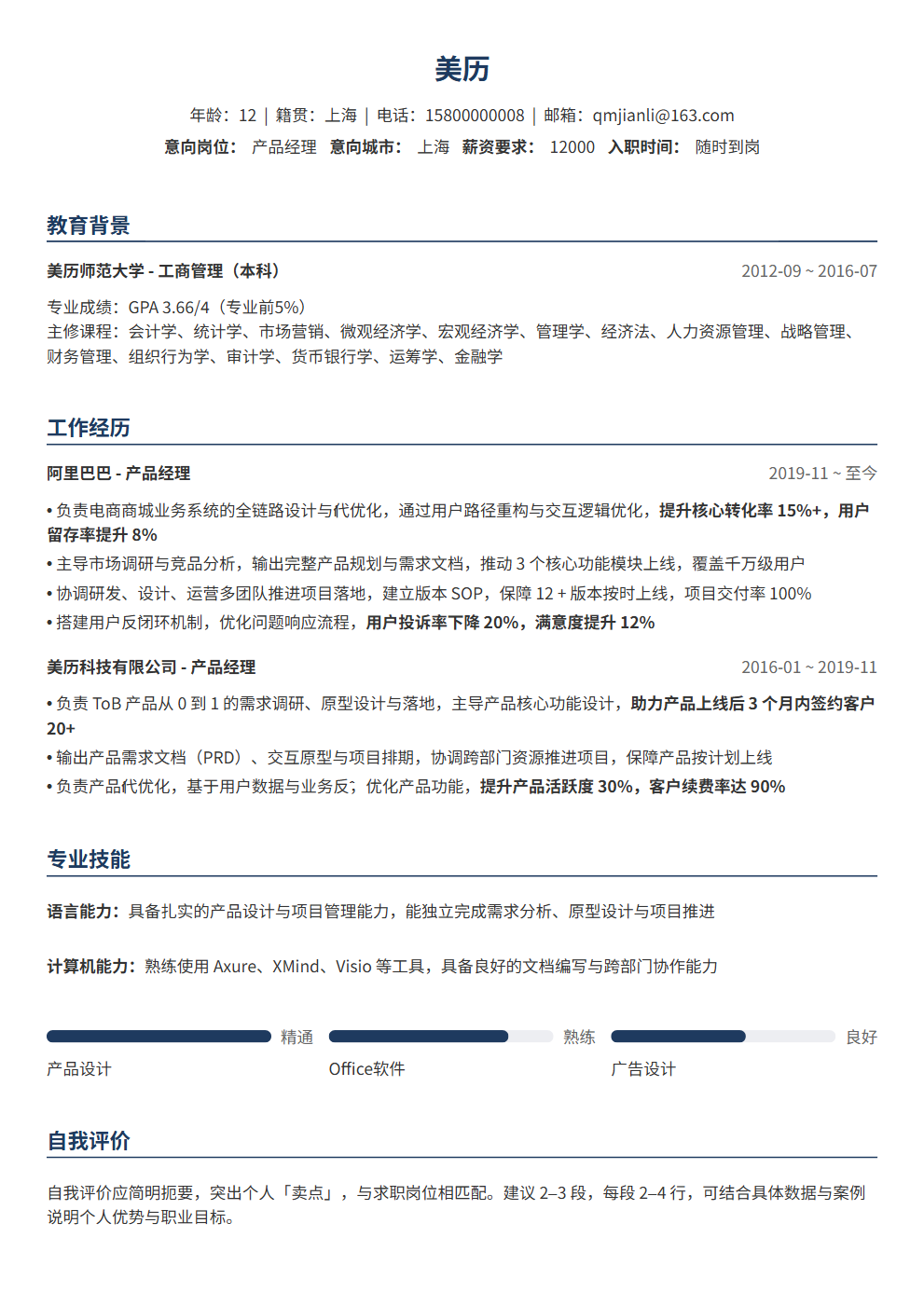
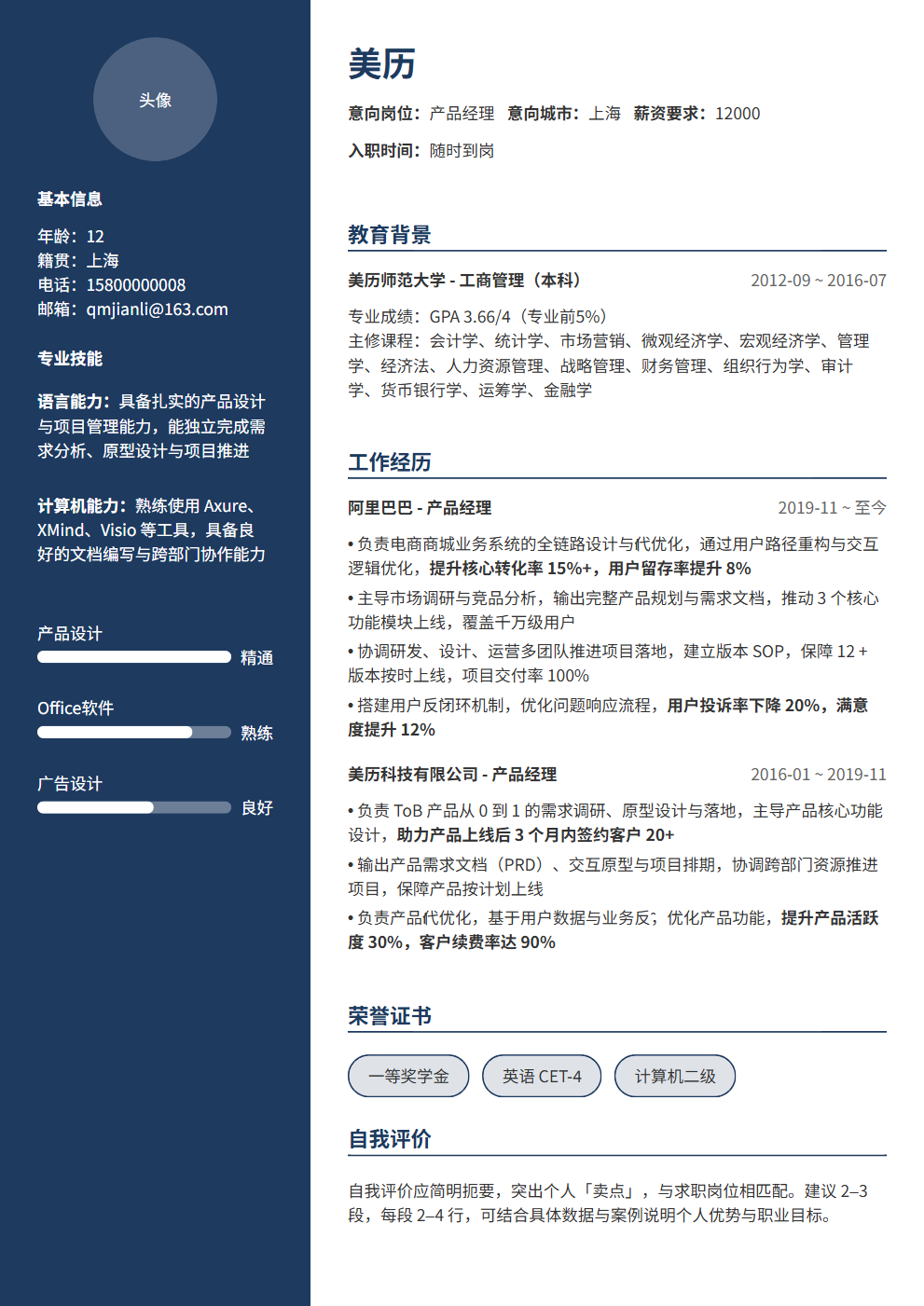
Efficient meetings start with efficient preparation. Use BeautyResume to clearly present your work achievements and professional capabilities—whether for meeting reports or professional presentations, organized content makes you more effective.