How to Do Workplace Retrospectives? 3 Frameworks for Rapid Growth from Every Experience
Doing a lot but not growing? 3 retrospective frameworks (KPT method, GRAI method, PDCA cycle) help you extract lessons from every experience, with templates for 3 scenarios and 3 retrospective principles, turning experience into real capability.
Do you ever feel this way—you've worked for several years, done many projects, experienced all sorts of things, but looking back, it seems like you haven't grown much? Where's the problem? It's not that you haven't done enough—it's that you haven't "extracted" lessons from what you've done. It's like eating without digesting—you swallow a lot, but your body doesn't absorb it, and it all passes through. Workplace retrospectives are the "digestion" process—they help you extract lessons, identify problems, and find improvement directions from every experience, turning experience into real capability. Today I'll share 3 retrospective frameworks to help you grow rapidly from every experience.
Why Doing a Lot Doesn't Lead to Growth?
Let's start with a harsh statistic: research shows that if you don't deliberately review and extract lessons from your work experience, less than 20% translates into actual capability improvement. In other words, out of 10 projects you've done, maybe only 2 projects' experience has truly been "absorbed"—the remaining 8 were just done, with nothing left behind.
- Experience ≠ capability: Experience is "I've done it"; capability is "I know how to do it." Doing 100 projects doesn't mean you'll know how to do the 101st—unless you've extracted transferable methodologies from each project. Retrospectives are the bridge from "experience" to "capability"
- Low-level repetition: Work without retrospectives is low-level repetition—you do the same things the same way and get the same results. You seem busy but are actually treading water. Retrospectives help you break out of repetition and find better approaches
- The forgetting curve: Human memory decays. One month after completing a project, you might only remember 30% of the details; after 3 months, maybe only 10%. If you don't review in time, valuable experience fades with time
- Attribution bias: People have a natural attribution bias toward their successes and failures—success means "I'm great," failure means "bad luck" or "someone held me back." Retrospectives help you objectively analyze causes rather than being self-congratulatory or self-defeating
Understanding why retrospectives are needed, next are 3 specific frameworks. Each has different emphases and applicable scenarios—you can choose based on your actual situation.
Framework 1: KPT Method—The Simplest and Most Practical Retrospective
The KPT method is the simplest, easiest-to-adopt retrospective method, suitable for quick reviews of daily work and small projects. KPT stands for: Keep, Problem, Try.
- Keep: What went well this time? Which approaches were effective? Which habits are worth maintaining? Don't skip this step—many people only focus on problems during retrospectives, overlooking what they did well. Acknowledging your successes lets you continue leveraging them next time
- Problem: What problems did you encounter this time? What didn't go well? Where did things go wrong? Note: describe objective facts here, not subjective judgments. "During the requirements review, developers raised 5 technical questions" is an objective fact; "the requirements were poorly written" is a subjective judgment
- Try: Based on the problems identified, what new approaches can you try next time? Note: Try isn't "be more careful next time"—it's a specific action plan. "Before the next requirements review, align with the tech lead on technical feasibility" is a specific action; "write requirements more carefully next time" is meaningless
KPT Method Steps:
- Step 1: Review objectives—what was the goal of this task/project? What were the expected outcomes?
- Step 2: Organize facts—what actually happened? Restore key events in chronological order
- Step 3: Fill in KPT—list 3-5 items each for Keep, Problem, and Try
- Step 4: Create action plan—select the 2-3 most important items from Try and create specific action plans (who does it, when, how)
For example: Marketing specialist Xiao Zhang did an online event and used KPT to review. Keep: the event poster design got lots of likes, community pre-promotion was effective; Problem: registration conversion rate was below expectations, the livestream lagged on event day; Try: simplify the registration page flow next time, do livestream stress testing in advance. All 3 Try items became improvements for the next event.
Framework 2: GRAI Method—The Most Systematic and In-Depth Retrospective
The GRAI method is more systematic and in-depth than KPT, suitable for deep reviews of medium-to-large projects or important experiences. GRAI stands for: Goal, Result, Analysis, Insight.
- Goal: What was the original goal? Why was this goal set? Was the goal reasonable? Many people skip this step and go straight to analyzing results—but if you don't even know the goal, how can you evaluate whether the result is good or bad? When reviewing goals, distinguish between "surface goals" and "real goals"—the surface goal might be "complete the project," the real goal might be "prove the team's capability through this project"
- Result: What was the actual result? Compared to the goal, what was achieved and what wasn't? Above or below expectations? Use quantitative data when evaluating results, not vague descriptions. "User growth of 30%" is more valuable than "user growth was decent." Also pay attention to "unexpected results"—some outcomes may not have been anticipated but could be more valuable than expected results
- Analysis: Why was it achieved/not achieved? What were the key success factors? What was the root cause of failure? Dig deep when analyzing—don't stop at surface causes. For example, "project delay" has the surface cause of "too many requirement changes," digging deeper it's "insufficient requirements review," deeper still it's "product manager didn't communicate enough with stakeholders," and even deeper it's "no established process for managing requirement changes"—finding the deepest cause lets you solve the problem at its root
- Insight: From this experience, what transferable patterns or methodologies can you extract? This is the most valuable part of retrospectives—abstracting universal patterns from specific experiences. For example, "too many requirement changes causing project delays" can be abstracted to "any project needs a change management process." The more abstract the pattern, the more transferable it is
GRAI Method Steps:
- Step 1: Goal—write down the project/task's initial goals and context
- Step 2: Result—present actual results with data, compare with goals
- Step 3: Analysis—use "5 Whys" to dig into root causes of success/failure
- Step 4: Insight—extract 3-5 transferable patterns or methodologies
- Step 5: Action—create follow-up action plans based on Insights
A real example: A tech team used GRAI to review after a system migration project. Goal: complete system migration in 2 weeks with zero downtime; Result: completed in 3 weeks with 2 hours of downtime; Analysis: after 5 Whys, the root cause was "insufficient gray release rehearsal"; Insight: any change involving production systems must be fully rehearsed in a gray environment first. This rule later became a team technical standard, and subsequent migration projects never had similar issues.
Framework 3: PDCA Cycle—The Most Continuously Effective Improvement Method
The PDCA cycle isn't a one-time retrospective method—it's a continuous improvement loop. It's suitable for work scenarios requiring iterative refinement—product iterations, process optimization, personal skill development, etc. PDCA stands for: Plan, Do, Check, Act.
- Plan: Set goals and action plans. The key is making plans specific—not "improve writing skills" but "write 500 words daily for 30 days, completing a 3,000-word article by month's end"
- Do: Execute according to plan while recording key information during execution. Don't pursue perfection while executing—start doing and discover problems in action rather than imagining them during planning
- Check: Compare execution results against the plan. What was achieved? What wasn't? Where are the gaps? The Check phase is the "retrospective" within PDCA—the difference is that PDCA's Check is periodic and continuous, not one-time
- Act: Based on Check findings, adjust plans or actions and enter the next PDCA cycle. Improvement isn't starting from scratch—it's optimizing on the existing foundation. Each small improvement, sustained over time, far exceeds one massive overhaul
The key to PDCA is "cycling"—it doesn't end after one round but continuously goes Plan→Do→Check→Act→Plan→Do→Check→Act... Each cycle is better than the last—this is the essence of "continuous improvement."
- PDCA rhythm: Determine cycle length based on work nature. Product iterations can use 2-week PDCA cycles, personal skill development can use 1-month cycles, process optimization can use quarterly cycles. Too long loses feedback timeliness; too short lacks sufficient data for judgment
- PDCA's compounding effect: A single PDCA cycle's improvement may be small, but 10 cycles stacked together produce amazing results. Assuming 5% improvement per cycle, after 10 cycles your capability/efficiency improves by 63%. This is the compound effect of continuous improvement
- Common PDCA mistakes: Only doing Plan and Do without Check and Act—same as not doing retrospectives; only looking at results during Check without analyzing causes—same as KPT with only Problem and no Try; changing actions during Act without changing plans—the same problems recur in the next cycle
For example: Content operator Xiao Li wanted to improve article readership using PDCA. Plan: publish 3 articles per week with A/B tested titles; Do: execute for 4 weeks; Check: Title A averaged 40% higher readership than Title B, but overall readership only improved 10%; Act: next cycle, summarize Title A's characteristics and apply to all article titles, while optimizing article opening paragraphs. After 4 PDCA cycles, average article readership improved by 120%.
3 Scenario Retrospective Templates
Different scenarios require different retrospective emphases. Here are templates for 3 most common scenarios that you can directly apply.
- Project retrospective template: 1. Project goal review (initial goals, key metrics, milestones) 2. Project result evaluation (actual results vs. goals, data comparison, highlights and shortcomings) 3. Process restoration (restore key decisions and turning points chronologically) 4. Cause analysis (success factors, failure root causes, dig deep with 5 Whys) 5. Experience extraction (3-5 transferable methodologies) 6. Improvement plan (specific action items, owners, deadlines)
- Communication retrospective template: 1. Communication goal review (what did you hope to achieve? What were the other party's needs?) 2. Communication result evaluation (what was achieved? What wasn't? How satisfied were both parties?) 3. Process analysis (which communication methods were effective? Which weren't? How did the other party react?) 4. Experience extraction (how should similar communications be handled next time?) 5. Follow-up actions (what needs follow-up? What are the improvement points for next communication?)
- Personal growth retrospective template: 1. Period goal review (what were your growth goals for this month/quarter?) 2. Achievement evaluation (what new skills did you learn? What new problems did you solve? What breakthroughs did you make?) 3. Method analysis (which learning methods were effective? Which weren't? Was time investment proportional to output?) 4. Direction adjustment (what should you focus on next period? What should you drop?) 5. Specific plan (next month/quarter's growth goals and action plan)
3 Principles of Retrospectives
Finally, regardless of which retrospective framework you use, there are 3 principles you must follow—violating any one makes the retrospective merely performative.
- Principle 1: Focus on issues, not people. The purpose of retrospectives is to "improve things," not to "assign blame." If retrospectives become criticism sessions, nobody will want to do them in the future. Use "why didn't this go well" instead of "why didn't you do this well"—the former focuses on the problem, the latter on the person. Focusing on problems finds solutions; focusing on people creates opposition
- Principle 2: Data-driven, not feeling-driven. "I think this event went well"—that's a feeling. "Event participation was 500, up 30% from last time, but conversion rate was only 2%, below the industry average of 5%"—that's data. Feelings are subjective and vague; data is objective and specific. Retrospectives must speak with data, otherwise they become self-comfort or self-denial
- Principle 3: Retrospectives must produce actions. A retrospective isn't "just summarize and move on"—it's "after summarizing, there must be specific improvement actions." If nothing changes after a retrospective, it's a waste of time. At the end of every retrospective report, there must be clear action items: who does it, when, how, and how to verify effectiveness. A retrospective without action items is just self-indulgence
Conclusion: Retrospectives Are the Only Path from Experience to Capability
Doing a lot without growing isn't because you're not working hard enough—it's because you're not doing retrospectives. The 3 frameworks—KPT for quick reviews, GRAI for deep reviews, PDCA for continuous improvement—you don't need to master all of them. Pick the one that best fits your current needs and start using it. What matters is starting, not finding the "perfect" method. The value of retrospectives isn't in the framework itself but in what you discover and change through them. When you build the habit of retrospecting, you'll find: every experience—whether success or failure—is nourishment for your growth. The question is whether you're willing to spend time "digesting" it.
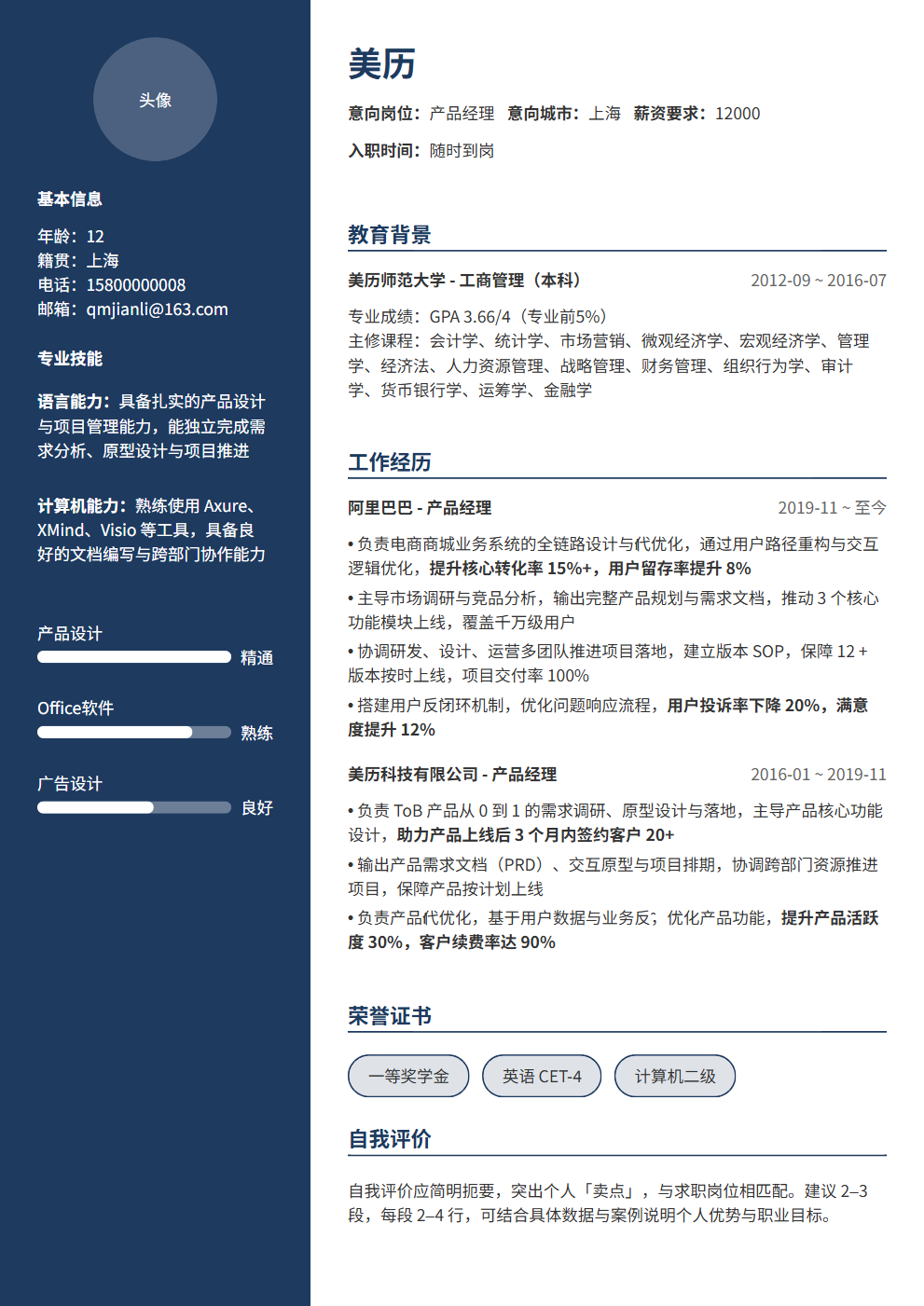
The first step in retrospectives is organizing your career experience. Use BeautyResume to clearly present each of your experiences and achievements—when you organize your experiences clearly, retrospectives have a solid foundation, and growth follows naturally.