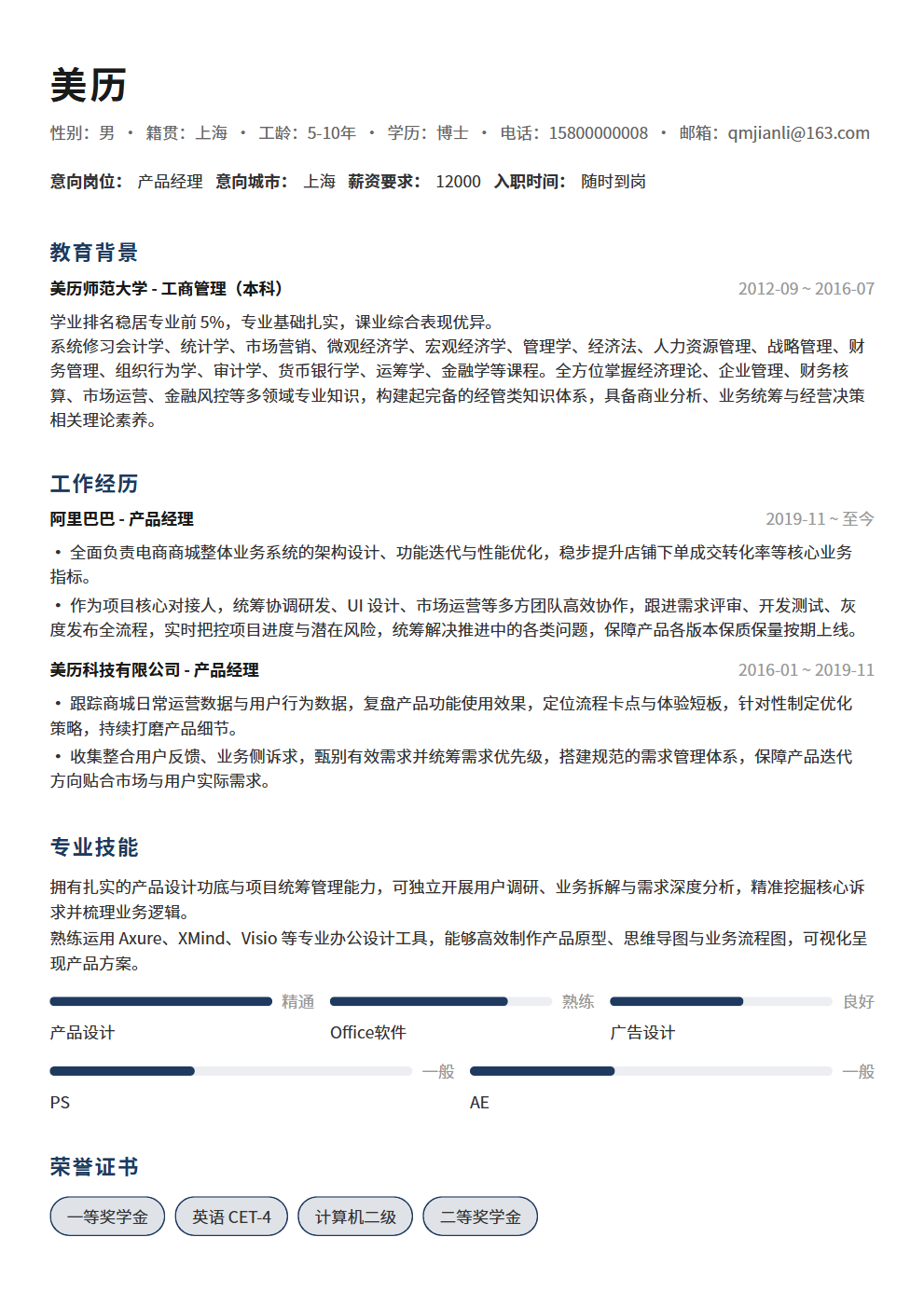
How Is a Job-Hopping Resume Different from a Fresh Graduate Resume? 5 Key Differences You Must Know
A job-hopping resume is fundamentally different from a fresh graduate resume—5 key differences: focus shifts from education to achievements, structure from timeline to competency-based, descriptions from responsibilities to results, self-evaluation from personality to value, and length from one page to flexible. Plus a resume restructuring template for experienced hires.
Many professionals with 3+ years of experience still write their job-hopping resumes like fresh graduates—filling pages with education details, listing coursework, and writing "cheerful personality" in self-evaluations. After sending dozens of resumes into the void, the root cause is clear: experienced-hire resumes and campus-hire resumes follow fundamentally different logic. This article breaks down 5 key differences to help you completely restructure your resume for job changes.
1. Focus Shifts from Education to Achievements—What HR Sees First Changes Everything
A fresh graduate resume's core selling point is "potential." Since you have no work achievements to showcase, HR can only gauge your capability ceiling through education, internships, and campus activities. Education goes first; GPA, scholarships, and competition awards all add value.
A job-hopping resume's core selling point is "achievements." What HR wants to see most is what results you delivered at your previous company and what value you created. Education is merely a baseline threshold, not a decision factor. A professional with 5 years of experience who still devotes the first page to school experiences signals to HR that they have nothing noteworthy to show from their career.
Specific Adjustments:
- Compress education to 2-3 lines: school, major, degree level. No courses, GPA, or clubs needed
- Place work experience before education—this is the golden rule for experienced-hire resumes
- Use data under each work experience: grew XX%, saved $XX, served XX users, improved XX efficiency
- If you graduated from a top school and have less than 3 years of experience, you can note the school next to your name as a supplementary signal
2. Structure Shifts from Timeline to Competency—Not a Chronicle but a Capability Matrix
Fresh graduate resumes are typically organized by timeline: education, internships, campus activities, skills and certifications. This structure works for campus recruiting because HR needs a quick overview of your complete background. But if an experienced-hire resume follows the same timeline format, it becomes a "career chronicle"—worked at Company A, then Company B, then Company C—with no clear picture of your core competencies.
A job-hopping resume should be organized by competency lines. First identify the 3-4 core competencies required by the target role, then categorize your experiences by competency, with each experience serving a capability label. This way, HR can immediately see "this person has the skills I need."
Specific Adjustments:
- Analyze the target role's job description first, extracting 3-4 core competency requirements (e.g., data analysis, project management, cross-functional collaboration)
- Use subheadings in your work experience to label competency dimensions, such as "Project Management: Led XX project, coordinated 5 departments, delivered 2 weeks ahead of schedule"
- Experiences demonstrating the same competency across different companies can be consolidated to reinforce depth
- Keep the timeline, but treat it as background information, not the organizing principle
3. Descriptions Shift from "Responsible For" to "Results Achieved"—The Most Critical Difference
This is the most fundamental difference between job-hopping and fresh graduate resumes, and where 90% of people stumble.
Writing "responsible for XX" on a fresh graduate resume is understandable—you were indeed in a learning and execution phase. But if an experienced-hire resume still reads "responsible for company social media operations," "responsible for client relationship maintenance," "responsible for team management," HR sees a list of job duties, not your value.
"Responsible for" is input; "results achieved" is output. HR pays for output, not input. Your job-hopping resume must answer one question: what results did your actions produce?
Specific Adjustments:
- Replace "responsible for" phrasing with the "action + result" formula: not "responsible for social media operations," but "built social media matrix, grew followers from 0 to 50K in 3 months, generating 200 conversion leads"
- Every experience entry should include at least one quantifiable result. If you lack direct metrics, use comparative data: before optimization XX, after optimization XX
- Avoid vague descriptions: "significantly improved," "substantially increased," "effectively enhanced"—adjectives without numbers are meaningless in experienced-hire resumes
- Results must connect to business value: not "completed XX task," but "completed XX task, saving the company $XX in costs / generating $XX in revenue"
4. Self-Evaluation Shifts from Personality to Value—Stop Writing "Cheerful Personality"
A fresh graduate resume's self-evaluation saying "cheerful personality, strong learning ability, team player" is marginally acceptable—HR understands that fresh graduates genuinely don't have much else to write. But putting this on an experienced-hire resume is a disaster.
A job-hopping resume's self-evaluation should be a "value proposition"—3-4 sentences summarizing the unique value you can bring to the target company. This isn't self-promotion; it's helping HR quickly assess your fit for the role.
Specific Adjustments:
- Use the "capability label + value promise" format: e.g., "8 years of B2B product experience, skilled at building product systems from 0 to 1, led 3 products from inception to commercialization"
- Highlight differentiation: What do you have that peers at your level don't? Industry-scarce experience, cross-domain composite skills, unique resources
- Align closely with the target role: self-evaluation isn't for you—it's for the target position. Adjust it for each different role you apply to
- Eliminate empty adjectives: replace "strong communication skills" with "led cross-functional collaboration across 6 departments, driving XX solution to implementation"
5. Length Shifts from One Page to Flexible—Don't Be Held Hostage by the "One-Page Rule"
Fresh graduate resumes must be one page because you don't have enough content—two pages would only expose the emptiness. But forcing an experienced-hire resume onto one page can cause you to lose critical information.
With 3-5 years of experience, 1-2 pages are both reasonable; with 5-10 years, 2 pages is standard; with 10+ years, 2-3 pages is acceptable. The key isn't page count but information density—every line must add value, with zero filler.
Specific Adjustments:
- Detail your 1-2 most recent work experiences (half a page to a full page each), and condense earlier experiences (2-3 lines each)
- Elaborate on experiences relevant to the target role; minimize or omit irrelevant ones
- Don't pad to fill two pages, and don't cut key achievements to squeeze onto one
- Optimize information density through formatting: use bullet points strategically, bold key terms, and maintain tight line spacing
6. Job-Hopping Resume Restructuring Template
Having understood the 5 differences, here's a ready-to-use structural template for your job-hopping resume:
- Header: Name | Phone | Email | Target Role (optional: alma mater, only if under 3 years of experience)
- Value Proposition (2-3 lines): Capability labels + years of experience + core achievements + differentiation advantage
- Work Experience (core section): Company name + role + dates → competency dimension subheadings → action + result descriptions (2-4 bullets each)
- Project Experience (optional): Project name + role → core challenge → solution → business outcome
- Education: School + major + degree + dates (2-3 lines, done)
- Skills/Certifications: Only include those directly relevant to the target role
Note: This template's order isn't fixed. If your most recent work experience is the most impressive, put it first; if your project outcomes outshine your work experience, move project experience up. Your resume's structure should serve your core selling points, not a rigid format.
7. Three Common Mistakes in Job-Hopping Resumes
- Mistake 1: Treating your resume like a work log. Listing what you did every day in chronological order shows HR busyness, not value. A resume doesn't record what you did—it proves what you're worth
- Mistake 2: Sending the same resume to every role. Experienced-hire positions vary widely. The same resume won't pass for both a product manager and a project manager. Spend 10 minutes adjusting focus for each application
- Mistake 3: Only changing company names. Many people simply swap the company name on their old resume and send it out—this is the laziest and most ineffective approach. Every job change warrants a complete review and restructuring of your resume
Conclusion
The fundamental difference between job-hopping and fresh graduate resumes is this: fresh graduate resumes prove potential; job-hopping resumes prove value. Focus shifts from education to achievements, structure from timeline to competency, descriptions from responsibilities to results, self-evaluation from personality to value, and length from one page to flexible—understanding these 5 differences puts your experienced-hire resume ahead of 80% of competitors. And to write a high-pass-rate job-hopping resume, you need a professional tool. Use BeautyResume's resume editor—smart formatting and industry templates let you focus on content without wasting time on layout, easily creating an experienced-hire resume that catches HR's eye.