From Grad School Rejection to Job Offer: A 3-Month Comeback Roadmap from Scratch
Grad school rejection isn't the end. This 3-month comeback roadmap helps you land an offer from scratch — Month 1: mindset reset, resume writing, direction setting; Month 2: mass applying, interview prep, skill building; Month 3: targeted applying, interview sprint, offer selection. Each stage includes a specific action checklist.
The moment you see your grad school exam results, your world might crumble. You spent an entire year preparing, skipped fall recruitment, turned down internships, and bet everything on that score line — and you didn't make it. Your classmates who passed are celebrating, others have already signed their employment contracts, and you're left empty-handed. What's worse, spring recruitment has already started, and you don't even have a resume. But here's what I want to tell you: grad school rejection isn't the end. Three months is enough time to land a solid offer from scratch. The key is — stop wasting time worrying and start taking action now.
Grad School Rejection Isn't the End — It's a New Beginning
Here's a harsh but true fact: over 3 million people fail grad school exams every year, and most of them eventually find jobs. You're not the first person to go through this, and you won't be the last. Failing the exam only means one thing — you didn't succeed on that particular path. It doesn't mean you'll fail in the workplace too. Many people actually find more suitable career directions after failing the exam, because the job search process forces you to think about what you really want to do, rather than just following the crowd.
- Exam failure doesn't mean you lack ability: grad school exams test test-taking skills and information advantages, while the workplace values execution and problem-solving — these are two completely different evaluation systems
- Your exam prep wasn't wasted: a year of studying developed your self-discipline, research skills, and stress tolerance — these are valuable soft skills you can leverage in interviews
- Spring recruitment has fewer positions but also fewer competitors: many students who didn't sign offers in fall have already gotten into grad school, so actual competition is less than you think
- Many companies reserve spring recruitment spots specifically for students who didn't pass grad school exams: especially large enterprises that know there's always a pool of talented students entering the job market after exam results
So the first step isn't editing your resume — it's adjusting your mindset. Give yourself 3 days to feel upset, to break down, to vent. Then tell yourself: starting tomorrow, I'm going to spend 3 months landing an offer that's just as good as what I could've gotten in fall recruitment.
Month 1: Mindset Reset + Resume Writing + Direction Setting
The first month is about building your foundation. The three core tasks are: shifting your identity from "exam failure" to "job seeker," writing a competitive resume, and determining your career direction. These seem simple, but many people get stuck at this stage — either trapped in the grief of failure, spending a week on a resume that's still not finalized, or wanting to apply for everything and ending up prepared for nothing.
- Mindset reset action items: delete all exam prep groups and apps to avoid seeing others' good news; set a fixed time daily to check job listings and build your "job seeker" identity; talk to friends who are already working to understand the real workplace and break the fear that "failing the exam means it's over"
- Resume writing action items: spend 3 days cataloging every experience from college — course projects, internships, competitions, clubs, volunteer work, part-time jobs, don't skip anything; describe each experience using the STAR method (Situation-Task-Action-Result); keep your resume to one page, highlighting experiences relevant to your target roles; ask 2-3 employed friends to review your resume — their perspective is closer to what HR sees
- Career direction action items: list 3 job directions you're interested in (no more than 3 — too many means no direction); read 5 job descriptions for each direction carefully to see if you meet basic requirements; talk to seniors working in these roles about real job content and career paths; choose 1 primary direction + 1 backup, and focus your preparation
- Month 1 daily schedule: 9am-12pm apply for jobs + browse listings, 2pm-5pm learn role-related skills, 7pm-9pm refine resume + prepare interview materials, 9pm-10pm review the day's progress
- Month 1 key metrics: resume finalized, at least 50 applications submitted, 1 primary career direction determined, 3 role-related skills learned
The biggest trap in Month 1 is perfectionism — your resume never feels good enough to submit, your direction never feels certain enough to start. Remember: done is better than perfect. Submit first, iterate later. Every resume you send out builds your experience and generates feedback.
Month 2: Mass Applying + Interview Prep + Skill Building
Month 2 is about intensive action. The three core tasks are: sending out lots of applications to get interview opportunities, systematically preparing for interviews, and strengthening skills based on interview feedback. You'll face many rejections at this stage, but each rejection brings you closer to an offer.
- Mass applying strategy: submit at least 10 applications per day, prioritizing roles that match your primary direction; don't only target big tech — mid-size companies and quality startups are great options too; use every channel — campus recruitment sites, Boss Zhipin, Lagou, Liepin, alumni referrals, professor recommendations; if no response after 3 days, follow up proactively to show your enthusiasm
- Interview prep action items: prepare 3 versions of your self-introduction (1 min/3 min/5 min) for different interview scenarios; organize 10 most common behavioral interview questions and write STAR-method answers; do mock interviews with friends, at least 3 times, 30+ minutes each; research target companies' business, products, and recent developments to show your understanding and thinking in interviews
- Skill building action items: based on JDs you've been applying to, list the most frequently mentioned skill requirements; prioritize learning skills that "always come up in interviews but you're not proficient in"; don't try to learn everything — focus on breaking through 2-3 core skills; learn by doing — building projects is 10x more effective than watching tutorials
- Interview review action items: immediately record interview questions and your answers after each interview; mark what you answered well and poorly; re-prepare answers for questions you struggled with; compile high-frequency questions into an "interview question bank" and practice repeatedly
- Month 2 key metrics: at least 200 applications submitted, at least 10 interview opportunities, 5 mock interviews completed, 2-3 core skills strengthened
The biggest trap in Month 2 is "waiting" — submitting your resume and waiting for a reply, finishing an interview and waiting for results. The right approach: keep applying after you apply, keep interviewing after you interview. Don't pin your hopes on one company. Keep 5-10 interview processes moving simultaneously to maintain your leverage.
Month 3: Targeted Applying + Interview Sprint + Offer Selection
Month 3 is the harvest stage. The three core tasks are: applying strategically based on the previous two months' feedback, going all-in on interviews, and making the optimal choice among multiple offers. By this stage, you should have interview experience and market understanding — you know where your competitive advantages and gaps are.
- Targeted applying strategy: adjust your resume and application strategy based on interview feedback from the past two months; focus on companies similar to those where you had high interview pass rates but haven't received offers yet; use referral channels to increase resume pass rates — ask alumni, seniors, and LinkedIn connections for referrals; watch for supplementary recruitment — many companies open additional spots in late spring
- Interview sprint strategy: for companies where you've reached final rounds, prepare thoroughly — research interviewers' backgrounds, prepare deep-dive questions, simulate challenging scenarios; demonstrate your learning ability and growth potential in interviews — quickly pivoting from exam failure to active job searching is itself proof of capability; prepare 3-5 thoughtful questions for the "do you have questions for us" segment to show your thinking about the company and role
- Offer selection strategy: don't just look at salary — consider 5 dimensions: compensation, growth potential, team culture, company prospects, commute distance; if you only have one offer, accept it first — it's always safer to have something than nothing; if you have multiple offers, create a comparison table, score each on 5 dimensions, and choose the highest total; don't choose a low-paying big tech role for "prestige," and don't choose a dead-end small company for "comfort"
- Contract signing notes: carefully read every clause in the employment agreement, especially regarding breach penalties, probation period length, and salary structure; confirm whether the offer salary is pre-tax or post-tax and whether it includes performance bonuses; clarify start date, probation evaluation criteria, and conversion conditions
- Month 3 key metrics: at least 2 offers received, offer comparison and selection completed, employment agreement or offer letter signed
The biggest trap in Month 3 is "settling" — getting one offer and rushing to sign, stopping all other interviews. The right approach: keep interviewing after getting an offer until you have 2-3 options before deciding. But also be mindful of timing — spring recruitment has a limited window, don't drag it out until you have nothing signed.
Action Checklists for Each Stage
Condensing the 3-month roadmap into 3 checklists — print them out and put them on your desk, checking off items daily.
- Month 1 checklist: □ Delete exam-related groups and apps □ Catalog all college experiences □ Write resume using STAR method □ Get 2-3 friends to review resume □ Determine 1 primary + 1 backup direction □ Submit 50 applications □ Learn 3 role-related skills □ Set up a job search tracking sheet
- Month 2 checklist: □ Submit 10 applications daily □ Prepare 3 versions of self-introduction □ Write answers for 10 behavioral questions □ Do 3 mock interviews □ Submit 200 applications □ Get 10 interview opportunities □ Strengthen 2-3 core skills □ Build interview question bank and review records
- Month 3 checklist: □ Adjust applying strategy for targeted submission □ Pursue referral opportunities □ Sprint on active interview processes □ Receive 2+ offers □ Create offer comparison table □ Sign employment agreement or offer letter □ Prepare onboarding materials
The purpose of checklists isn't to make you anxious — it's to give you clarity about what to do each day. The biggest danger after exam failure isn't lack of opportunity — it's wasting time in anxiety. With a checklist, you have direction; with direction, you have action; with action, an offer is just a matter of time.
Conclusion: 3-Month Comeback, From Exam Failure to a New Career Starting Point
Grad school rejection isn't the end of your life — it's the starting point of your career. Three months: Month 1 for mindset reset, resume writing, and direction setting; Month 2 for mass applying, interview prep, and skill building; Month 3 for targeted applying, interview sprint, and offer selection. Each step has a specific action checklist, and each step brings you closer to an offer. The key isn't where you start — it's that you start now. Stop wondering "what if I had passed the exam" and focus your energy on "what am I going to do in the next 3 months." Your future isn't determined by one exam — it's determined by every action you take from here on.
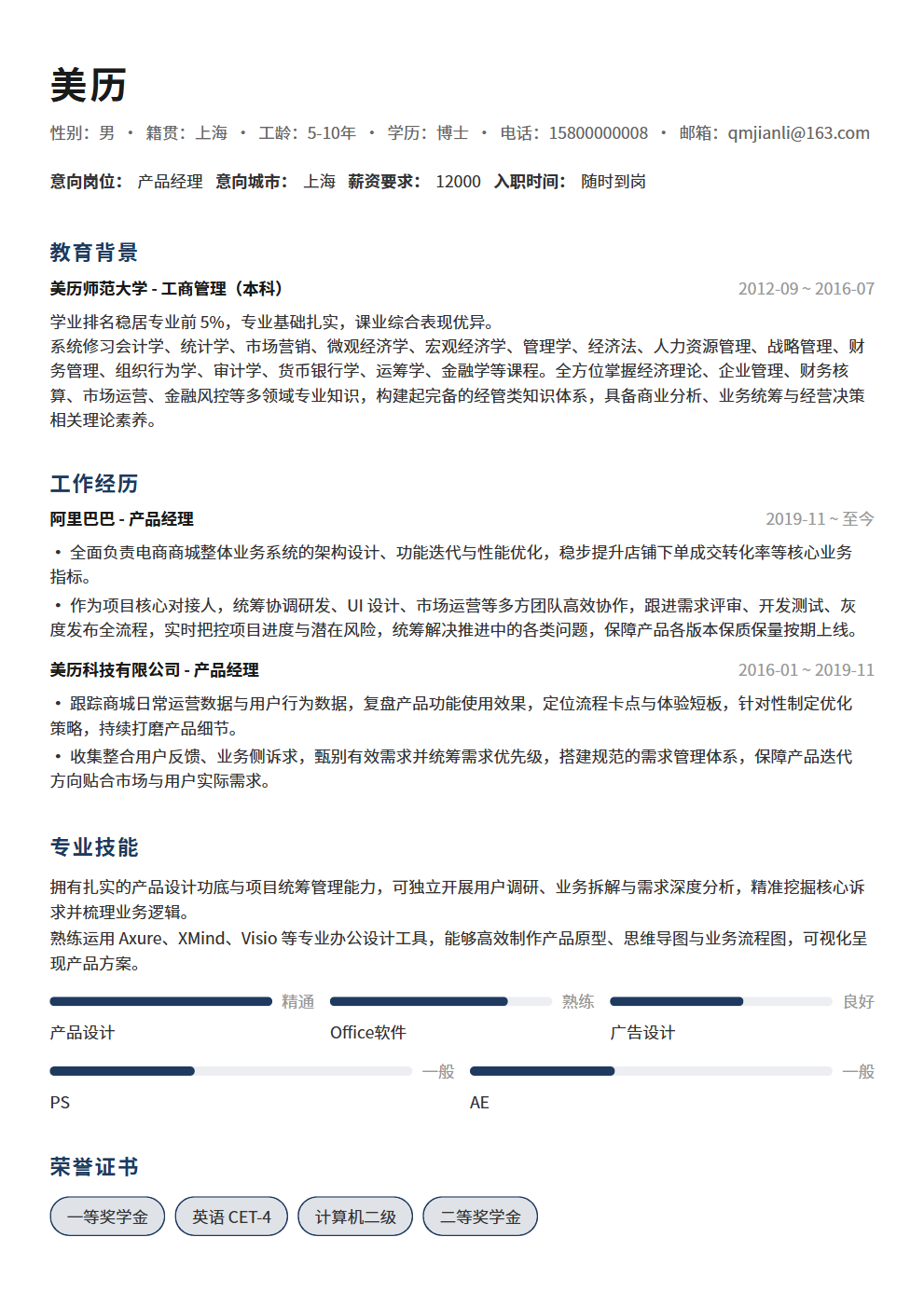
Start with your resume — use BeautyResume resume editor to quickly create a professional resume that showcases your experiences and strengths at a glance. Your 3-month comeback starts with this resume.