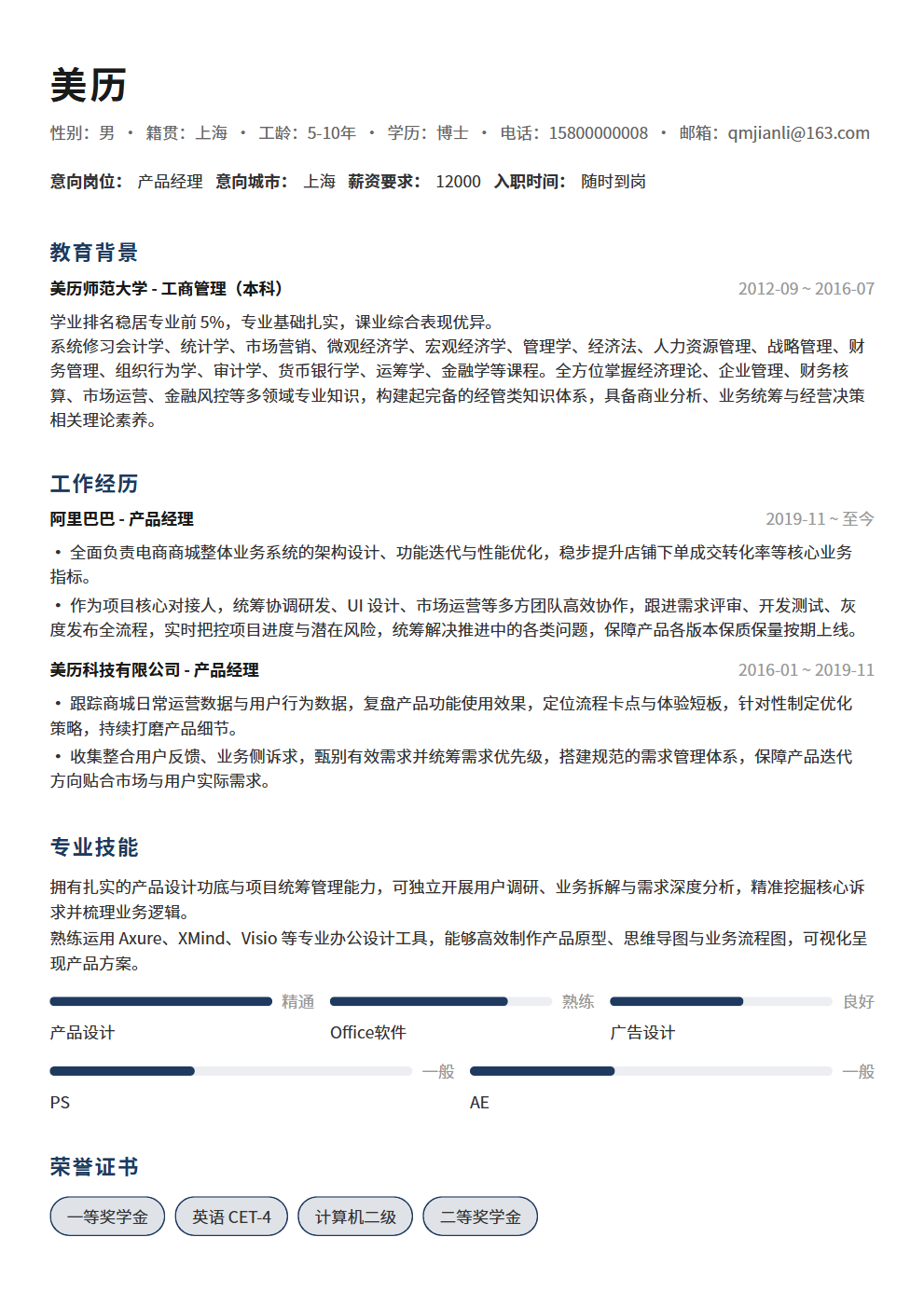
6 Core Differences Between Social Recruitment and Campus Recruitment Resumes: Stop Writing Social Recruitment Resumes with a Student Mindset
Still writing social recruitment resumes with a campus recruitment mindset years after graduation? 6 core differences between the two — education background placement, project vs work experience, skill description style, self-evaluation focus, resume length, and application strategy. Stop thinking like a student and write a competitive social recruitment resume.
You graduated 3 years ago, recently wanted to change jobs, opened your resume — and it's still the one from campus recruitment days. Education background comes first, 3 internship experiences listed, self-evaluation says "fast learner, diligent and responsible," skills section lists a bunch of course names. You think the content is fine, but after sending it out, you hear nothing back. Why? Because you're still writing a social recruitment resume with a campus recruitment mindset. Campus and social recruitment are completely different games — campus recruitment compares "potential," social recruitment compares "capability." Writing a social recruitment resume with a student mindset is like using a college essay formula to write a business proposal — wrong format, wrong content, and naturally wrong results.
Difference 1: Education Background Placement — Campus: First, Social: Last
During campus recruitment, your education background is your biggest selling point — prestigious school reputation, relevant major, excellent GPA, scholarships — these are the primary screening criteria for campus recruitment resumes. But in social recruitment, recruiters care more about your work experience and practical results; education background is just supplementary reference. If you've been graduated for 5 years and your resume still leads with education background, recruiters will think "you have nothing to say beyond your degree."
- Campus recruitment resume: Education background placed first, highlighting school, major, GPA, scholarships, academic achievements. For fresh graduates, education background is the first screening threshold — many large companies directly screen by school during campus recruitment
- Social recruitment resume: Education background placed last (or second to last), work experience placed first. After 3+ years of graduation, what recruiters care most about is "what you did and achieved at your previous company," not "which school you graduated from"
- Special case: If your school is very top-tier (Tsinghua/Peking/Fudan level) and you graduated recently (within 3 years), you can place education background second, right after your core personal tags. But if it's been over 5 years, even top schools should go toward the end
- In social recruitment resumes, education background writing should also be streamlined — no course lists, no GPA (unless exceptional and recently graduated). Just school, major, degree, and dates. Recruiters won't give you an interview because you took "Advanced Mathematics"
The shift in education background placement reflects a core logic change: during campus recruitment, you're a "blank slate," and recruiters judge your learning ability and potential through education; during social recruitment, you already have "work products," and recruiters judge your practical ability through work results. Having products but not looking at them, instead checking education — is as absurd as having box office data but still checking which school the director graduated from.
Difference 2: Project Experience vs. Work Experience — Campus: Projects, Social: Work
In campus recruitment resumes, "project experience" is the core module — course projects, competition projects, internship projects, graduation theses — these are all vehicles for showcasing your abilities. But in social recruitment resumes, "work experience" is the core — which company you worked at, what position you held, what business you were responsible for, what results you achieved. Project experience is just supplementary detail within work experience, not a standalone module.
- Campus recruitment resume: Project experience is the main body, with each project detailing your role, contributions, and results. Because fresh graduates lack formal work experience, projects are the only vehicle to demonstrate ability
- Social recruitment resume: Work experience is the main body, with each work experience presented in "company + position + dates + core achievements" format. Project experience can be integrated into work experience as specific cases but doesn't need to be a separate module
- Bad example: Social recruitment resume has a separate "project experience" module, pulling projects out of work context — recruiters see scattered project experience without systematic work capability
- Good example: Social recruitment resume describes core achievements in 2-3 bullet points under each work experience, naturally incorporating project information — "Led XX project, completed 0-to-1 launch within 3 months, DAU exceeded 100K, user retention rate 45%" — work results and project information integrated
- Campus resumes can include course projects, competition projects, personal projects; social recruitment resumes should only include real work projects — listing university course projects when you've been working for 3 years only exposes your lack of work experience
The shift from "project experience" to "work experience" is essentially a shift from "doing things" to "taking responsibility." During campus recruitment, recruiters look at "can you do things"; during social recruitment, they look at "can you take responsibility" — consistently producing results at a company proves your professional capability more than a few impressive projects.
Difference 3: Skill Description Style — Campus: List Tools, Social: Describe Capabilities
Campus recruitment resume skill sections typically look like this: "Proficient in Python, Java, SQL, Excel, SPSS, Tableau..." — listing tools and skill names like a menu. Social recruitment resume skill descriptions should be completely different — not "what tools I know" but "what problems I solved using what capabilities."
- Campus recruitment resume: Skills section lists mastered tools, languages, frameworks, software — because fresh graduates lack practical experience, recruiters need to assess knowledge reserves through skill lists
- Social recruitment resume: Skill descriptions integrated into work experience, using results to prove capability — "Built real-time data processing pipeline using Python+Spark, reducing data processing latency from 4 hours to 15 minutes" — 100 times more persuasive than simply writing "proficient in Python, Spark"
- Bad example: Social recruitment resume has a standalone skills section listing "Proficient in Office, Axure, Visio, XMind" — these are workplace basics, listing them is as redundant as writing "can use a computer"
- Good example: Social recruitment resume has no standalone skills section, or only lists 2-3 core professional skills (like "Expert in B2B product architecture design" or "Specialized in 0-to-1 product building"), with specific skills naturally reflected in work achievements
- Skill description upgrade logic: Campus is "I know A, B, C, D" (listing style), social is "I used A and B to solve C problem, achieving D result" (application style). The former proves you've studied it; the latter proves you've used it and used it well
The shift in skill description style reflects the transition from "knowledge reserves" to "capability application." Recruiters don't care how many tools you "know" — they care what problems you "can solve" using these tools. Tools are means; results are ends — social recruitment resumes should showcase the achievement of ends, not the accumulation of means.
Difference 4: Self-Evaluation Focus — Campus: Attitude, Social: Value
"I am outgoing, diligent, a fast learner, and a team player" — does this sound familiar? 90% of campus recruitment resume self-evaluations use this template. In campus recruitment, while this writing style isn't particularly impressive, it at least doesn't lose points — because recruiters know fresh graduates don't have much to write about. But in social recruitment, this kind of self-evaluation is negative — it tells recruiters you've been working for years and still can only write empty phrases.
- Campus recruitment resume self-evaluation: Emphasizes attitude and potential — "fast learner, works well under pressure, passionate about XX industry." While vague, at least shows a positive attitude
- Social recruitment resume self-evaluation: Emphasizes value and results — "8 years internet product experience, led 3 products with 10M+ DAU from 0 to 1, specialized in user growth and monetization, led 12-person team to achieve 120% annual revenue target." Summarize your core value in 3-4 sentences, each with specific information
- Bad example: Social recruitment resume self-evaluation reads "I am diligent and responsible, with good communication skills and team spirit, able to handle work pressure" — this statement works for any position's resume, with zero differentiation
- Good example: Social recruitment resume self-evaluation — "5 years B2B sales experience, cumulative contract value exceeding 200M, specialized in key account acquisition and long-term relationship maintenance, won company top sales award for 3 consecutive years." Each sentence is specific, verifiable, and differentiated
- Better approach: Social recruitment resumes can drop the "self-evaluation" module entirely, replacing it with "core strengths" or "career highlights" — list your most core competitiveness in 3-5 bullet points, each one sentence containing specific results or data
The shift from "attitude" to "value" in self-evaluation is essentially a shift from "what I'm willing to do" to "what value I can bring." During campus recruitment, recruiters are willing to train you, so attitude matters; during social recruitment, recruiters need you to produce immediately, so value is key.
Difference 5: Resume Length — Campus: One Page, Social: Up to Two Pages
"Resumes must be kept to one page" — you've definitely heard this rule. But it's only half right. Campus recruitment resumes should indeed be kept to one page — fresh graduates have limited experience, and one page is sufficient; writing two pages makes it look like you're padding. But social recruitment resumes, especially for professionals with 5+ years of experience, one page often isn't enough — cramming everything in only leads to information loss and actually reduces resume quality.
- Campus recruitment resume: Strictly one page. Fresh graduates have limited experience; one page is enough to showcase it. Exceeding one page suggests you can't filter for key points
- Social recruitment resume: 1-2 pages are both acceptable, depending on years of experience and richness of experience. 1-3 years: one page is sufficient; 3-5 years: 1.5 pages; 5+ years: two pages is reasonable
- Bad example: An 8-year professional's resume crammed into one page, font size reduced to 8pt, line spacing compressed to nearly nothing — recruiters strain to read it and can't see key information clearly
- Good example: An 8-year professional's resume using two pages, each work experience described with 3-4 bullet points for core achievements, clean layout with highlighted key points — comfortable to read, high information acquisition efficiency
- Key principle: Page count isn't the point — information density is. One page of garbage resume is worse than two pages of quality resume. But two pages doesn't mean you can pad — every line must have value; content without value must be firmly deleted
The change in resume length reflects the change in experience richness. During campus recruitment, you're a blank page — one page suffices; during social recruitment, you're a book — forcibly compressing it to one page only loses the best content. The key is: regardless of page count, every line must be worth the recruiter's time to read.
Difference 6: Application Strategy — Campus: Mass Apply, Social: Targeted Apply
During campus recruitment, many students adopt a "mass application" strategy — applying to 50 companies in one day, thinking more applications mean more opportunities. In campus recruitment, this strategy makes some sense — fresh graduates don't differ much in matching degree, and volume does increase interview chances. But social recruitment is completely different — the match between your experience and target position is core; mass applying only wastes your time and the recruiter's time.
- Campus recruitment applications: Moderate mass application is acceptable, especially during fall/spring recruitment seasons. Fresh graduates don't differ much, and application volume is an important means of getting interview opportunities
- Social recruitment applications: Targeted applications — carefully study the JD before each application, ensuring your experience highly matches the position requirements. Better to apply to 10 targeted positions than 100 random ones
- 3 steps for social recruitment applications: First, filter out 20-30 target positions (not 100); Second, customize your resume for each position (adjust experience emphasis and keywords); Third, if you have referral channels, prioritize referrals — social recruitment referral interview rates are 3-5x higher than regular applications
- Bad example: Applying to 50 companies in one day using the same resume — response rate under 3%, and wasting time interviewing at companies you don't want to join
- Good example: Carefully applying to 8-10 companies per week, with each resume customized — response rate over 30%, and all interview companies are ones you genuinely want to join
The shift in application strategy reflects the transition from "wide net casting" to "precision strikes." During campus recruitment, you're the one being chosen and need to increase exposure; during social recruitment, you have choosing power (or at least should) and need to improve matching. Targeted applications are not only more efficient but also help you perform better in interviews — because you're applying to companies you genuinely want to join, your enthusiasm and preparation level are completely different.
3 Signs of Student Mindset — Is Your Social Recruitment Resume Guilty?
Here are the 3 most common "student mindset" traits — if your social recruitment resume has any of them, fix it immediately.
- Sign 1: Using "participated in," "assisted with," "cooperated on" to describe work — these words suggest you were a supporting role, not a leading one. Social recruitment resumes should use "led," "was responsible for," "drove" to demonstrate your initiative and accountability. If you truly were in a supporting role, describe the specific work and results you handled in the project, rather than glossing over it with vague "participated"
- Sign 2: Writing "fast learner" in self-evaluation — this phrase is a negative in social recruitment resumes. It implies you don't have enough practical results to prove your ability and can only pad with "fast learner." If you truly learn fast, prove it with results — "Self-taught Python in 3 months and built an automated reporting system, reducing weekly report generation time from 4 hours to 10 minutes"
- Sign 3: Heavy use of adjectives instead of data in the resume — "significantly improved," "substantially grew," "effectively optimized" — these adjectives are completely unpersuasive in social recruitment resumes. Replace with data — "improved by 32%," "grew 3x," "reduced costs by 45% after optimization." Adjectives without data, like "fast learner," are products of student mindset
The core characteristics of student mindset: replacing "results" with "attitude," replacing "data" with "adjectives," replacing "leadership" with "participation." Fix these 3 traits and your social recruitment resume immediately levels up.
Conclusion: A Social Recruitment Resume Is a Professional's Business Card, Not a Student's Exam Paper
The 6 core differences between campus and social recruitment resumes — education background placement, project vs. work experience, skill description style, self-evaluation focus, resume length, and application strategy — all essentially point to the same transition: from "showcasing potential" to "showcasing capability," from "I'm willing" to "I can deliver," from "student mindset" to "professional mindset." You've been working for years — you're no longer a student who needs to prove yourself through education and attitude. You have practical experience, work results, and industry knowledge — these are your real competitive advantages. Stop writing social recruitment resumes with campus recruitment thinking; showcase professional value in a professional way.
Still using campus recruitment templates for social recruitment resumes? Use BeautyResume resume editor, select social recruitment exclusive templates, automatically optimize education background placement, work experience presentation, and visual hierarchy — transform your resume from "student vibe" to "professional style" in seconds, precisely matching social recruitment recruiters' reading habits.