Asked About Your Greatest Achievement Three Selection Approaches and Four Story Templates
Halfway through the interview, the interviewer smiles and drops that classic line: "Tell me about your greatest achievement." Your mind goes blank — What achievement?
Asked "What's Your Greatest Achievement" in an Interview? 3 Selection Strategies + 4 Storytelling Templates
Halfway through the interview, the interviewer smiles and drops that classic line: "Tell me about your greatest achievement." Your mind goes blank — What achievement? I just clock in, attend meetings, and write documents every day. My greatest achievement? Probably submitting my weekly report on time last month. Don't laugh — this is the real reaction of 90% of job seekers facing this question. You either can't think of anything, or what you come up with sounds too ordinary, or you ramble on while the interviewer zones out. The truth is, this question isn't testing how amazing you are — it's testing how well you tell a story. Today I'm giving you 3 selection strategies and 4 storytelling templates to make your answer both substantive and structured.
Why Is "Greatest Achievement" So Hard to Answer?
This question is hard not because you're not accomplished, but because you don't know how to "select" and "narrate." Most people's problems fall into two categories: first, poor selection — either choosing an achievement unrelated to the role, or one that sounds impressive but can't withstand follow-up questions; second, poor narration — either reciting facts like a laundry list, or bragging without logic, focus, or persuasiveness. When interviewers ask this question, they really want to see three things: your self-awareness (do you know your own value), your value system (what do you consider meaningful), and your communication ability (can you tell a story clearly). So, pick the right story and tell it well, and this question becomes your highlight moment.
Selection Strategy 1: Choose the Achievement Most Relevant to the Role
This is the most critical selection principle — the achievement you share should be directly related to the position you're interviewing for. The interviewer isn't listening to your personal hero biography; they're evaluating whether you can do this job. So your achievement should directly prove you possess the core competencies required for the target role.
- Example: If you're interviewing for a product manager role, "leading a team to build a product from scratch that reached 100K daily active users" is ten thousand times more useful than "winning a singing competition in college." The former proves your product skills; the latter only proves you can sing
- Example: If you're interviewing for a sales role, "exceeding quota for 3 consecutive quarters with a peak of 152%" is far more convincing than "organizing a successful team-building event." The former proves your sales ability; the latter only shows you're sociable
- Example: If you're interviewing for a technical role, "independently designing and implementing a solution that reduced system response time from 3 seconds to 200 milliseconds" impresses far more than "getting a PMP certification." The former proves your technical depth; the latter only shows you passed an exam
- How to do it: Carefully read the job description, identify 3-5 core competency requirements, then find achievements from your experience that best prove these capabilities. If the role requires "cross-functional coordination," share a successful cross-departmental collaboration story; if it requires "data analysis skills," tell a data-driven decision-making story
Remember, an interview isn't a talent show — it's a capability match. Every achievement you share should make the interviewer nod inwardly: "Yes, this person can definitely do this job."
Selection Strategy 2: Choose the Achievement That Best Showcases Your Core Competency
Sometimes you may have multiple achievements relevant to the role. How do you choose? The answer: pick the one that best demonstrates your core competency. Core competency isn't about how many skills you have — it's about your unique value that differentiates you from other candidates: your problem-solving ability, your ability to drive results, your persistence in the face of difficulty.
- Core competency ≠ hard skills. Hard skills are "I know Python" or "I know SQL"; core competency is "I can find optimal solutions with limited resources," "I can clarify thinking amid ambiguous requirements," "I can maintain quality output under high pressure"
- Example: For the same "completed XX project" achievement, you could emphasize "how I delivered 2 weeks early by optimizing processes despite being understaffed" (showcasing resource integration), or "how I persuaded 3 uncooperative departments to collaborate" (showcasing cross-departmental communication), or "how I maintained quality despite frequent requirement changes" (showcasing adaptability). Which angle you choose depends on what core competency you want to highlight
- Judging criterion: Ask yourself — "If I remove the core competency from this achievement, does the story still hold?" If not, you've chosen well. For example, "discovered an overlooked growth opportunity through data analysis, driving 30% revenue growth" — remove "data analysis" and the story falls apart, meaning your core competency is the key driver
Core competency is your "moat" in the workplace. Choose an achievement that best showcases this moat, and the interviewer will remember you.
Selection Strategy 3: Choose Achievements Backed by Data
Data is the best persuader. "Improved user experience" becomes far more compelling when you say "reduced user complaints by 40% through optimizing interaction flows" versus "users said it got better." Interviewers hear dozens of candidates tell stories every day — stories without data are like bodies without skeletons: limp and unable to stand.
- What kind of data works: absolute numbers ("served 5 million users"), relative numbers ("improved efficiency by 60%"), ranking numbers ("ranked #1 among 20 teams"), time numbers ("reduced launch time from 3 months to 1 month"). Different types suit different scenarios — absolute numbers show scale, relative numbers show improvement, ranking numbers show competitiveness, time numbers show efficiency
- Example: Weak — "I ran a campaign and it worked great." Strong — "I planned a user acquisition campaign that gained 20K users in 3 days, with acquisition cost 35% lower than regular channels, achieving an ROI of 8.2." The more specific the data, the more credible the story
- Example: Weak — "I optimized the process and everyone found it more convenient." Strong — "I redesigned the approval process, reducing average approval cycle from 7 days to 2 days, and improving department satisfaction from 3.2 to 4.5 out of 5." There's comparison, data, and results
- Note: Data must be real and verifiable. The interviewer might ask "how was this number calculated?" If you can't explain it, it actually hurts your credibility. Only use data whose origins you thoroughly understand
Data is the "evidence" for your achievement story. A story without evidence is just self-talk. Pair each achievement with at least one key data point, and your answer instantly upgrades from "seems good" to "genuinely impressive."
Storytelling Template 1: STAR Narrative — The Classic Structure
STAR is the golden framework for interview answers, applicable to nearly all behavioral questions. Its logic: Situation → Task → Action → Result. Using STAR to tell your achievement gives the story a clear beginning, middle, and end that the interviewer can easily follow.
- Situation: Use 1-2 sentences to set the context. "The company was preparing to enter the Southeast Asian market, but we had zero brand recognition there, and competitors already held 70% market share"
- Task: One sentence stating your goal or challenge. "My task was to increase brand awareness from 0 to 20% and acquire the first 1,000 seed users within 3 months"
- Action: This is the main part — 60% of your answer. Describe in detail what you did, how you did it, and why. "I did three things: First, I researched local users' social media habits and found they primarily used Line and Facebook; Second, I designed culturally appropriate marketing content and partnered with 5 local KOLs; Third, I built a user referral mechanism where existing users could earn discounts by inviting new users. The biggest challenge was that KOL quotes exceeded our budget by 30% — I negotiated long-term partnership deals with performance-based revenue sharing to keep costs within budget"
- Result: Use data to demonstrate outcomes. "After 3 months, brand awareness reached 23%, exceeding the target by 15%; we acquired 1,800 seed users, 80% above target; acquisition cost was 25% below industry average. This case later became the company's standard template for Southeast Asian market expansion"
The key to STAR: Action should dominate, because interviewers most want to hear what you did; Results need data, because data best proves your achievement. A common mistake is spending too much time on Situation and too little on Action — remember the ratio: 2:1:6:1.
Storytelling Template 2: Challenge-Breakthrough Narrative — The Most Dramatic Structure
The challenge-breakthrough narrative suits "comeback" achievement stories. Its logic: first describe a seemingly impossible challenge, then how you broke through, and finally the results. This narrative has natural dramatic tension that draws the interviewer in.
- Step 1: Describe the challenge — "Things were harder than expected." Example: "Two weeks after the project launched, the core developer suddenly quit, leaving behind undocumented code. Worse, the client required delivery of the first version in 2 weeks or they'd cancel the contract. No one on the team understood that module's logic, and I'd just joined as project lead and hadn't even fully familiarized myself with the codebase"
- Step 2: Describe the breakthrough — "How I solved it step by step." Example: "I did three things: First, I spent an all-nighter梳理ing the departed colleague's code logic and drew flowcharts for the core modules; Second, I found a frontend engineer who'd previously collaborated with him and spent 2 hours understanding the API design approach; Third, I re-planned the project schedule, deferring non-core features to version 2 to ensure version 1 would be delivered on time. The hardest part was convincing the client to accept feature cuts — I prepared a detailed feature priority analysis proving the cut features wouldn't affect core business processes, and the client ultimately agreed"
- Step 3: Describe the results — "What happened in the end." Example: "Version 1 was delivered on time and passed client acceptance. Over the next 3 months, all features were completed, and the client renewed for a second phase with a 40% larger contract. This project was later named the department's best project of the year"
The appeal of challenge-breakthrough narrative: the bigger the challenge, the more impressive the breakthrough. But note — the challenge must be real, not exaggerated; the breakthrough must come from your own effort, not luck or others' help; the results must be quantifiable, not just "it went okay."
Storytelling Template 3: Team Collaboration Narrative — Showcasing Soft Skills
Not all achievements are solo heroics — many are the result of team collaboration. The focus of team collaboration narrative isn't "what I did" but "how I enabled the team to achieve something." This narrative is especially suited for management positions and roles requiring cross-departmental coordination.
- Step 1: Describe the team's shared challenge — "What problem was the team facing." Example: "The company decided to launch a new SaaS product within 3 months, but the design, development, and operations teams were working in silos. The requirements document had gone through 7 revisions without being finalized, and development progress was severely behind"
- Step 2: Describe your role and contribution — "What I did for the team." Example: "I took on the cross-team coordination role: First, I organized a joint workshop across all three teams, finalizing the requirements document in just 2 revisions instead of 7; Second, I established a daily 15-minute standup mechanism for transparent information flow; Third, I designed a shared project board where everyone could see real-time progress and blockers"
- Step 3: Describe the team's results — "What we achieved together." Example: "The product launched one week ahead of schedule, gaining 2,000 paid users in the first month with a 4.7 customer satisfaction score. More importantly, this collaboration model was adopted by the company for other project teams and became the standard project management process"
The key to team collaboration narrative: your contribution must be clear — not "we did something" but "because of my specific action, the team was able to achieve something." The interviewer wants to see your unique value within the team, not a vague "we."
Storytelling Template 4: Zero-to-One Narrative — Showcasing Entrepreneurial Spirit
The zero-to-one narrative suits "pioneering" achievements — things you did that no one had done before, or results you built from scratch in a blank area. This narrative is especially suited for startups, new business lines, and internal innovation projects.
- Step 1: Describe the "zero" state — "There was nothing before." Example: "The company had no data platform at all — each business line operated independently with severe data silos. Producing a cross-business-line analysis report required 3 people spending 2 weeks manually aggregating data"
- Step 2: Describe how "one" came about — "How I built it from nothing." Example: "I spent 2 weeks researching the data needs of 5 business lines and designed a unified data warehouse architecture; then I spent 3 months building the data platform from scratch, including 4 modules: data collection, cleaning, storage, and analysis. Along the way, I self-taught the Airflow scheduling framework to solve data dependency management issues"
- Step 3: Describe what "one" brought — "The value of this zero-to-one result." Example: "After the data platform launched, cross-business-line analysis reports went from 2 weeks to 2 hours — a 98% efficiency improvement; data accuracy rose from 85% to 99.5%; within 6 months, it supported 12 business decisions, directly contributing approximately 8 million yuan in revenue growth"
The core of zero-to-one narrative: emphasize the contrast between "nothing before" and "something after," letting the interviewer feel your pioneering capability. Also highlight the difficulties you overcame in the zero-to-one process — because the hardest part of going from zero to one isn't doing things, but finding direction when there is none.
3 Pitfalls to Avoid
With the right selection and template, there are still 3 pitfalls you absolutely must not step into.
- Pitfall 1: Don't choose overly personal achievements. "My greatest achievement is getting married / having a child / running a marathon" — these are indeed major life achievements, but the interviewer doesn't care. Interviews are professional settings; your achievements should be career-related. Unless you can connect personal achievements to professional capabilities, like "running a marathon taught me persistence and planning, qualities that also show up in my work"
- Pitfall 2: Don't just state results without process. "My greatest achievement is leading the team to complete the XX project with 50% revenue growth" — and then? The interviewer wants to hear not just the result, but how you achieved it. An achievement without process is like a dish without a recipe — people only know it's good but not how to make it. Process is where you demonstrate your capabilities
- Pitfall 3: Don't put others down to elevate yourself. "My greatest achievement was saving a failing project because the previous lead was terrible" — this only makes the interviewer think you lack team spirit and professionalism. When sharing achievements, focus on what you did, not what others did wrong. If you must mention others' shortcomings, use neutral language: "The project was behind schedule" is infinitely better than "the previous lead was incompetent"
Conclusion: Pick the Right Story, Tell It Well, and the Achievement Question Becomes Your Highlight
Being asked about your greatest achievement isn't testing how amazing you are — it's testing whether you can pick the right story and tell it well. 3 selection strategies help you choose the most impressive story: pick what's most relevant to the role, what best showcases your core competency, and what's backed by data. 4 storytelling templates help you narrate with logic and persuasiveness: STAR narrative for most scenarios, challenge-breakthrough for comebacks, team collaboration for soft skills, and zero-to-one for pioneering ability. Remember, achievements aren't about size — they're about whether you can make the interviewer feel your value. Pick the right story, use the right template, and this question becomes your shining moment in the interview.
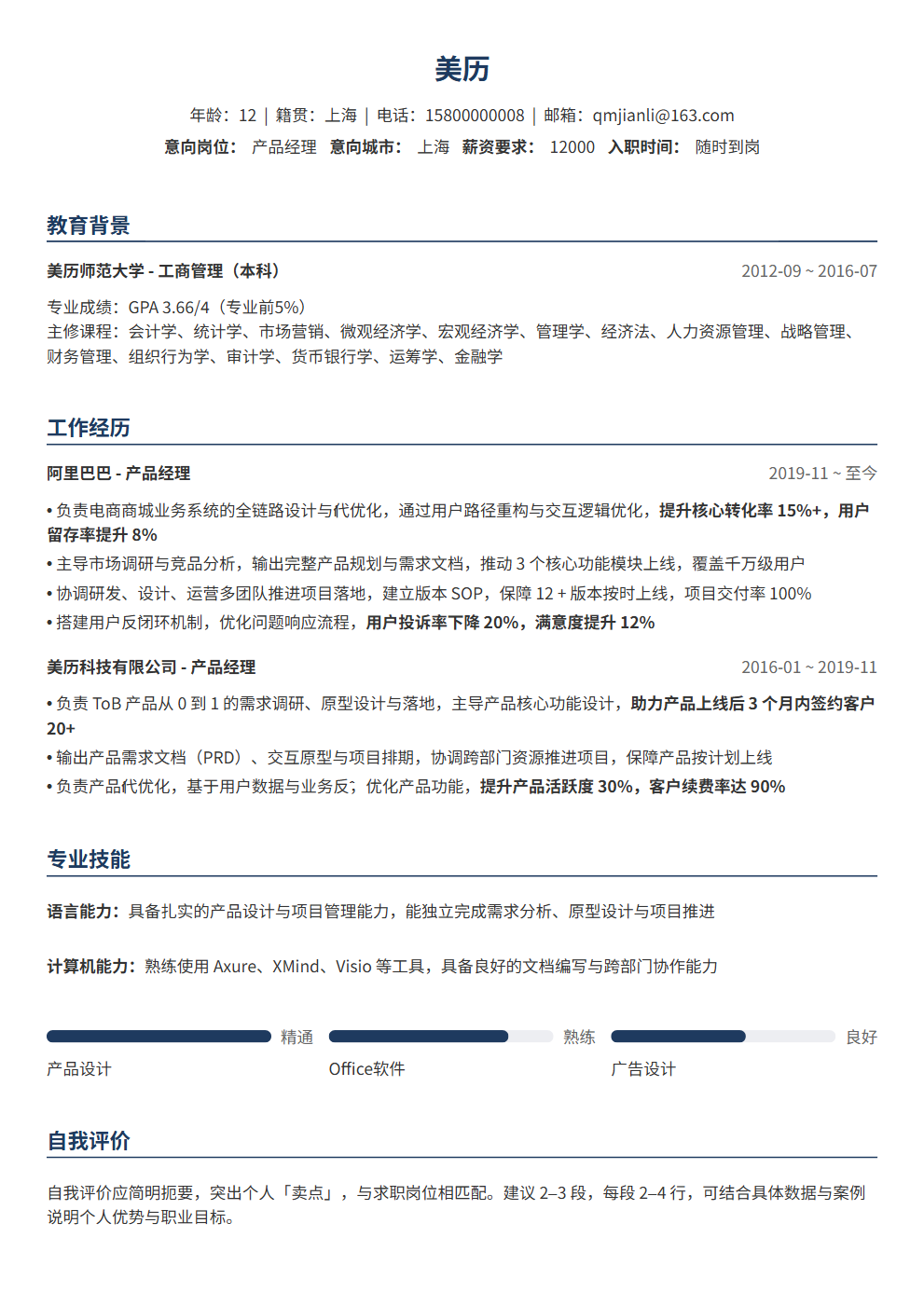
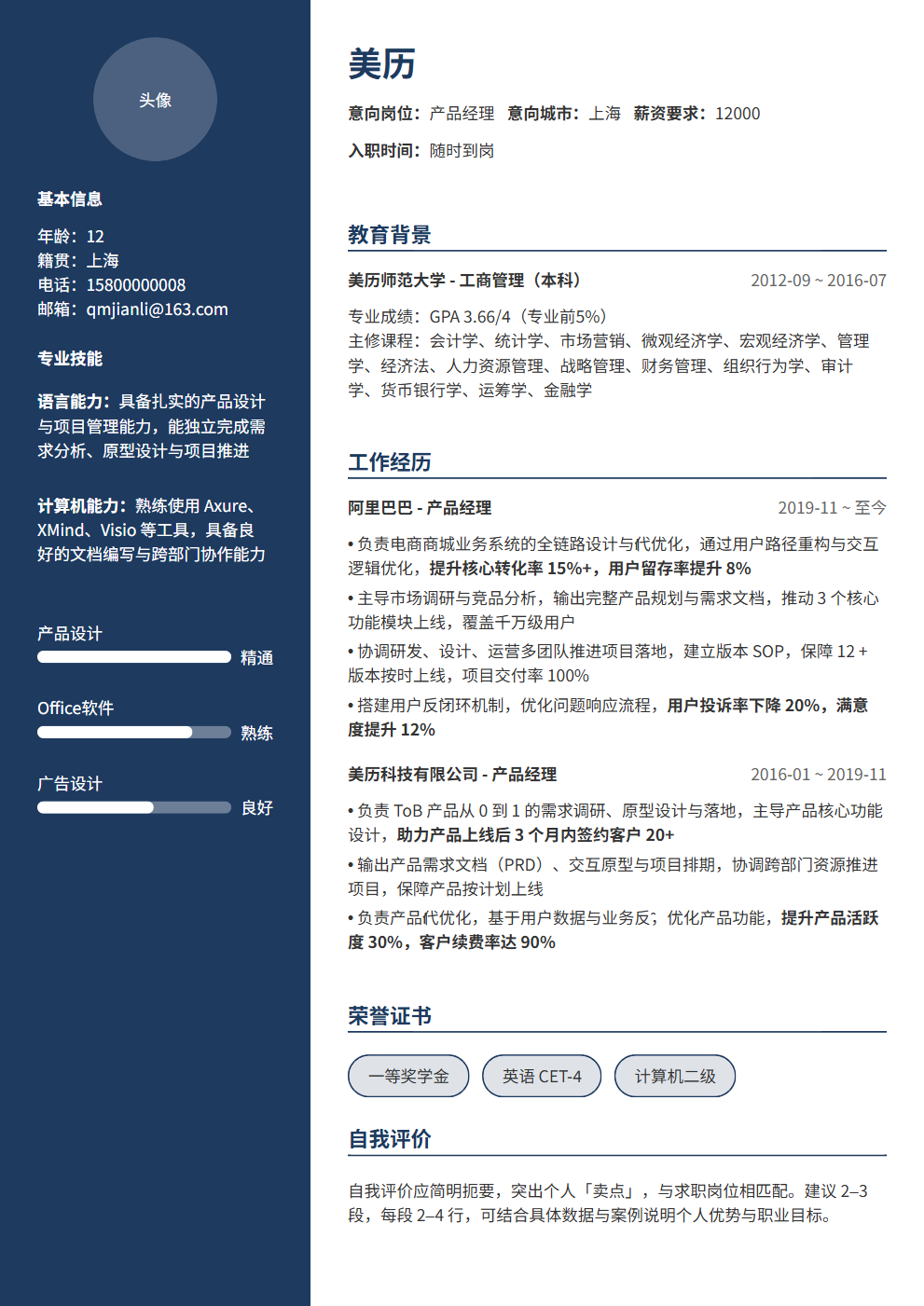
The most important preparation before an interview is your achievement story — and a professional resume is the condensed version of that story. Use BeautyResume resume editor to present your achievements with data and logic, so interviewers are impressed by your capabilities even before meeting you.