1000 Applicants for One Position: How Does Your Resume Stand Out? 5 Differentiation Strategies
In the era of fierce job competition, a single position can attract 1000+ applicants. How does your resume stand out? 5 differentiation strategies — tell stories with data, put your best achievements in the first 3 lines, customize for each position, add industry insights, and use visual hierarchy to guide the recruiter's eyes.
You submitted a resume and thought it was pretty good. Then you check the data — this position received 1000 resumes. Your resume is mixed in with 1000 similar documents, and recruiters spend an average of 6 seconds on each one. In 6 seconds, what can they see? Only things that are "different." And how is your resume different from the other 999? If the answer is "not really different," then you know why you've sent 50 resumes and only got 2 interviews. Job market saturation isn't about you not being good enough — it's about you not being "different enough." In a sea of identical resumes, differentiation is your life preserver.
Strategy 1: Tell Stories with Data, Not Lists of Responsibilities
90% of resumes list responsibilities: "Responsible for company social media operations," "Responsible for team management," "Responsible for client development." What's wrong with these descriptions? They tell recruiters what you "did," not what you "achieved." Responsibilities belong in a job description; results are your personal value. Telling stories with data means transforming "what I did" into "what I achieved" — using specific numbers, comparisons, and outcomes to present your contributions.
- Bad example: "Responsible for company WeChat account operations, regularly publishing content, improving fan engagement rate" — this statement could appear on any social media operator's resume, with zero differentiation
- Good example: "Independently managed company WeChat account, growing followers from 12K to 58K in 6 months, increasing average article reads from 800 to 4,200, with a single article reaching 120K+ reads, reducing customer acquisition cost by 37%" — data makes achievements immediately clear
- Three dimensions of data storytelling: absolute values (how much it grew), relative values (what percentage improvement), comparative values (what's the industry average, how much did you exceed). Among these, comparative values are most persuasive — "92% customer retention rate vs. 75% industry average" is more impactful than simply stating "92% customer retention rate"
- No data available? Recall your work achievements — estimated values work too. "Reduced customer complaint response time from an average of 4 hours to under 1 hour" is still 100 times better than "responsible for handling customer complaints," even if not precisely tracked
- More data isn't always better — select 2-3 most impressive data points per work experience. Piling on numbers makes it hard to grasp key points
The essence of telling stories with data: let recruiters "see" your capabilities rather than "guess" them. Data is the most objective proof of ability — more persuasive than any self-evaluation.
Strategy 2: Put Your Most Impressive Achievements in the First 3 Lines
Recruiters' eye-tracking patterns follow a "Z" shape — from top-left to top-right, then from middle-left to middle-right, and finally a quick scan of the bottom. This means the top 3 lines of your resume determine whether recruiters continue reading. If your resume opens with "Name: Zhang San | Phone: 138xxxx | Email: xxx@xxx.com," the recruiter's 6 seconds have already wasted 2 seconds on useless information. What should the first 3 lines contain? Your most impressive achievements — letting recruiters know in one second that "this person is impressive."
- Bad example: Resume opens with basic personal info + job objective + self-evaluation — after reading the first three lines, the recruiter only knows your name, what you want to do, and that you think you're good — nothing memorable
- Good example: Resume opens with — "5 years B2B product experience | Led 3 products from 0 to 1 worth 10M+ | 200%+ user growth | Company's Best Product Manager of the Year" — the recruiter knows in 3 lines this is a seasoned PM with proven results
- Formula for the first 3 lines: years of experience + core domain + most impressive achievement. For example: "8 years Java backend development | Led restructuring of 5M DAU system | 10x QPS improvement" — all your core competitiveness in 3 lines
- Fresh graduate with no work achievements? Use internship results, project outcomes, competition awards instead — "Computer Science Top 5% | ACM Regional Gold Medal | Independently developed 3 launched products with 100K+ cumulative users"
- The first 3 lines are not an upgraded self-evaluation — don't write empty phrases like "diligent, responsible, fast learner." Only include objective, verifiable achievements
The logic of the first 3 lines: place the most valuable information where the recruiter's attention is most concentrated. Like a news headline and lead — if the first 3 lines can't grab attention, no one will read the rest, no matter how good it is.
Strategy 3: Customize for Each Position, Not Mass-Apply One Resume
Mass-applying is the least efficient job search method — using the same resume for 100 positions might yield less than 5% response rate. But if you customize your resume for each position, applying to just 20 positions could yield over 50% response rate. Why? Because every position's JD (job description) is different, and recruiters look for the "best match," not the "most outstanding candidate." Your resume needs to tell recruiters not "I'm excellent" but "I'm a great match."
- Bad example: Applying for product manager, project manager, and operations manager positions using the same resume — recruiters think you want to do everything but excel at nothing
- Good example: When applying for a product manager role, highlight 0-to-1 product experience, user growth data, and requirements analysis methodology; when applying for a project manager role, highlight project delivery outcomes, cross-departmental coordination skills, and risk management cases — same experiences, different presentations
- 3 steps to customize: First, carefully read the JD and highlight keywords (words that appear repeatedly in job requirements are keywords); Second, prioritize and strengthen the parts of your experience that match the keywords; Third, remove or downplay experiences unrelated to the position
- Customization ≠ fabrication. Customization is "selective presentation," not "making things up." Things you actually did — just adjusting the emphasis and order based on the position's needs
- Efficient customization method: Prepare an "experience asset library" with all work experiences organized in "achievement + data + method" format. When applying, select the most matching experiences from the library based on the JD to compose a customized resume. This way, each customization takes only 15-20 minutes instead of rewriting from scratch
The essence of position customization: make recruiters feel this resume was "tailor-made for this position," not "mass-mailed." When a recruiter sees a highly matching resume, they immediately feel "this is the one" — this sense of match is the most powerful weapon in differentiated competition.
Strategy 4: Add Industry Insights to Demonstrate Professional Depth
Most resumes only show "what was done," some show "what was achieved," and very few show "what was thought." And "what was thought" — your insights and thinking about the industry — is precisely the differentiation capability most valued for senior positions. Someone who can only execute and someone who can think have completely different values in a recruiter's eyes. Adding industry insights to your resume tells the recruiter: I'm not just an executor, I'm a thinker.
- Bad example: Resume contains only work content and results, without any analysis or thinking about industry trends, business logic, or methodology — the recruiter sees you as a "doer" but isn't sure you have deep thinking capability
- Good example: Adding an "insight" section within project experience — "Based on deep analysis of lower-tier market user behavior, discovered why traditional acquisition models fail in tier-3/4 cities, proposed 'community viral growth + localized content' new acquisition strategy, reducing pilot city acquisition cost by 52%" — this description showcases not just results but also the thinking process and industry understanding
- Three ways to present industry insights: First, add "strategic thinking" or "methodology" descriptions within project experience to show how you analyze problems and formulate strategies; Second, add "industry understanding" in the skills section, listing your understanding of industry trends and competitive landscape; Third, use one paragraph in self-evaluation to summarize your industry insights rather than generic self-praise
- Industry insights are not "I think" style empty talk, but data- and experience-based judgments — "Based on 3 years of education industry operations experience, observed that 'parent word-of-mouth' weight in K12 user decision-making chain increased from 30% to 55%, therefore increased investment in parent communities in operations strategy" — with data, observation, and action
- Note on balance: Keep industry insights brief — don't write a mini-essay in your resume. 1-2 sentences of insight are more powerful than a long analysis — a resume is a showcase window, not a thesis defense
The value of adding industry insights: it lets recruiters see not just your "past" (what you've done) but also your "future" (what you can think of). Someone with industry insights can also demonstrate deeper thinking in interviews — the resume is just the first step; insight is a core competitiveness that runs through the entire job search process.
Strategy 5: Use Visual Hierarchy to Guide the Recruiter's Eyes
Have you ever thought about the order in which recruiters read resumes? It's not "top to bottom, word by word" — it's "scan for key points." If your resume is a dense wall of text, the recruiter's eyes have nowhere to land, and they end up missing all the key points. But if your resume has clear visual hierarchy — prominent headings, highlighted key points, clear structure — the recruiter's eyes will naturally be guided to the information you most want them to see. Visual hierarchy isn't "fancy design" — it's "efficient information delivery."
- Bad example: Entire resume uses the same font, same size, same color, no spacing between paragraphs, key and secondary information mixed together — the recruiter gets a headache after 3 seconds and skips it
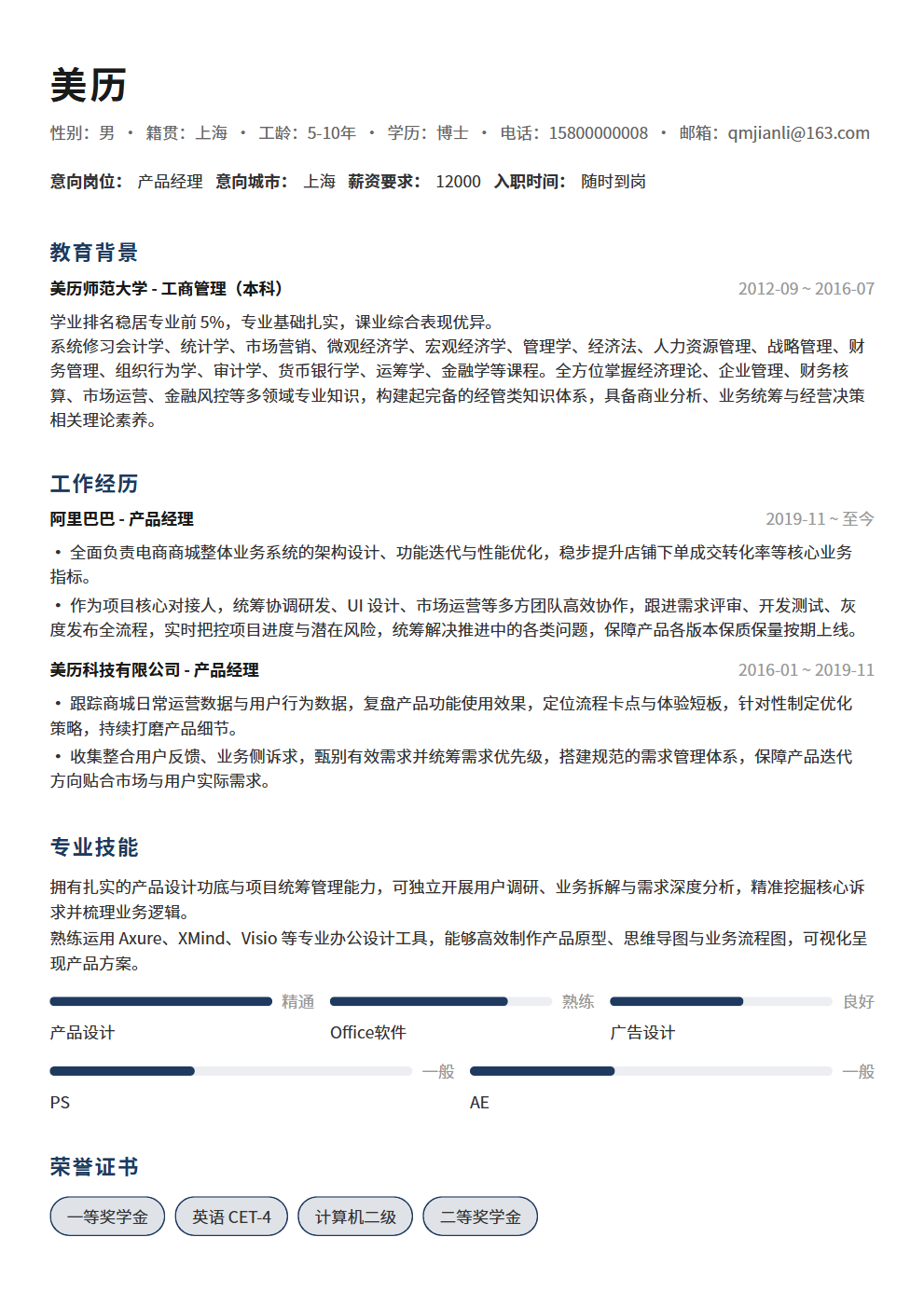
- Good example: Name and core tags in large bold font, work experience headings in medium bold, achievement data highlighted with numbers + bold, secondary information in small gray font — the recruiter can grasp all key information with one scan
- 4 elements of visual hierarchy: font size hierarchy (headings > body > auxiliary info, at least 3 levels), font weight hierarchy (core info bold, secondary info regular), color hierarchy (core info dark, secondary info light, but no more than 2 colors), spacing hierarchy (larger spacing between important modules, smaller spacing within modules)
- Most effective visual guidance technique: present the most critical numbers and achievements in bold + standalone line — "User growth 280%" catches the eye more than "User growth 280%"
- Visual hierarchy isn't a design competition — no need for fancy icons, gradients, or decorative elements. Clean, clear, and hierarchical is the best visual design — remember, recruiters read resumes to get information, not to admire design
The essence of visual hierarchy: save the recruiter time. When 1000 resumes are in front of them, recruiters prioritize those where "key points can be grasped at a glance." A resume with good visual hierarchy lets the recruiter get core information in 6 seconds; a resume with poor visual hierarchy might leave the recruiter unable to even tell what you do in 6 seconds. In the time-limited screening process, visual hierarchy is your competitive advantage.
Differentiation Self-Check List
After writing your resume, use this checklist to self-check whether your resume achieves differentiation.
- Does every work experience section have specific data-driven achievements? If not, at least have quantifiable comparative descriptions
- Do the first 3 lines of your resume showcase your most impressive achievements? If the recruiter only reads 3 lines, can they understand your core competitiveness?
- Has your resume been customized for the target position? Would you need to adjust content if applying for a different position?
- Does your resume contain 1-2 industry insights or methodology reflections? Can people tell you're not just an executor?
- Is the visual hierarchy of your resume clear? Can the recruiter grasp your 3 core highlights within 6 seconds?
- If you place your resume alongside 10 others for the same position, can it be identified within 3 seconds? If not, differentiation isn't strong enough
If your answer to all 6 questions above is "yes," congratulations — your resume has differentiated competitiveness. If any answer is "no," optimize point by point using the 5 strategies above — each improvement moves your resume 200 positions ahead out of 1000.
Conclusion: Differentiation Isn't About Being Different — It's About Precisely Showcasing Your Unique Value
1000 people applying for one position means 1000 similar resumes in front of the recruiter. Most people write resumes with the mindset of "what I did," some with "what I achieved," and very few with "why I could achieve it." The 5 differentiation strategies — telling stories with data to make achievements visible, putting the most impressive achievements in the first 3 lines to grab attention, customizing for each position to increase match feel, adding industry insights to demonstrate thinking depth, and using visual hierarchy to guide the recruiter's eyes — all essentially answer the same question: what makes you different from the other 999? Differentiation isn't about being unconventional or attention-seeking — it's about precisely and powerfully showcasing your unique value. When your resume makes the recruiter say "this person is different" in 6 seconds, you've won.
Want your resume to stand out from 1000 others? Use BeautyResume resume editor, with built-in professional layout templates and visual hierarchy design, letting your differentiated content be presented in the best way — data more prominent, achievements more striking, hierarchy more clear, helping you win at the starting line in the competitive job market.