Operations Role Interview Guide: 7 High-Frequency Question Types and Data-Driven Answer Frameworks
A systematic guide to 7 high-frequency operations interview question types, from user operations to content operations to data-driven approaches, with data-driven answer frameworks and high-scoring examples.
Operations Interviews: Why Does It Always Feel Like "I Know It But Can't Explain It"?
Operations role interviews share a common pain point: you've clearly done a lot, but during the interview, you can't articulate it clearly, can't explain it well, and lack data. When the interviewer asks "how did you drive user growth," you answer "we did a lot of campaigns" — this kind of vague response is fatal in operations interviews. The core competency of operations is data-driven decision-making, and the same applies in interviews.
This guide systematically covers 7 high-frequency operations interview question types, from user growth to strategic planning, each with data-driven answer frameworks and high-scoring examples to help you fully conquer operations interviews.
Type 1: User Growth and Retention
User growth and retention is the most frequently asked and highest-weighted question type in operations interviews. Interviewers care not only about how you acquire users but also about how you retain them — after all, retention is the foundation of growth.
Common Questions
- What was your user growth strategy for the product you managed? What were the results?
- User retention rate is declining — how would you investigate and resolve this?
- How would you design a user re-engagement plan?
- Customer acquisition costs keep rising — how do you optimize?
Data-Driven Answer Framework
- Define core metrics: Start by stating which metrics you track (DAU/MAU, next-day retention, 7-day retention, LTV, CAC)
- Break down the growth funnel: Analyze data layer by layer from acquisition → activation → retention → monetization → referral
- Provide specific numbers: "DAU increased from 50K to 120K, 7-day retention improved from 18% to 32%"
- Attribution analysis: Use data to show which stage contributed the most, rather than vaguely saying "the results were great"
High-Scoring Example
"When managing a social product, I first used funnel analysis to discover that the activation stage had a 65% drop-off rate. To address this, I optimized the new user onboarding flow, simplifying the 3-step registration to 1 step and adding personalized recommendations. After optimization, the activation rate improved from 35% to 58%, 7-day retention increased from 22% to 38%, and DAU grew from 80K to 150K within 3 months. A/B testing also confirmed that the new onboarding flow's conversion rate was 23 percentage points higher than the old version."
Type 2: Campaign Planning and Execution
Campaign operations is a fundamental skill for operations roles. Interviewers use these questions to assess your planning ability, execution details, and results review capability. Many candidates only talk about "what campaigns they ran," missing what interviewers really want to hear — the strategic logic behind the campaigns and data validation.
Common Questions
- Tell me about the most successful campaign you've planned
- A campaign underperformed — how do you review and adjust?
- How do you evaluate a campaign's ROI?
- How do you run campaigns with a limited budget?
Data-Driven Answer Framework
- Quantify objectives: Set clear KPIs before the campaign (participation, conversion rate, GMV, ROI)
- Break down strategy: From user reach → participation conversion → viral spread → repeat purchase/retention, with data for each stage
- Present results: Core data + year-over-year/period-over-period comparison + industry benchmark comparison
- Review and attribute: What worked well (supported by data), what can be optimized (specific improvement plans)
High-Scoring Example
"I planned a 618 mega-sale campaign with a target GMV of 5 million. Strategically, I divided the campaign into three phases: warm-up, peak, and encore. During the warm-up phase, I reached 300K existing users via community groups and SMS. The peak phase featured flash sales and tiered discounts, while the encore phase pushed exclusive coupons to non-buyers. The final GMV reached 7.2 million, exceeding the target by 44%, with an ROI of 1:8.5 and new customers accounting for 37%. The review revealed that flash sale periods had conversion rates 5.2 times higher than normal, but the encore phase underperformed — next time, I would optimize the encore incentive design."
Type 3: Content Operations and Distribution
Content operations assesses your full-funnel capability from content production to distribution. Interviewers want to see not just "what I wrote," but "how I used content to drive business growth."
Common Questions
- How do you build a content operations system?
- How do you create viral content?
- Content is becoming homogeneous — how do you break through?
- How do you measure content operations effectiveness?
Data-Driven Answer Framework
- Content metrics system: Production volume, views/plays, engagement rate (likes + comments + shares / views), conversion rate
- Distribution data: Impressions by channel, CTR, completion rate, bounce rate
- Business conversion: Registrations, orders, and GMV attributed to content
- Content ROI: Cost per piece of content vs. revenue generated
High-Scoring Example
"I managed content operations for an education platform and built a '3×3 content matrix': 3 content tiers (traffic-driving/conversion/brand-building) × 3 distribution channels (WeChat Official Account/Xiaohongshu/Douyin). Data tracking revealed that Xiaohongshu's traffic-driving content had the highest CTR at 8.7%, while the WeChat Official Account's conversion content achieved a 12% registration rate. After shifting budget toward high-efficiency channels, content-driven registrations grew 65% month-over-month, and the cost per user acquisition dropped from 120 RMB to 68 RMB."
Type 4: Community Operations and User Relationships
Community operations assesses your ability to build user connections and maintain the community ecosystem. Interviewers focus on how you balance community atmosphere with business objectives, and how you use data to measure community health.
Common Questions
- How do you build a community from scratch?
- Community activity is declining — how do you address it?
- How do you cultivate community KOCs (Key Opinion Consumers)?
- How do you monetize a community without hurting user experience?
Data-Driven Answer Framework
- Community health metrics: DAU/MAU ratio, posting rate, engagement rate, KOC percentage, user segment distribution
- Growth metrics: New users, invitation rate, 7-day return rate
- Monetization metrics: Community GMV share, paid conversion rate, average order value, repeat purchase rate
- User segmentation: Use RFM model to quantify user value for targeted operations
High-Scoring Example
"I built a maternal and baby community from scratch, initially recruiting 200 highly active mothers through a seed user invitation system. For the operations strategy, I designed a content rhythm of 'daily topics + expert Q&A + product sharing' and established a KOC cultivation system: users with ≥20 monthly posts and ≥15% engagement rate automatically upgraded to KOC status with exclusive benefits. After 6 months, the community reached 50K MAU with a stable DAU/MAU ratio of 35%. KOCs represented 8% of users but contributed 42% of quality content, and community GMV averaged 1.2 million RMB per month."
Type 5: Data Metrics and Analysis
Data capability is the foundational core competency for operations roles. Interviewers use these questions to assess whether you can discover problems from data, validate hypotheses, and guide decisions. Just looking at data isn't enough — you need to tell stories with data.
Common Questions
- What operations metrics do you track daily? Why?
- DAU suddenly drops by 30% — how do you investigate?
- How do you design a data dashboard?
- What do you do when data contradicts your intuition?
Data-Driven Answer Framework
- Metric layering: North Star metric → Level 1 metrics → Level 2 metrics → process metrics, breaking down layer by layer
- Anomaly investigation: Split by dimensions (channel/version/region/time period) to locate the root cause
- Hypothesis validation: Propose hypothesis → design experiment → collect data → draw conclusions
- Decision implementation: Based on data conclusions, provide specific action plans and expected outcomes
High-Scoring Example
"When DAU suddenly dropped by 30%, I followed an investigation path of 'external factors → technical issues → business changes.' I first ruled out external factors like competitor campaigns and policy changes, then confirmed no technical failures. Next, splitting by channel revealed that organic traffic had dropped 45%. Further splitting by source pinpointed a sharp decline in Baidu search traffic. Investigation found that SEO keyword rankings had dropped, and after emergency optimization, traffic recovered to 92% of normal levels within 3 days. This experience led me to establish a daily monitoring mechanism for core channel traffic."
Type 6: Channel Operations and Advertising
Channel operations assesses your ability to maximize customer acquisition efficiency within limited budgets. Interviewers want to know if you understand the characteristics of major channels and can optimize advertising strategies with data.
Common Questions
- Which channels have you managed advertising for? What were the results?
- How do you evaluate whether a new channel is worth investing in?
- Advertising ROI keeps declining — how do you optimize?
- How do you balance organic and paid traffic?
Data-Driven Answer Framework
- Channel evaluation metrics: CAC, LTV/CAC ratio, ROI, retention rate, paid conversion rate
- Advertising optimization: Creative CTR → landing page conversion rate → backend ROI, optimizing layer by layer
- Budget allocation: Dynamically adjust based on each channel's LTV/CAC ratio — increase investment in high-ROI channels, pause or optimize low-ROI channels
- Attribution analysis: Multi-touch attribution, avoiding last-click-only analysis
High-Scoring Example
"I managed channel advertising for a SaaS product with a monthly budget of 500K RMB. Initially, I distributed the budget equally across 6 channels, with an overall ROI of only 1:2.3. Data tracking revealed that search engine SEM had an LTV/CAC ratio of 4.2, while feed ads were only 1.8. I decisively increased SEM budget from 80K to 250K and reduced feed ads from 150K to 50K, while optimizing SEM keywords and landing pages. After the adjustment, overall ROI improved to 1:4.1, monthly registrations increased from 3,200 to 5,800, and CAC dropped from 156 RMB to 86 RMB."
Type 7: Operations Strategy and Planning
Operations strategy questions are mandatory for senior operations roles, testing your big-picture perspective, strategic thinking, and resource integration capabilities. Interviewers want to see how you develop actionable operations plans starting from business objectives.
Common Questions
- If you were responsible for a new product's operations from scratch, what would you do?
- How do you create an annual operations plan?
- Business growth has hit a bottleneck — how do you break through?
- How do you coordinate across departments to advance operations projects?
Data-Driven Answer Framework
- Goal decomposition: Annual target → quarterly milestones → monthly KPIs → weekly execution metrics
- Strategy portfolio: Acquisition strategy + retention strategy + monetization strategy, each with corresponding budget and expected ROI
- Resource inventory: Personnel, budget, technical support, external partnerships — quantify resource gaps
- Risk contingency: Emergency plans and stop-loss thresholds when core metrics fall below expectations
High-Scoring Example
"When taking over operations for an e-commerce product, the annual GMV target was increased from 80 million to 150 million RMB. I decomposed the target: new user acquisition contributing 30%, retention improvement contributing 40%, and average order value increase contributing 30%. For acquisition, I focused on Douyin + Xiaohongshu advertising, expecting 80K new users with CAC under 100 RMB. For retention, I built a membership system + points mall, targeting a repeat purchase rate increase from 28% to 42%. For AOV, I used bundle recommendations + tiered discounts, targeting an increase from 180 to 240 RMB. The final annual GMV reached 162 million RMB, exceeding the target by 8%."
Core Principles for Operations Interviews
Mastering the 7 question types is just the foundation. What truly sets candidates apart are these three core principles:
Principle 1: Every Answer Must Include Data
In operations interviews, "an answer without data equals no answer." Don't say "the results were great" — say "it improved by XX%." Don't say "we had a lot of users" — say "DAU reached XX million." Developing the habit of speaking with data signals to interviewers that you possess genuine operations thinking.
Principle 2: Present the Framework First, Then Fill in Details
For any operations question, first provide your analytical framework, then fill in specific details. For example, when asked "how to drive user growth," first say "I would analyze from five stages: acquisition, activation, retention, monetization, and referral," then elaborate on each. This demonstrates your structured thinking.
Principle 3: Proactively Review to Demonstrate Growth
After presenting each case, proactively add a review: what worked well, what could be optimized, and what you would do differently next time. This demonstrates your growth mindset and self-iteration capability, which are the most valued qualities for senior operations roles.
Operations Interview FAQ
How many questions are typically asked in an operations interview?
Typically 5-8 questions, covering 2-3 question type categories. Junior roles focus more on execution details (campaigns, content, channels), while senior roles emphasize strategic planning (growth strategy, data systems, cross-departmental collaboration). We recommend preparing at least 1 complete data-backed case for each question type.
How do I interview for operations without prior experience?
Without formal operations experience, you can extract cases from internship projects, campus activities, self-media operations, and personal projects. The key is to repackage them with operations thinking: set objectives → develop strategy → execute → review with data. Even at a small scale, clear logic and data support can be persuasive.
What if I state incorrect data during the interview?
Don't panic — honestly correct it. You can say "I apologize, I don't remember this number exactly, but the approximate range is XX to XX." Interviewers care more about your data thinking and analytical logic than precise recall of every number. However, never fabricate data — if discovered, it's an automatic disqualification.
What's the difference between operations and product interviews?
Operations interviews focus more on execution and data-driven approaches, while product interviews emphasize requirement analysis and product thinking. Operations interviewers will ask "how did you achieve this" and "what were the numbers," while product interviewers will ask "how did you discover the need" and "why did you design it this way." The preparation focus differs, but the underlying capabilities overlap.
How should I prepare my resume for operations interviews?
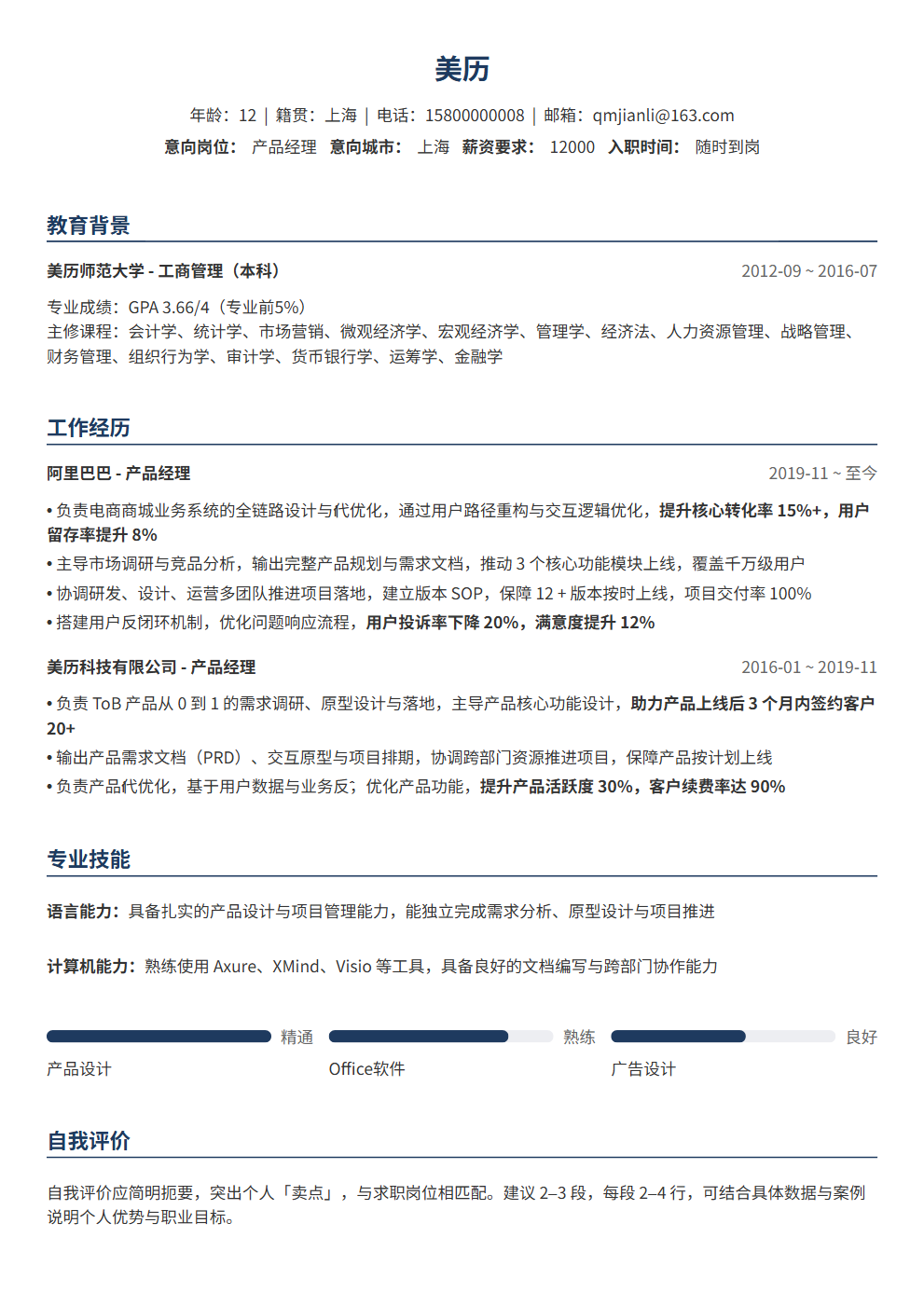
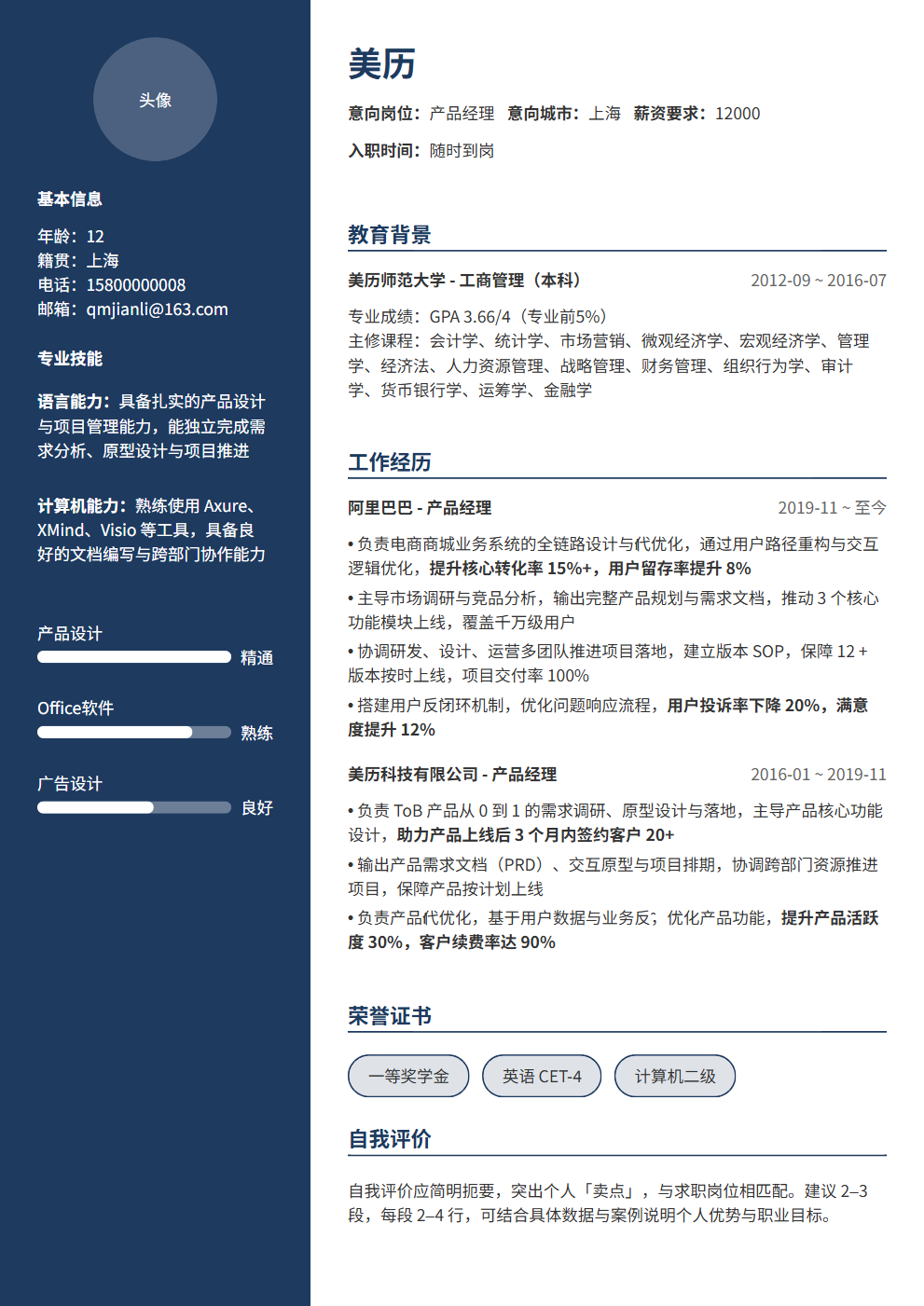
The core of an operations resume is quantifying every experience with data. Don't write "responsible for user operations" — write "managed user growth operations, increasing DAU from 50K to 120K and improving 7-day retention by 15 percentage points." We recommend using a resume builder to quickly generate a professionally formatted operations resume, ensuring data stands out, logic is clear, and formatting is standardized. A strong operations resume itself is the best proof of your data-driven thinking.
Conclusion: 7 Question Types + Data Frameworks = Operations Interview Mastery
The core of operations interviews isn't "having done a lot means you'll pass" — it's using data to prove you achieved results, and using frameworks to show you can consistently achieve results. Each of the 7 high-frequency question types has its own focus: user growth emphasizes funnel decomposition, campaign planning emphasizes ROI review, content operations emphasizes matrix thinking, community operations emphasizes segmented operations, data analysis emphasizes anomaly attribution, channel advertising emphasizes efficiency optimization, and strategic planning emphasizes goal decomposition.
When preparing for operations interviews, we recommend preparing 1-2 data-backed cases for each of the 7 question types and refining them until you can express them fluently. Don't forget to use a resume builder to craft a data-highlighted operations resume, ensuring your job search is fully data-driven from resume to interview.