Multinational Company Interview Guide: 6 English Interview Question Types and High-Scoring Templates
A systematic guide to 6 English interview question types at multinational companies, from self-introduction to behavioral to case interviews, with high-scoring templates and English scripts.
Why Are English Interviews at Multinational Companies So Challenging?
Interviews at multinational companies differ fundamentally from domestic interviews. They assess not only your professional skills but also your cross-cultural communication, English expression, and global mindset. Many highly qualified candidates stumble at the English interview stage — not because their English is poor, but because they don't understand the "rules of the game" at multinational companies.
This guide systematically covers 6 major English interview question types at multinational companies, each with high-scoring answer templates and English scripts, plus special rules for multinational interviews, helping you fully prepare from start to finish.
Type 1: English Self-Introduction
Self-introduction is a mandatory opening question and a critical moment for first impressions. Multinational interviewers don't want you to recite your resume — they expect a well-structured, highlight-rich, time-controlled presentation.
High-Scoring Strategies
- Keep it to 1.5-2 minutes — exceeding 3 minutes suggests poor summarization skills
- Use the Present-Past-Future framework: what you do now → key past achievements → why you're here
- Quantify achievements with data — avoid vague descriptions
- Connect your closing to the target role — demonstrate value alignment
English Answer Template
"I'm currently a [Role] at [Company], where I lead [Core Responsibility/Project]. Over the past [Number] years, I've [Key Achievement with Data], which resulted in [Quantifiable Impact]. Before that, I [Key Transition or Growth Experience]. What excites me about this role at [Target Company] is [Connection to Role], and I believe my experience in [Relevant Field] would allow me to [Value You Bring]."
Analysis
The core logic of this template is "who I am → what I've done → why I'm a fit for you". The Present section positions your current level; the Past section proves your capabilities with data; the Future section demonstrates your understanding of and enthusiasm for the role. Avoid listing all your experiences — select only the 2-3 most relevant highlights.
Type 2: Behavioral Interview (STAR Method in English)
Behavioral interviews are the most heavily weighted question type at multinational companies. The underlying principle is "past behavior predicts future performance." Interviewers probe for details to assess whether your experiences are genuine and how you think and act in specific situations.
STAR Method Breakdown
- S - Situation: Briefly describe the context — 1-2 sentences suffice, don't over-set the scene
- T - Task: Clarify the challenge or objective you faced
- A - Action: This is the core — focus on what you did, not what the team did
- R - Result: Quantify outcomes with data and articulate what you learned
English Answer Template
"In my previous role at [Company], we faced a situation where [Situation]. My task was to [Task]. I took several actions: first, I [Action 1]; then, I [Action 2]; finally, I [Action 3]. As a result, [Result with Data]. Through this experience, I learned that [Reflection/Growth]."
Analysis
The key to STAR responses is that the Action section should comprise 60%+ of your answer. Many candidates spend too much time on Situation, leaving the core actions compressed. Additionally, Results must be data-supported — "improved efficiency" is far less convincing than "reduced processing time by 40%." Adding a reflection at the end demonstrates your growth mindset, which is highly valued in multinational company cultures.
Common Behavioral Interview Questions
- Tell me about a time you dealt with a difficult team member.
- Describe a situation where you had to meet a tight deadline.
- Give me an example of when you took initiative beyond your role.
- Tell me about a time you failed and what you learned.
- Describe how you handled a conflict with a stakeholder.
Type 3: Motivation and Cultural Fit Questions
Multinational interviewers place great emphasis on cultural alignment. Skills can be trained, but cultural mismatch often leads to rapid turnover. These questions appear to ask "why," but they actually assess whether you genuinely understand the company and share its values.
Common Question Types
- Why do you want to work for this company?
- Why are you leaving your current job?
- What motivates you in your career?
- How do you align with our company values?
- Where do you see yourself in 5 years?
English Answer Template (Why This Company)
"I've been following [Company] for a while, and three things really stand out to me. First, [Specific Business/Product Highlight]. Second, [Company Culture/Values — quoting the official website is even better]. Third, [Company's Position in Industry Trends]. This aligns perfectly with my background in [Your Field] and my passion for [Relevant Direction]. I believe I can contribute to [Specific Team/Project] while growing professionally in this environment."
Analysis
When answering "Why this company," you must demonstrate that you've done your homework. Mentioning recent company news, product launches, or strategic directions is far more convincing than generic statements like "your company is an industry leader." Regarding reasons for leaving, never speak negatively about your current employer. Use positive framing like "seeking new challenges" or "looking for a role that better aligns with my long-term goals." For the 5-year plan question, avoid naming specific titles — describe the capabilities you want to develop and the value you want to create.
Type 4: Case Study Questions
Case studies are a core question type in interviews at consulting firms, FMCG companies, and tech product roles. The interviewer presents a business scenario and asks you to analyze the problem and propose solutions within a limited time. These questions don't test for a "correct answer" — they evaluate your structured thinking, business acumen, and logical reasoning.
Problem-Solving Framework
- Clarify: Restate the problem, confirm key assumptions and constraints
- Structure: Break the problem into 2-4 sub-questions, establish an analytical framework
- Analyze: Work through each sub-question, ask the interviewer for data when needed
- Conclude: Provide a clear recommendation, with risk caveats and next steps
English Answer Template
"Let me make sure I understand the problem correctly — we're looking at [Restate Problem], and the key question is [Core Question]. I'd like to approach this from [Number] angles: first, [Dimension 1]; second, [Dimension 2]; third, [Dimension 3]. Starting with [Dimension 1], [Analysis Process]... Based on this analysis, my recommendation would be [Conclusion], with the caveat that [Risk/Assumption]."
Analysis
The essence of case interviews is showcasing your thought process, not delivering a perfect answer. Interviewers care more about how you break down problems, interact with them, and make reasonable inferences with incomplete information. You must think out loud so the interviewer can follow your logic. If you need data, ask the interviewer boldly — this demonstrates business judgment, not ignorance.
Type 5: Technical/Professional Questions
For technical and functional roles at multinational companies, professional competency assessment is a hard threshold. Unlike domestic interviews, multinational technical interviews place greater emphasis on problem-solving approach and communication skills rather than just whether you can produce the correct answer.
Special Rules for Technical Interviews
- Communication matters more than the answer: Interviewers want to see how you think and handle uncertainty
- Admit what you don't know: Saying "I haven't encountered this before, but here's how I would approach it" is far better than making things up
- Explain while coding: Articulate your design choices and trade-offs
- Focus on trade-offs: Multinational interviewers love asking "What other approaches exist? What are the pros and cons of each?"
English Answer Template (When You Don't Know the Answer)
"That's an interesting question. I haven't worked with [Specific Technology/Concept] directly, but based on my understanding of [Related Field], I would approach it by [Your Approach]. I'd first [Step 1], then [Step 2], and verify by [Verification Method]. Does that sound like a reasonable approach?"
Analysis
Multinational technical interview scoring typically covers five dimensions: problem understanding, solution design, implementation, testing/verification, and communication. Even if the final answer isn't perfect, demonstrating clear thinking and good communication can still earn high marks. Never stay silent for more than 30 seconds — if you need time, say "Let me think about this for a moment," then narrate your thought process aloud.
Type 6: Reverse Questions (Your Turn to Ask)
At the end of the interview, the interviewer will almost certainly ask, "Do you have any questions for me?" This is not mere politeness — the reverse question round is your last opportunity to demonstrate depth of thought and professionalism. Having no questions or only shallow ones will make the interviewer question your sincerity and insight.
High-Scoring Reverse Question Strategies
- Prepare 3-5 questions and flexibly select 2-3 based on the conversation
- Questions should demonstrate deep thinking — avoid information readily available on the company website
- Customize questions for the interviewer's role: ask business leaders about strategy, HR about culture, technical leads about architecture
- Avoid asking about salary and benefits — save those for the HR discussion
English Question Templates
- "What does success look like in this role for the first 90 days?" — Shows you care about execution and results
- "How would you describe the team culture, and what type of person thrives here?" — Shows you value cultural fit
- "What's the biggest challenge the team is facing right now?" — Shows you're willing to tackle tough problems
- "How does this role contribute to the company's broader strategic goals?" — Shows you have a big-picture perspective
- "Based on our conversation today, do you have any concerns about my fit for this role?" — Proactively seeks feedback and addresses concerns on the spot
Analysis
The last question is especially recommended — it demonstrates your openness and confidence while giving you a chance to address any weaknesses from the interview. If the interviewer raises concerns, you can address them immediately. Even if they say "no concerns," the question itself demonstrates maturity.
Special Rules for Multinational Company Interviews
Beyond answering techniques, multinational interviews have unwritten rules and etiquette that could cost you points without you even realizing it.
Dress Code
The dress code principle for multinational interviews is to dress slightly above the everyday office level. Finance and consulting industries require Business Formal; tech and internet companies allow Business Casual, but never be too casual. If the interview invitation email specifies a dress code, follow it strictly; if unsure, Business Casual is the safest choice.
Small Talk
Multinational interviews typically begin with 1-3 minutes of small talk — the interviewer might chat about the weather, weekend plans, or your commute. This isn't wasted time — it's assessing your social skills and cultural adaptability. Prepare a few safe topics: weather, recent industry news, impressions of the office. Avoid politics, religion, salary, and other sensitive subjects.
Follow-up Email
After a multinational interview, you must send a thank-you email within 24 hours — this is basic professional etiquette. Keep it brief: thank them for their time, reiterate your interest in the role, and add one highlight from the interview. If you had multiple interviewers, send each one a different thank-you email.
Thank-you Email Template
"Dear [Interviewer's Name], Thank you for taking the time to speak with me today about the [Position] role. I particularly enjoyed our discussion about [Specific Topic from Interview], which reinforced my enthusiasm for this opportunity. I'm confident that my experience in [Relevant Field] would enable me to [Value You Bring]. Please don't hesitate to reach out if you need any additional information. I look forward to hearing from you. Best regards, [Your Name]"
FAQ: Common Questions About Multinational Company Interviews
Are multinational company interviews entirely in English?
Most multinational interviews are primarily in English, but the exact ratio varies by company and role. Generally, headquarters interviews are fully in English; local team interviews may be a mix of English and the local language. We recommend preparing as if the entire interview will be in English — even if the actual interview switches to your native language, your English preparation will make your responses more structured.
What if my English isn't fluent enough?
Fluency isn't the most important factor — clarity and structure are key. Slow down, use simple sentences to express complex ideas, and leverage transition words (First, Additionally, In conclusion) to organize your logic. Interviewers care more about whether you can communicate effectively than your accent or vocabulary. Practice your STAR stories out loud in English until you can deliver them smoothly.
How many interview rounds do multinational companies typically have?
Typically 3-5 rounds: HR screening (phone/video) → First business interview (direct supervisor) → Second business interview (cross-functional or skip-level) → Case study/Technical assessment → Final round (Partner/VP level). Each round has a different focus: HR interviews emphasize motivation and cultural fit, business interviews focus on professional competency, and final rounds assess strategic thinking and leadership.
What should I do if I don't understand a question during the interview?
Never pretend to understand and then answer the wrong question. Politely ask the interviewer to repeat or rephrase: "Could you rephrase that?" or "Just to make sure I understand, you're asking about [Your Understanding]?" This is far better than going off-topic and also demonstrates your communication awareness.
How should I prepare my resume for multinational company interviews?
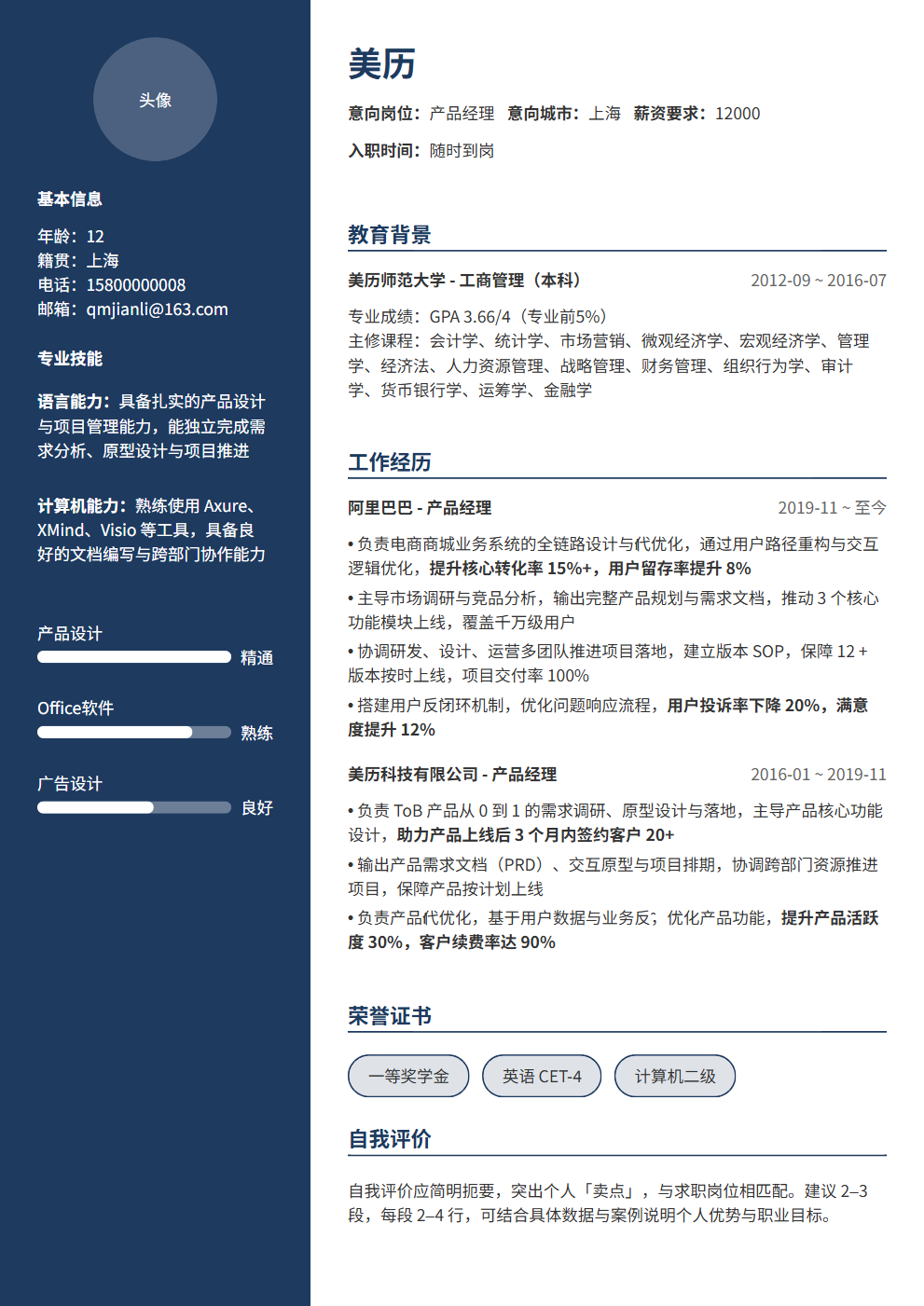
Multinational resumes differ significantly from domestic ones: must be in English, one page, no photo or personal info, use action verbs to describe experiences, and quantify all achievements. We recommend using a resume builder to quickly generate an English resume that meets multinational standards, ensuring professional formatting and content precisely matched to the role requirements. A strong resume is your ticket to a multinational interview — it's worth the time to polish it.
Conclusion: Master the 6 Question Types and Conquer Multinational Interviews
The key to multinational interviews isn't "good English equals success" — it's understanding question type logic, mastering answer frameworks, and familiarizing yourself with multinational rules. Each of the 6 question types has its own focus: self-introduction emphasizes conciseness, behavioral interviews require STAR structure, motivation questions demand deep research, case studies showcase your thinking process, technical questions prioritize communication, and reverse questions demonstrate deep insight.
When preparing for multinational interviews, we recommend preparing English scripts for each question type and practicing repeatedly until you can express yourself naturally. Don't forget to use a resume builder to craft a professional English resume, ensuring your multinational job search is on point from application to interview.