Inside the Interviewer's Mind: 6 Core Dimensions Big Tech Really Assesses
Reveal the 6 core assessment dimensions of big tech interviews from the interviewer's inside perspective, breaking down evaluation criteria from professional skills to cultural fit, helping you precisely target the high-score profile.
What Does the Interviewer's Scorecard Look Like?
Many candidates think interviews are a "Q&A game" — answer correctly and you pass, answer wrong and you fail. But behind real big tech interview questions, there's a systematic scoring system. The scorecard in an interviewer's hand isn't a simple "right/wrong" checklist — it's a quantitative assessment across 6 dimensions, each scored 1-5, then weighted and aggregated.
The core logic of this scoring system is the "Capability-Will-Fit" triangle model: Can you do the job well? Do you have the will to commit long-term? Do you fit the team's culture? All three corners are essential — if any one collapses, your offer is in jeopardy. Let's break down each of these 6 core dimensions, revealing what interviewers are really assessing, what high-score and low-score signals look like.
Dimension 1: Professional Skills — The Baseline of Hard Skills
Professional skills are the ticket to entry. Without hard skills, no amount of strength in other dimensions matters. Interviewers aren't testing how many facts you've memorized — they're assessing your depth of understanding and practical application ability.
Scoring Criteria (1-5 points):
- 1 point: Fuzzy on basic concepts, cannot answer simple technical questions
- 2 points: Can answer surface-level questions, but stumbles on follow-ups
- 3 points: Grasps core knowledge, can explain with project experience
- 4 points: Deep understanding of principles, can extrapolate, has technology selection thinking
- 5 points: Systematic understanding, can identify knowledge gaps and proactively fill them, has technical influence
High-score signal: When answering, you can go from principles to applications, from applications to pitfalls, from pitfalls to optimization solutions. For example, when asked "Why is Redis fast?", you don't just say "in-memory" — you expand on I/O multiplexing, the advantages and limitations of the single-threaded model, and comparisons with Memcached.
Low-score signal: Only recites standard answers, can't explain "why" when probed. Or only says "we used XX in our project" without explaining why it was chosen or what trade-offs were involved.
Real case: A candidate asked about "database index principles" didn't just explain B+ tree structure — they proactively shared "we had a slow query in production because our composite index didn't follow the leftmost prefix rule. After adding the right index, query time dropped from 2 seconds to 20 milliseconds." The interviewer immediately scored professional skills at 5 points.
Dimension 2: Problem Solving — The Leap from Execution to Thinking
Professional skills answer "do you know it"; problem solving answers "can you do it." Big tech doesn't lack people who can execute — they lack people who can think independently and decompose complex problems. In this dimension, interviewers assess your thought process when facing unknown problems.
Scoring Criteria (1-5 points):
- 1 point: Only asks for help when facing problems, lacks independent thinking
- 2 points: Can follow steps, but doesn't understand why
- 3 points: Can independently solve common problems, has basic troubleshooting thinking
- 4 points: Can decompose complex problems, propose multiple solutions and make trade-offs
- 5 points: Can identify hidden problems, anticipate risks, provide systematic solutions
High-score signal: When facing open-ended questions, you first clarify the problem boundaries, then decompose sub-problems and tackle them one by one. For example, when asked "how would you design a URL shortener service," you first confirm QPS scale, storage requirements, and availability needs, then expand layer by layer from encoding schemes to storage choices to caching strategies.
Low-score signal: Jumps straight to answers without showing your thought process. Or only provides one solution without comparing alternatives or making trade-offs. The classic low-score answer: "I did something similar in a previous project, just use XX."
Real case: When an interviewer asked "how do you troubleshoot a sudden API slowdown," a candidate didn't just say "check the logs." Instead, they first asked "is the slowdown gradual or sudden? Is it all APIs or just one?" Then they provided two different troubleshooting paths for gradual (possibly data growth / index degradation) versus sudden (possibly GC / dependency service jitter). The interviewer commented: "This is someone who has actually debugged production issues."
Dimension 3: Communication — The Underestimated Core Skill
Many technical people think "my tech skills are enough, communication doesn't matter." But at big tech companies, communication is the skill that determines your ceiling. Someone who can't articulate their ideas clearly becomes a bottleneck in cross-team collaboration, technical design reviews, and upward reporting.
Scoring Criteria (1-5 points):
- 1 point: Disorganized expression, interviewer needs to repeatedly probe to understand
- 2 points: Can state conclusions, but jumps logic, lacks context
- 3 points: Clear and organized expression, can fully describe a project or problem
- 4 points: Can adjust communication style for the audience, technical solutions understandable to non-technical people
- 5 points: Expressive and engaging, can guide conversation direction, makes complex issues concise and powerful
High-score signal: When answering questions, you give the conclusion first, then expand with supporting arguments. You use a "overview-detail-summary" structure rather than thinking out loud. When you don't know something, you honestly say "I'm not deeply familiar with this area, but my understanding is..." rather than making things up.
Low-score signal: Long-winded answers with no key points — taking 10 minutes for what could be said in 2. Or only focusing on your own monologue without noticing the interviewer's reactions and follow-ups. The most fatal low-score signal: the interviewer asks A, you answer B, and you think you answered well.
Real case: A candidate doing a system design question first spent 30 seconds saying "I'll analyze this from three layers: functional design, technology selection, and scalability," then expanded layer by layer. The interviewer's feedback: "Just from that opening, I know this person must be very mature in design reviews."
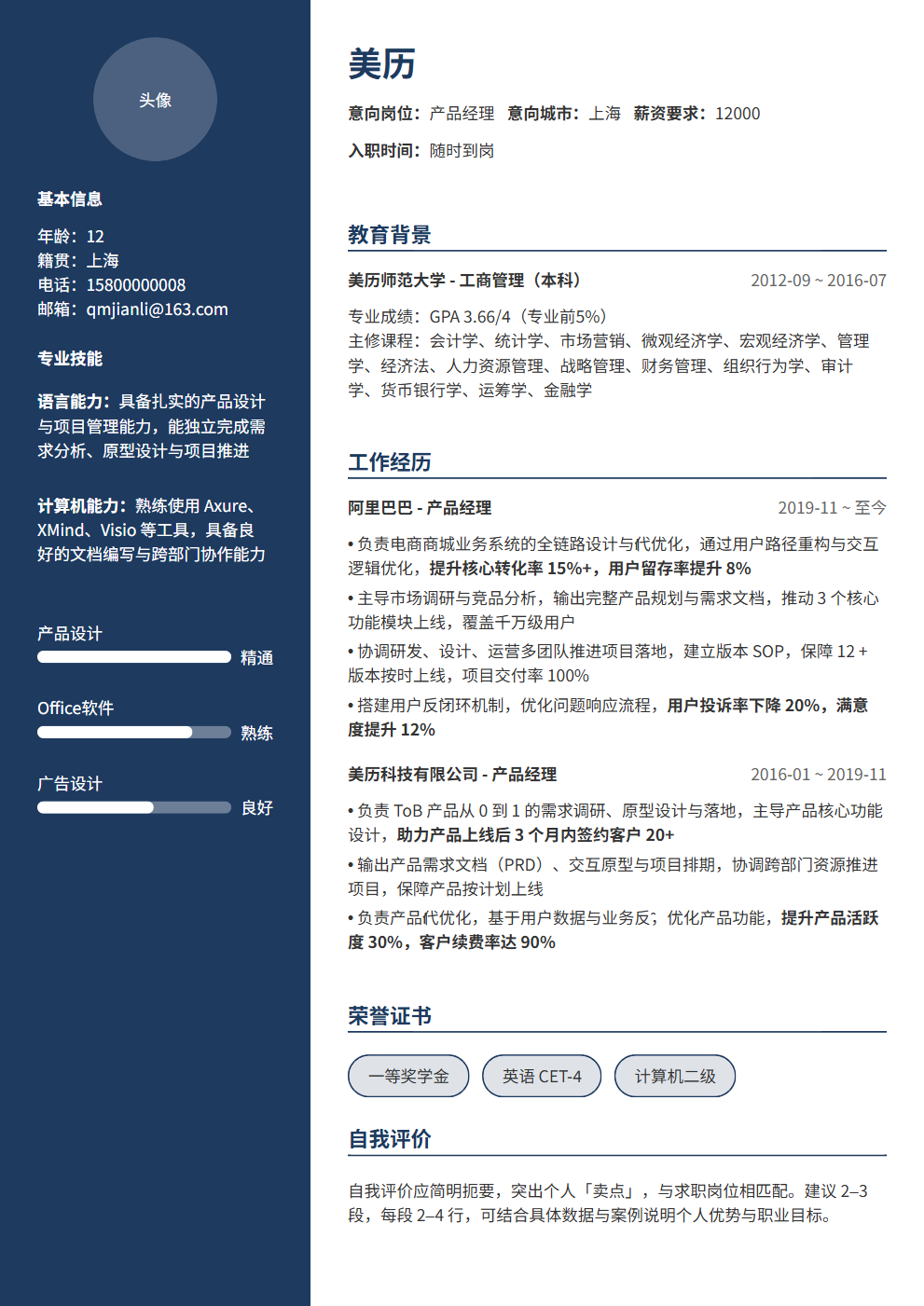
If your project experience isn't expressed clearly on your resume, you naturally won't be able to explain it clearly in interviews either. Use our resume generator to optimize project descriptions — upgrade "what I did" to "what problem I solved and what value I created", letting interviewers see your core contributions at a glance.
Dimension 4: Learning & Growth — The Signal of Long-term Potential
Big tech hiring isn't just about what you can do now — it's about what you can grow into. Technology evolves faster than ever, and someone who stops learning becomes a team burden within two years. Interviewers use this dimension to assess your growth trajectory.
Scoring Criteria (1-5 points):
- 1 point: No active learning habits, knowledge frozen at onboarding
- 2 points: Reactive learning, only learns new things when projects require it
- 3 points: Has learning habits, can keep up with technology trends
- 4 points: Has systematic learning methods, can quickly master new domains and produce results
- 5 points: Deep and broad learning, can fuse cross-domain knowledge for innovation, influences team's technical direction
High-score signal: Can clearly articulate your learning path and methodology. For example: "I learn new tech in three steps: first read official docs to understand design philosophy, then build a small project to validate core functionality, finally apply in real scenarios and output summaries." Having a tech blog, open source contributions, or tech talk experience is a bonus.
Low-score signal: Stumbling when asked "what new technology have you learned recently," or saying "I'm too busy to learn." An even worse signal: learned something but can't explain why, what was learned, or how it was applied.
Real case: A candidate with 3 years of experience had no particularly impressive projects on their resume, but when asked "what are you learning recently," they said: "I'm researching WebAssembly because I think the next step in frontend performance optimization might be there. I built a demo migrating image processing logic from JS to Wasm, and performance improved 8x." The interviewer commented: "This person's growth potential is stronger than many people with 5 years of experience."
Dimension 5: Team Collaboration — The Underlying Logic of Big Tech Survival
Almost no project at a big tech company can be completed by one person. Team collaboration ability determines whether you can amplify your value within the organization, or become friction for the team. In this dimension, interviewers assess your collaboration awareness, conflict resolution, and influence.
Scoring Criteria (1-5 points):
- 1 point: Only focused on own tasks, lacks collaboration awareness
- 2 points: Can cooperate with the team, but passively waits for assignments
- 3 points: Proactively collaborates, communicates smoothly with different roles
- 4 points: Can drive cross-team collaboration, resolve conflicts and obstacles in collaboration
- 5 points: Can establish collaboration mechanisms, improve overall team efficiency, is a trusted core node of the team
High-score signal: When describing projects, naturally mentions collaboration with other roles rather than only saying "what I did." When handling conflicts, thinks from the other person's perspective and seeks win-win solutions. Has experience driving process improvements and knowledge sharing.
Low-score signal: All "I" and no "we" when describing projects. Negative comments about former colleagues or companies. When asked "how do you handle disagreements with colleagues," the answer is either "follow the manager" or "I insist on my way."
Real case: A candidate was asked "how do you handle disagreements with product managers." They said: "I first try to understand why they think that way — usually it's because they've seen data or user feedback I haven't. Then I use my technical perspective to help evaluate the feasibility of their approach, and together we find a balance. Once, our compromised solution performed better than either original proposal." The interviewer immediately gave 5 points in the collaboration dimension.
Dimension 6: Cultural Fit — The Invisible Elimination Line
This is the most hidden evaluation criterion among the 6 dimensions, and the reason many people get rejected without understanding why. Cultural fit isn't about becoming a "company person" — it's about whether your values and working style are in sync with the team. Cultural differences across companies are significant: Alibaba values "embrace change," ByteDance values "candid and clear," Tencent values "user first."
Scoring Criteria (1-5 points):
- 1 point: Clear value conflicts, working style completely misaligned with the team
- 2 points: Can adapt but needs significant time, large style differences
- 3 points: Basically compatible, can integrate into the team's daily rhythm
- 4 points: Highly compatible, working style naturally aligns with the team
- 5 points: Not just compatible, but enriches team culture and brings positive influence
High-score signal: Has genuine understanding of the target company's business and culture, not just reciting website slogans. Values demonstrated in answers align with company culture. For example, when interviewing at ByteDance, if your answers are concise, direct, and data-driven, you naturally fit "candid and clear."
Low-score signal: No understanding of the target company at all. When asked "why us," can only give universal answers like "big platform" or "good growth." Or values demonstrated in answers clearly conflict with company culture — for example, interviewing at a company that emphasizes self-drive while your answers are all about "I do whatever my manager assigns."
Real case: A technically strong candidate passed all technical rounds at a big tech company but was rejected in the HR round. The reason: they repeatedly emphasized "I only care about technology, I don't want to deal with business," while the company's culture is "technology should serve the business." The interviewer commented: "The tech is fine, but they'll definitely clash with the team after joining."
3 Hidden Evaluation Logic of Interviewers
Logic 1: Anchoring Effect — The First 5 Minutes Set the Tone
Interviewers are human too — the impression from the first 5 minutes anchors all subsequent judgments. If your self-introduction is organized and has highlights, the interviewer will unconsciously give you bonus points and be more forgiving of later answers. Conversely, if you stumble at the start, even great answers later require more effort to turn the impression around. So, your self-introduction is your highest-ROI investment — polish it until it rolls off your tongue.
Logic 2: Your Floor Matters More Than Your Ceiling
Interviewers aren't looking for "the best person" — they're looking for "the safest choice." Your ceiling determines how much you impress the interviewer, but your floor determines whether you pass. Someone who occasionally performs brilliantly but has shaky fundamentals is less reassuring than someone who's consistently solid with no obvious weaknesses. So, fixing weaknesses impacts interview outcomes more than amplifying strengths.
Logic 3: Interviews Use "Elimination" Not "Selection"
The essence of big tech interviews isn't selecting the best 1 from 100 people — it's eliminating 95 unqualified candidates, then making a comprehensive choice from the remaining 5. So the interviewer's mindset is "finding reasons to reject you," not "finding reasons to accept you." Any obvious weakness in any dimension can become grounds for elimination. Don't give the interviewer a reason to reject you — aim for at least 3 points in every dimension.
How to Prepare for All 6 Dimensions
Professional Skills: Build a Knowledge System, Not Memorize Facts
Don't prepare by going through an "interview question list" one by one. Instead, organize by knowledge system. For backend development, go from language fundamentals → framework principles → databases → caching → message queues → distributed systems. Draw a knowledge tree for each domain, ensuring no obvious blind spots. Before the interview, use a resume tool to review your project experience, ensuring you can discuss each project in technical depth for 3 minutes.
Problem Solving: Prepare 5 In-depth Cases
Prepare 5 problem-solving cases you've personally experienced, covering performance optimization, production incident troubleshooting, architecture evolution, technology selection, and cross-team collaboration. Polish each case using the STAR method, ensuring you can clearly state: what the problem was → how you analyzed it → what you did → what the result was. These 5 cases can cover 80% of problem-solving interview questions.
Communication: Practice the "30-Second Elevator Pitch"
For every project and technical point, practice both a 30-second version and a 3-minute version. The 30-second version only covers conclusions and core value; the 3-minute version expands with details. In interviews, use the 30-second version first to give the interviewer the big picture, then dive deeper based on follow-ups. This "overview first, details later" approach is the key to scoring high in communication.
Learning & Growth: Prepare 1-2 "Learning Stories"
Don't just say "I read tech articles in my spare time." Prepare 1-2 specific learning stories: why you decided to learn this → how you learned it → what you learned → how you applied it → what results it produced. A complete learning loop from start to finish is 100x more convincing than a vague "I love learning."
Team Collaboration: Replace "I" with "We"
When describing project experience, deliberately practice starting with "we", then explaining your specific role and contribution within the team. For example: "Our team was responsible for the XX system refactoring, and I was responsible for the payment module's design and core code implementation." Also prepare 1 real case of handling a collaboration conflict that demonstrates your empathy and driving force.
Cultural Fit: Research the Target Company's "Culture Code"
Spend 1 hour before the interview researching the target company's culture: read the CEO's public letters, employee interviews, and tech blogs, distilling 3 core culture keywords. Then in the interview, naturally let your answers reflect the values corresponding to these keywords. Note: "naturally reflect," not "forcefully attach labels" — interviewers can tell the difference at a glance.
FAQ
Are the weights of the 6 dimensions equal?
No. Weights vary across companies, levels, and roles. Generally, professional skills and problem solving are base weights (about 50%), communication and learning are bonus weights (about 30%), and team collaboration and cultural fit are elimination weights (about 20%). "Elimination weight" means if these are too low, you'll be rejected regardless of how high other dimensions score.
Do interviewers really score all 6 dimensions?
Big tech interviewers do have structured scorecards, but not every dimension gets individual written comments. Typically, professional skills and problem solving have explicit scores and comments, while other dimensions are more about the interviewer's "overall impression." This is why hidden dimensions like cultural fit are easily overlooked — you think you performed well, but the interviewer's "gut feeling" has already eliminated you.
What if I'm obviously weak in one dimension?
Bringing it up to the 3-point passing line is the baseline strategy. If professional skills are weak, focus on mastering core knowledge points thoroughly — don't aim for 5, but ensure at least 3. If cultural fit is weak, invest time researching the target company's culture and proactively align during the interview. Remember the "elimination" logic — any dimension below 3 points can become a reason for rejection.
How do the 6-dimension emphases differ across big tech companies?
Significantly. Alibaba most values professional depth and cultural fit (embrace change, customer first), ByteDance most values problem solving and communication (candid and clear, always day 1), Tencent most values professional skills and user mindset (user first, tech for good), Meituan most values problem solving and execution ability (customer-centric, pursuit of excellence). We recommend adjusting your preparation focus based on your target company.
Can I proactively guide the interviewer to focus on my strong dimensions?
Yes, and this is an advanced strategy. Plant hooks in your self-introduction to lead interviewers to probe your strengths. For example: "I did a performance optimization in the XX project, reducing API response time from 2 seconds to 50 milliseconds" — the interviewer will likely follow up on this project's details, which is exactly what you want to showcase. But don't over-guide — if the interviewer shifts to other topics, naturally follow along.
Understanding the 6 core assessment dimensions is just the beginning — you also need a resume that scores high in the professional skills dimension from the start. Your project experience, technical abilities, and quantified achievements on your resume are the first evidence interviewers use to judge your professional skills. Use our resume generator to optimize your resume according to the interviewer's scoring standards — not by stuffing keywords, but by making every project experience serve as evidence of your professional capability. Get the interview first, then use this guide to land the offer.