Complete Resume Optimization & Submission Guide: 7 Steps to Build an Interview-Winning Resume
An original 7-step resume optimization method, revealing 3 fatal resume errors with fixes, role-specific differentiation strategies, 5 submission channel techniques, and a deep dive into ATS screening systems.
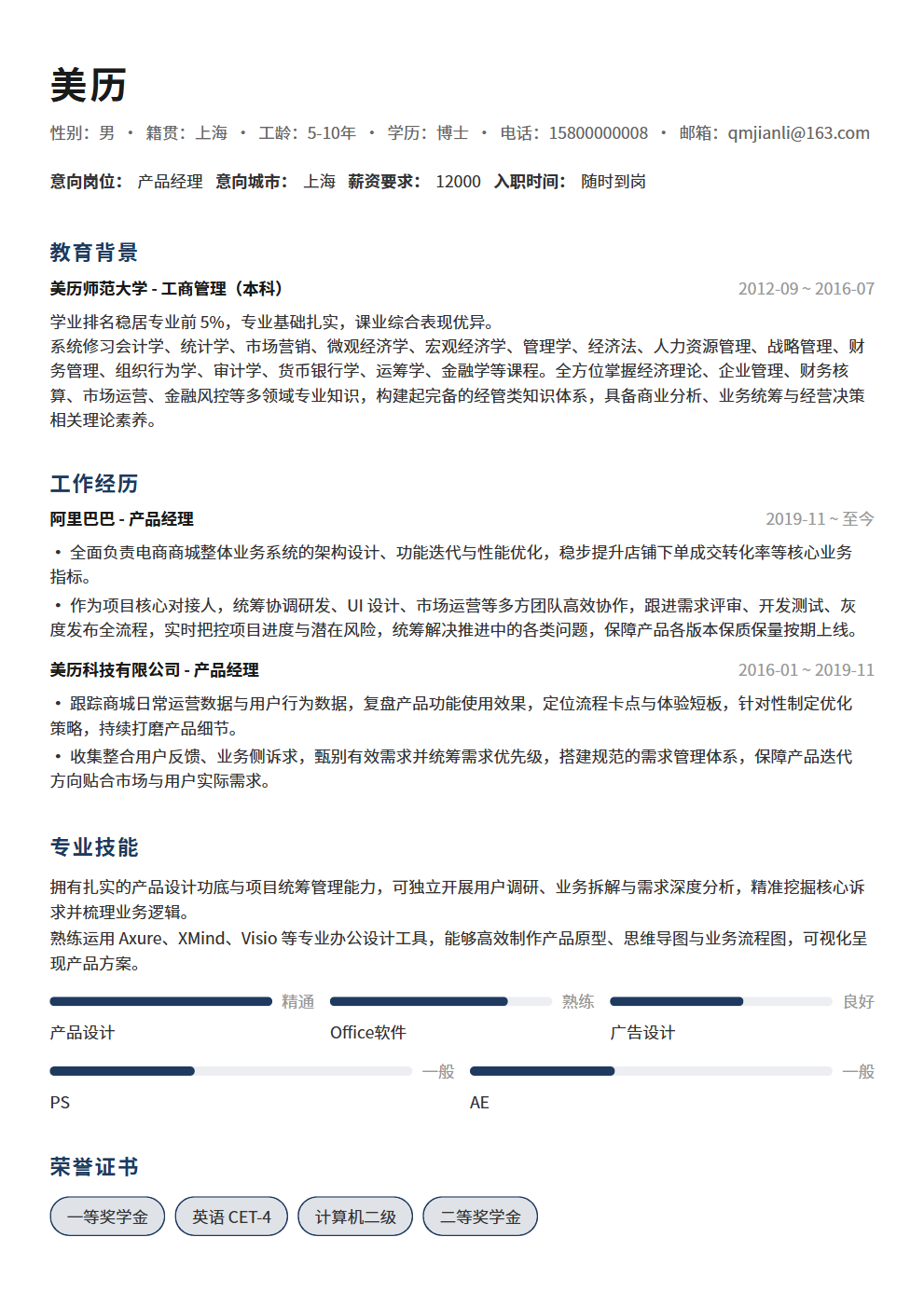
HR spends an average of only 6-8 seconds scanning a resume, and ATS screening systems eliminate 70% of resumes before a human ever sees them. Your resume isn't written for interviewers first—it's written for machines. This article presents an original 7-step resume optimization method to help you build a resume that conquers both ATS and interviewers.
1. The 7-Step Resume Optimization Method
Resume optimization isn't "write then revise"—it's a systematic process from positioning to verification. The 7-step method gives you clear deliverables at each stage:
Step 1: Positioning (Define Your Target Role)
One resume = one target role. Vague positioning is the root cause of resume failure:
- Be specific: Don't write "seeking internet-related work"—write "Senior Java Developer"
- Study the JD: Deconstruct the job description, extracting core keywords and competency requirements
- Gap analysis: Map your experience against JD requirements one by one, identifying strengths and weaknesses
Action method: Highlight keywords in the JD with a marker, categorizing them as "hard requirements" (education, skills, years) and "soft requirements" (communication, collaboration, resilience), then match each against your experience. At Google, a candidate who refined their resume positioning from "general internet operations" to "user growth operations" saw their interview invitation rate jump from 5% to 40%.
Step 2: Structure (Build the Resume Skeleton)
Resume structure determines how efficiently interviewers extract information. Golden structure order:
- Personal info: Name, phone, email, city (no photo, age, or marital status)
- Objective: Target role + availability (one line only)
- Education: School, major, degree, graduation date (top for new grads, bottom for experienced hires)
- Work/Internship experience: Reverse chronological, most recent = most detailed
- Project experience: 2-3 projects most relevant to the target role
- Skills & certifications: Only list what's relevant to the role
At Amazon, HR explicitly states: resumes exceeding 2 pages are penalized; 1 page is ideal. Poorly structured resumes get skipped during the 6-second scan.
Step 3: Quantification (Speak with Data)
Quantification is the dividing line between "average" and "excellent" resumes. Compare:
- Average: "Responsible for website redesign, improved user experience"
- Quantified: "Led website redesign project, improved page load speed by 40%, increased user session duration by 25%, boosted conversion rate from 2.1% to 3.8%"
Quantification formula: Verb + Specific task + Quantified result + Timeframe/Scale. When you lack hard numbers, use relative quantification like "ranked top X%," "outperformed X peers," or "first to achieve X." At Microsoft, a candidate who quantified all 8 bullet points on their resume saw interview invitations triple.
Step 4: Keywords (Align with ATS Screening)
ATS systems screen resumes through keyword matching—missing keywords = invisible resume:
- Hard skill keywords: Programming languages, tools, frameworks, methodologies (e.g., Python, Spring Boot, Agile)
- Industry keywords: Industry terminology, business contexts (e.g., SaaS, e-commerce, fintech)
- Action keywords: Led, optimized, refactored, built, drove (not "participated" or "assisted")
Keyword insertion technique: Naturally weave core JD keywords into work descriptions without stuffing. In NVIDIA's ATS, "Java development" and "Java backend development" may be treated as different keywords—cover both full terms and common abbreviations.
Step 5: Layout (Enhance Readability)
Layout isn't about aesthetics—it's about information transfer efficiency:
- Fonts: Arial/Calibri for English, 10-12pt
- Spacing: 1.2-1.5x line spacing; paragraph spacing > line spacing
- Emphasis: Bold key data and technical terms, but no more than 10 bold items per resume
- Format: Always export as PDF—Word formatting breaks across devices
At Apple, HR reveals: poorly formatted resumes are assumed to reflect "careless work habits," hurting first impressions even when content is solid.
Step 6: Customization (One Resume Per Role)
Sending 10 generic resumes is worse than sending 3 customized ones:
- Reorder experiences: Put the most relevant experience first
- Adjust emphasis: Same experience—highlight user insights for product roles, data growth for operations roles
- Tailor skills: Emphasize skills the target role requires; de-emphasize irrelevant ones
At Meta, a candidate created two versions of the same internship experience—one "product-focused" emphasizing requirements analysis and user research, one "operations-focused" emphasizing data monitoring and campaign planning—both landed interviews.
Step 7: Verification (Pre-Submission Checklist)
Check each item before submitting—a single error can get your resume eliminated:
- Contact info is correct (phone works, email receives)
- No typos or grammar errors (have a friend review)
- Filename is professional (Name-Role-Years.pdf)
- Doesn't exceed 2 pages (1 page for new grads, max 2 for experienced)
- Quantified data can withstand deep questioning (interviewers will probe)
2. Three Fatal Resume Errors & How to Fix Them
Fatal Error 1: Laundry List Descriptions
"Responsible for XX work, participated in YY project, completed ZZ tasks"—the classic laundry list. Interviewers can't see your value. Fix: Reconstruct each experience using the STAR method—Situation → Task → Action → Result. Change "managed user operations" to "facing 3 consecutive months of declining DAU, implemented user segmentation strategy that grew DAU from 500K to 800K in 3 months—a 60% increase."
Fatal Error 2: Skill Stuffing
Listing 20+ skill keywords, from Java to Excel. Interviewers assume you're a jack of all trades, master of none. Fix: Display skills by proficiency level—Expert (can architect independently) / Proficient (can develop independently) / Familiar (have hands-on experience)—no more than 3-5 items per level. At Oracle, interviewers explicitly note: "90% of candidates who write 'Expert in Java' can't withstand follow-up questions—'Proficient' is more honest."
Fatal Error 3: False Exaggeration
Presenting team achievements as personal ones, writing "expert" when you're "familiar." One deep-dive question in the interview will expose the truth. Fix: Honestly describe your role—"participated as a core member" rather than "solely responsible"; use "led" instead of "independently completed" (if you led but didn't work alone). At JPMorgan, a candidate wrote "independently built a recommendation system" but couldn't answer technical follow-up questions during the interview and was eliminated immediately.
3. Role-Specific Resume Differentiation Strategies
Technical Roles
Core principle: Technical depth + project complexity + quantified results. Put your tech stack in the most prominent position; structure project experience as "technical challenge → solution → performance metrics." At Tesla, technical resumes are judged most on "what technical problems you solved," not "what tech stack you used."
Product Roles
Core principle: User insight + data-driven + business thinking. Structure each project as "user pain point → product solution → data validation," demonstrating 0-to-1 or 1-to-N product thinking. At Netflix, product resumes are judged most on "whether you can prove your product decisions with data."
Operations Roles
Core principle: Growth data + methodology + replicability. Structure each operations project as "strategy → execution → data → retrospective," emphasizing growth numbers and methodology extraction. At Salesforce, operations resumes are judged most on "whether you can distill successful experiences into replicable methodologies."
4. Five Resume Submission Channels & Techniques
Channel 1: Company Career Sites
The most official channel, but also the most competitive. Technique: Apply within 48 hours of JD posting—the earlier HR sees your resume, the better. At IBM, resume screening peaks 3-5 days after posting; after that, HR rarely reviews new submissions.
Channel 2: Employee Referrals
Referral interview pass rates are 3-5x higher than regular submissions. Technique: Find employees at target companies through LinkedIn, alumni networks, and tech communities. At Intel, referred resumes are prioritized and referrers can track progress.
Channel 3: Recruiters
Best for candidates with 3+ years of experience. Recruiters provide inside information beyond the JD—team culture, salary range, interview style. Technique: Work with 2-3 recruiters simultaneously, but don't let the same role be submitted by multiple recruiters (causes resume conflicts).
Channel 4: Job Platforms
LinkedIn, Indeed, Glassdoor, etc. Technique: Set your profile to "open to opportunities" so recruiters can find you proactively. On LinkedIn, candidates with complete project descriptions and skill tags are 5x more likely to be contacted by recruiters.
Channel 5: Social Recruiting
Professional social platforms like LinkedIn and Twitter. Technique: Embed target role keywords in your profile headline and regularly post professional content to boost visibility. At Samsung, many senior-level candidates come from recruiters' proactive LinkedIn searches.
5. How ATS Resume Screening Systems Work & How to Beat Them
ATS (Applicant Tracking System) is your resume's first gatekeeper. Understanding how it works is essential:
- Parsing mechanism: ATS uses OCR and NLP to extract text from resumes and create structured data
- Matching mechanism: Extracted information is scored against JD keywords and skill requirements
- Ranking mechanism: Resumes are ranked by match score; HR typically only reviews the top 20-30
ATS optimization strategies: 1) Use standard formatting—avoid tables, images, custom fonts; PDF preferred; 2) Distribute keywords naturally—core keywords should appear in job titles, work descriptions, and skills sections; 3) Use standard job titles—"Java Developer" not "Code Ninja"; 4) Avoid complex layouts—two-column designs and text boxes can cause ATS parsing failures.
Your resume is your first impression in the job search—a great one can increase interview invitations by 3-5x. Use a resume builder to quickly generate professionally formatted resumes with built-in ATS-friendly templates and keyword optimization suggestions, helping your resume conquer both machines and interviewers.
FAQ
Q1: How do I write a resume as a new grad with no internship experience?
No internships doesn't mean no content. Mine these experiences: 1) Course projects—package major assignments as project experience using the STAR method; 2) Competition awards—math modeling, coding competitions, and business case competitions all add value; 3) Open source contributions—GitHub project contributions can be more convincing than internships (for tech roles); 4) Campus activities—student government and club leadership demonstrate soft skills. At NVIDIA, a new grad with no internship experience landed a top-tier offer thanks to a GitHub project with 300+ stars and a national math modeling competition first prize.
Q2: Should I include a photo on my resume?
For most job applications, don't include a photo (unless the role explicitly requires it, like reception or sales). Reasons: 1) Photos can trigger appearance bias concerns; 2) ATS systems may not correctly parse photo areas; 3) Photo files increase resume file size. If you must include one, use a professional headshot—never casual or heavily edited photos. At most tech companies and multinational corporations, excluding photos is the default standard.
Q3: How do I optimize a resume with frequent job changes?
Frequent job changes are a red flag for HR, but strategic framing can minimize the negative impact: 1) Consolidate short stints—different roles at the same company can be presented together; 2) Emphasize objective reasons for each change—company closure, department layoffs, and business pivots are more persuasive than "personal growth"; 3) Highlight achievements over duration—show above-expectation results in each brief stint, proving "short time, big impact"; 4) Prepare interview talking points—"My first two moves helped me clarify my career direction—my goals are now very clear."
Q4: How long should I wait before assuming my resume wasn't selected?
General rule: No response within 1 week likely means your resume didn't pass screening. But timing varies: campus recruiting peaks may take 2-3 weeks; experienced hires typically get feedback in 3-5 business days. Ways to improve response rates: 1) Follow up with HR 2-3 days after submitting; 2) Apply through referral channels where your referrer can track progress; 3) Message HR directly on job platforms expressing interest. At Goldman Sachs, a candidate called HR 3 days after submitting—HR was screening resumes for that role at that moment and scheduled an interview on the spot.
Q5: How should I state salary expectations on my resume?
Don't include specific salary numbers on your resume. Reasons: 1) If you state a low number, you lose negotiation room during interviews; 2) If you state a high number, ATS or HR may screen you out immediately; 3) Salary negotiation should happen late in the interview process—revealing your number too early weakens your position. If you must fill in a field, use a range rather than a fixed number (e.g., "Negotiable" or "$120K-$150K"), and the range floor should be your minimum acceptable amount. At McKinsey, HR notes that candidates who write "Negotiable" are more likely to advance to interviews than those who state specific numbers.