8 Common Fresh Graduate Interview Mistakes and How to Fix Them
A comprehensive review of 8 common mistakes fresh graduates make in campus recruitment interviews, from resume over-packaging to attitude issues, each with correction strategies and real cases to help you avoid basic errors.
Why Do Fresh Graduates Have Such a High Interview Mistake Rate?
Every campus recruitment interview season, countless fresh graduates walk into interview rooms full of confidence, only to miss out on offers due to seemingly minor mistakes. Data shows that over 60% of fresh graduates make at least 2 common mistakes during interviews, and these mistakes are often not about ability but rather stem from insufficient preparation and cognitive biases.
The root causes of high interview mistake rates among fresh graduates are threefold: lack of real interview experience, insufficient understanding of workplace norms, and over-reliance on "interview guides" while neglecting personalized expression. Many students treat interviews like exams, thinking that memorizing standard answers will get them through, but they overlook that an interview is essentially a conversation between people.
This article reviews the 8 most common mistakes fresh graduates make in interviews, each accompanied by correction strategies and real cases to help you avoid these pitfalls and truly showcase your abilities.
Mistake 1: Over-Packaging Your Resume — Exposed the Moment You're Questioned
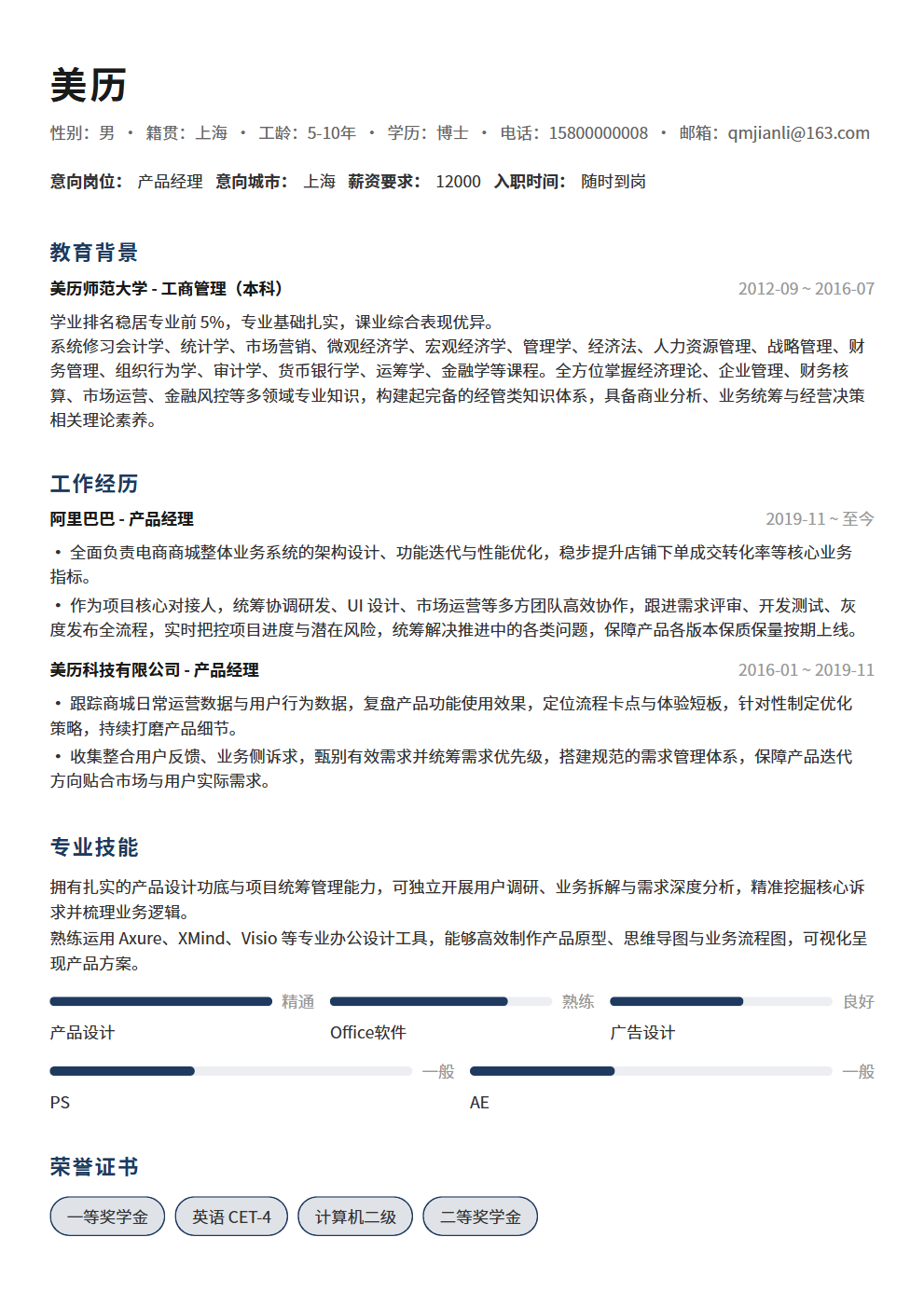
This is the most common and most fatal mistake in fresh graduate interviews. To pass resume screening, many students "beautify" their project experience on resumes: presenting team achievements as individual contributions, listing "familiar with" as "proficient in," and describing participation as leadership. The resume may pass screening, but once the interviewer digs deeper, the truth is immediately exposed.
Typical Manifestations
- Resume says "independently responsible for XX system development," but during the interview you say "I was mainly responsible for a small part"
- Resume says "proficient in XX technology," but you can't answer questions about underlying principles
- Project data on the resume doesn't hold up to scrutiny — you stumble when the interviewer asks for details
Real Case
A computer science student from a top university wrote on their resume: "Independently completed recommendation algorithm optimization, CTR improved by 30%." The interviewer followed up: "What algorithm did you use? How did you do feature engineering? How was the A/B test designed?" The student could only name the algorithm — they couldn't answer anything about feature engineering or A/B testing. The interviewer concluded they were only marginally involved in the project, and they failed on the honesty check.
Correction Strategies
- Use the STAR method to describe experience: Situation - Task - Action - Result. Focus on what you did, how you did it, and what the results were.
- Distinguish between "familiar with," "proficient in," and "expert in": Familiar = know the concepts, Proficient = can use independently, Expert = can solve complex problems. Interviewers' expectations for "expert" far exceed what you might imagine.
- Honestly indicate your role in team projects: Writing "participated as a core member" is safer than "independently responsible." Interviewers value your real contribution within the team more.
Your resume is the key to getting an interview. A genuine resume with real highlights is far more competitive than an over-packaged one. Use our resume generator to precisely present your project experience using the STAR method — neither exaggerating nor underselling — so interviewers see the real you.
Mistake 2: Self-Introduction Sounds Like Reciting a Textbook — Zero Memorability
The self-introduction is the first opportunity to score points in an interview, and it's also the most wasted segment by fresh graduates. 90% of fresh graduates use the same template: "My name is XX, from XX University majoring in XX, I received XX scholarship during school, participated in XX club..." An interviewer hears dozens of these self-introductions a day, and your information disappears from their mind in 3 seconds.
Typical Manifestations
- Self-introduction completely repeats resume content with no incremental information
- Chronological,流水-account style narration with no clear focus
- Speaking rapidly with wandering eyes — clearly reciting from memory
Real Case
A student interviewing at ByteDance spent 3 minutes reading their resume from start to finish. The interviewer interrupted: "I've already read your resume. Can you tell me in 1 minute what your biggest strength is?" The student was stunned — they had never thought about this question.
Correction Strategies
- Use a "tag + story" structure: Start with 2-3 differentiated tags (like "data-driven product thinking" or "zero-to-one execution ability"), then support each tag with a brief story.
- Keep it to 1-2 minutes: A self-introduction isn't about reciting your resume — it's about giving the interviewer a reason to keep listening to you.
- Practice in front of a mirror until it's natural: The difference between reciting and natural expression lies in eye contact and pauses. Record yourself and review until it looks like you're "chatting" rather than "reciting."
Mistake 3: Only Saying "We" Instead of "I" — Vague Contributions
There's a very typical phenomenon in fresh graduate interviews: the entire interview is about "what our team did," never about "what I did." This might stem from modesty or habit, but the interviewer's interpretation is singular — this person has no independent contributions.
Typical Manifestations
- "We built a campus e-commerce platform" — what was your role?
- "Our team optimized the process" — which part did you specifically optimize?
- "We won the provincial first prize" — what was your contribution percentage?
Real Case
A student interviewing for a product role at Tencent spent 5 minutes talking about how "our team" built a campus social product. The interviewer asked directly: "What were you personally responsible for in this project?" The student replied: "I mainly coordinated everyone's work." The interviewer followed up: "What did you coordinate? What conflicts did you resolve?" They couldn't answer. Final interview assessment: teamwork ability was acceptable, but lacked independent thinking and execution capability.
Correction Strategies
- Replace "we" with "I": During practice, force yourself to start every action description with "I."
- Quantify personal contributions: "I was responsible for the user research module, independently completed 200 survey designs and data analysis, identified 3 key pain points, and drove product direction adjustments."
- Acknowledge teamwork while highlighting personal value: "The team had 5 members; I was responsible for module XX and collaborated with the member handling YY to complete ZZ."
Mistake 4: Going Silent or Making Things Up When You Don't Know the Answer
When encountering a question they can't answer in an interview, fresh graduates typically have two extreme reactions: either going completely silent, with their mind going blank and the interview room falling into awkward silence; or fabricating an answer, rambling on with increasingly absurd claims. Both reactions make the interviewer question your thinking ability and honesty.
Typical Manifestations
- Silent type: After the interviewer asks a question, the candidate doesn't speak for 10+ seconds and doesn't say "let me think about it"
- Fabrication type: Clearly doesn't know but forces an answer with chaotic logic and contradictions
- Evasion type: Answers a different question, steering the topic toward familiar territory
Real Case
The interviewer asked: "If you were asked to design a URL shortening service, how would you handle high concurrency?" The student had never encountered system design and fell silent for 20 seconds before fabricating: "We could use caching... load balancing... microservices..." The interviewer followed up: "What caching strategy? How do you distribute load?" Complete blank. The interviewer's assessment: Not knowing isn't scary — pretending to know when you don't is what's truly scary.
Correction Strategies
- Start by saying "I haven't deeply studied this topic," then demonstrate your thinking process: "But my understanding is..., and I would analyze it from the angle of..." Interviewers assess not just knowledge but thinking approach.
- Buy thinking time: Saying "I need 30 seconds to organize my thoughts" is 100 times better than silence.
- Connect to known knowledge: Link the unknown question to something you're familiar with, demonstrating transfer ability. For example, if you don't know URL shortening design: "I haven't designed a URL shortening service, but I understand the principles of URL redirection, so from that angle..."
Mistake 5: Asking About Salary and Benefits During the Q&A — Revealing Short-Term Thinking
The Q&A segment at the end of an interview is one of the easiest places for fresh graduates to stumble. When the interviewer asks "Do you have any questions for me?" many students blurt out: "I'd like to know about the salary and benefits." The question itself isn't wrong, but the timing and approach reveal your short-term thinking and immaturity.
Why Is This a Mistake?
- Wrong timing: Discussing salary before getting an offer makes the interviewer think you care more about money than the work itself.
- Information asymmetry: Campus recruitment salaries are usually standardized — asking won't change anything, and it shows you haven't done your homework.
- Wasted opportunity: The Q&A is your last chance to demonstrate depth of thought and sincerity about the position. Asking about salary wastes this opportunity.
Correction Strategies
- Ask business-related questions: "What's the biggest challenge for this role right now?" "What's the team's focus for the next six months?" This shows you're focused on the work.
- Ask growth-related questions: "What's the company's training system for fresh graduates?" "How long does it typically take for outstanding fresh graduates to independently lead projects?" This shows your desire to grow.
- Save salary questions for the offer stage: Once you have an offer, you'll have plenty of room to negotiate — there's no need to risk it during the interview.
Mistake 6: Arriving Late or Being Insufficiently Prepared
Being late and being unprepared may seem like two different issues, but they're both essentially attitude problems. The interviewer's logic is simple: if you can't even show up on time and prepare for an interview, how can you be reliable after joining the company?
Typical Manifestations
- Arriving more than 5 minutes late without prior notice
- Not bringing printed copies of your resume, or the resume version differs from what was submitted
- Having no knowledge of the position's responsibilities and requirements
- For online interviews: noisy environment, laggy internet, casual attire
Real Case
A student interviewing at Meituan arrived 15 minutes late, explaining "there was a subway malfunction." The problem was they hadn't left early and didn't contact HR when they realized they might be late. The interviewer still conducted the interview, but the first impression was significantly damaged. The student performed well technically but received a low overall score due to poor time management.
Correction Strategies
- Arrive 30 minutes early: Arriving early lets you adjust your state and familiarize yourself with the environment — much better than cutting it close.
- Prepare 2-3 printed copies of your resume: There may be more than one interviewer; bringing extra copies is basic etiquette.
- Test equipment before online interviews: Camera, microphone, internet, background environment — check everything one hour in advance.
- If unexpectedly late, contact HR immediately: "I'm very sorry, I encountered XX situation and expect to be X minutes late. Would it be possible to adjust?" Proactive communication is 10 times better than after-the-fact explanations.
Mistake 7: Knowing Nothing About the Company or Position
"Why do you want to join our company?" is an almost guaranteed interview question, and one where fresh graduates have the highest failure rate. If you can only come up with generic answers like "your company is a big tech firm" or "good development prospects," the interviewer will immediately conclude: you haven't seriously researched this company.
Typical Manifestations
- Can't articulate the company's main business and products
- Don't know the specific responsibilities of the position you're interviewing for
- Have no awareness of recent industry developments
- Your answer to "why us" could apply to any company
Real Case
A student interviewing at Xiaohongshu (RED) was asked: "Do you use Xiaohongshu regularly? What do you think is the difference between Xiaohongshu and Douyin?" The student replied: "I use it occasionally. The difference... Douyin is short videos, and Xiaohongshu is... also short videos, right?" The interviewer was speechless. How can someone who hasn't even seriously used the product possibly do well in this role?
Correction Strategies
- Do at least 3 things before the interview: ① Experience the company's core product ② Read the company's news/financial reports from the past 3 months ③ Understand the JD and team background for the position.
- Prepare a personalized "why us" answer: Combine the company's business characteristics + your personal experience + career plans to give an answer that only works for this specific company.
- Prepare 1-2 in-depth questions: For example, "I noticed the company has recently expanded into XX area — how will this impact our team's work?" This shows you've done your homework.
Mistake 8: Not Following Up After the Interview — Missing the Last Impression
The end of an interview isn't the finish line — it's the starting point for final impression management. Many fresh graduates disappear after the interview, neither sending a thank-you note nor doing any follow-up. In fiercely competitive campus recruitment, among candidates with similar interview performance, a proper follow-up could be the deciding factor.
Why Is Not Following Up a Mistake?
- Missing a scoring opportunity: A thank-you note can reiterate your interest and strengths, making the interviewer remember you again.
- Appearing disinterested: The interviewer might think: this person hasn't reached out since the interview — are they not interested in the position?
- Unable to supplement information: Questions you didn't answer well during the interview can be supplemented in a thank-you note.
Correction Strategies
- Send a thank-you note within 24 hours of the interview: Briefly thank the interviewer for their time, reiterate 1-2 strengths matching the position, and express strong interest in the role.
- Supplement weaknesses from the interview: "Regarding the XX topic we discussed today, I thought about it afterward and want to add another perspective..." This demonstrates your ability to reflect.
- Don't frequently push for results: One thank-you note is enough. If you don't hear back after the agreed timeline, you can politely inquire once.
3 Bonus Habits for Fresh Graduate Interviews
Avoiding the 8 major mistakes is great, but mastering 3 bonus habits will elevate your interview performance from "not making mistakes" to "truly memorable."
Habit 1: Write a "Position Match Checklist" Before the Interview
Before the interview, list every requirement from the job description and write down your matching points and examples. This checklist not only helps you prepare but also naturally guides the conversation toward your strengths during the interview. For example, if the JD requires "data analysis skills," emphasize data analysis examples in your self-introduction and project experience.
Habit 2: Proactively Confirm Understanding During the Interview
After the interviewer asks a question, restate it in your own words: "You're asking about my experience in XX, correct?" This habit has two benefits: ① Ensures you understood the question, avoiding irrelevant answers ② Gives you a few seconds to think. Many interviewers note that candidates who proactively confirm questions have noticeably stronger communication skills.
Habit 3: Write Review Notes After Each Interview
After each interview, spend 15 minutes recording: which questions you answered well, which ones you didn't, what feedback the interviewer gave, and how you can improve next time. Campus recruitment typically involves interviewing with multiple companies, and reviewing is the fastest way to improve. Many students interview 10 times but remain at the same level because they never review.
FAQ
What if I get so nervous my mind goes blank?
Interview nervousness is a normal physiological response — the key is having coping mechanisms. Three practical techniques: ① Take 3 deep breaths before the interview to activate your parasympathetic nervous system ② Prepare an "opening anchor" — practice the first 3 sentences of your self-introduction until they're muscle memory ③ Allow yourself to say "let me think about it" — it's much better than silence. Remember, interviewers have experienced nervousness too. They won't deduct points for nervousness itself, only for how you handle it.
What if I don't have big tech internship experience on my resume?
No big tech internship doesn't mean no competitiveness. Interviewers look at ability, not brand names. You can highlight strengths from these angles: ① Deep thinking and problem-solving approaches in course projects ② Open-source contributions or personal projects ③ Teamwork and stress resilience from competition experience. The key is to demonstrate depth in each experience rather than stacking quantity.
How should I perform in group interviews (leaderless group discussions)?
The core of group interviews isn't "talking the most" but "talking most effectively". Three bonus roles: ① Icebreaker — speak first and set the discussion framework ② Driver — steer the discussion back on track when it goes off-topic ③ Summarizer — provide a clear summary at the end. Avoid two negative behaviors: ① Interrupting and talking over others ② Staying silent the entire time with no contribution. Group interviews assess collaboration skills, not individual performance.
How should I answer "What are your weaknesses?"
This is a classic trap question in interviews. Don't say "I'm too much of a perfectionist" — it's a fake weakness that makes interviewers roll their eyes. The correct approach: mention a real weakness that's unrelated to the core requirements of the position, while demonstrating your improvement actions. For example: "I sometimes lack confidence when speaking in public, so I joined a Toastmasters club and practice weekly — I've improved a lot compared to six months ago."
What's the difference between campus recruitment interviews and social recruitment interviews?
The core difference lies in evaluation criteria. Social recruitment focuses on "what you can do" — existing work experience and skills. Campus recruitment focuses on "what you can grow into" — learning ability, thinking approach, and potential. So in campus recruitment interviews, demonstrating your thinking process is more important than giving perfect answers, and showing growth speed is more important than showing current level. Don't be anxious about insufficient experience — interviewers don't expect you to "know everything."
The prerequisite for avoiding interview mistakes is getting interview opportunities in the first place. And the prerequisite for getting interviews is a professional, genuine, and distinctive resume. Use our resume generator to precisely present your campus experience and project achievements — pass the resume screening first, then shine in your interviews.