Big Tech Interview 50 Questions Quick Reference: High-Frequency Questions by Category
50 high-frequency big tech interview questions, categorized by behavioral, technical, and HR interviews, each with answer frameworks and key points — essential quick reference before your interview.
Why Do You Need an Interview Quick Reference?
When preparing for big tech interview questions, the biggest fear isn't not knowing the answer — it's not knowing what will be asked. Reading through dozens of articles and hundreds of question banks before an interview only creates more anxiety. What you need is a categorized quick reference index of high-frequency interview questions — not complete answers, but answer frameworks and key points that let you quickly review before your interview and walk in with confidence.
This article curates the 50 most high-frequency interview questions, categorized into 5 types: behavioral, technical, HR, case analysis, and salary negotiation. Each question includes a 1-2 line answer framework. Remember: understanding frameworks matters more than memorizing answers. Master the frameworks, and you can deconstruct any variation of a question.
15 High-Frequency Behavioral Interview Questions (With Answer Frameworks)
Behavioral interviews have the highest probability of appearing among high-frequency interview questions — virtually every big tech company includes them in the first round. The core logic is "past behavior predicts future performance," so answers must be structured using the STAR method (Situation, Task, Action, Result).
1. Please introduce yourself
Answer framework: 1-minute version = Name + Current role + 3 core tags (e.g., "3-year backend developer specializing in high-concurrency architecture") + 1 highlight project + Why you're interviewing. Avoid reciting your resume like a laundry list.
2. What are your greatest strengths and weaknesses?
Answer framework: Strength = Your most role-relevant skill + specific example; Weakness = A real but non-fatal shortcoming + the improvement steps you're taking. Avoid cliché answers like "I'm too much of a perfectionist."
3. Tell me about the most challenging problem you've solved
Answer framework: Expand using STAR. Focus on Action (what you did) and Result (quantified outcome), with Situation and Task in one sentence each. Use data for results: "Reduced response time from 3s to 200ms."
4. Describe a time you had a conflict with a colleague
Answer framework: Conflict cause (objective description, no disparaging) → Your approach (communication, compromise, seeking consensus) → Final result (positive impact on project/team). Core assessment: maturity and collaboration ability.
5. How do you handle tight deadlines?
Answer framework: Prioritization method (e.g., Eisenhower Matrix) → Resource coordination strategy → Risk contingency plan → Real example. Emphasize "strategic progress, not brute force."
6. Tell me about a time you took on extra responsibility
Answer framework: Context (why someone needed to step up) → What you did (specific actions beyond your scope) → Result (value to team/project). Demonstrates initiative and ownership.
7. How do you handle disagreements with your manager?
Answer framework: First understand your manager's perspective → Express your view with data and facts → If your manager insists, execute first then review. Core: respect hierarchy without blind obedience.
8. Describe a failure you've experienced
Answer framework: Real failure case → Root cause analysis (attribute to controllable factors, no blame-shifting) → What you learned → How you prevent it now. The key isn't the failure itself — it's your ability to reflect.
9. How do you learn a new technology?
Answer framework: Learning path = Official docs/source code first → Hands-on practice (write demos/small projects) → Solve real problems → Output summaries (blog/presentations). Demonstrates systematic approach and self-drive.
10. Tell me about a time you demonstrated leadership in a team
Answer framework: Situation (what problem the team faced) → Your leadership behavior (not title, but action: coordination, decision-making, motivation) → Team outcome. Leadership ≠ management role; any level can demonstrate it.
11. How do you handle juggling multiple tasks?
Answer framework: Task categorization and priority assessment → Time-blocking → Setting expectations (proactively informing stakeholders of potential delays) → Real example. Demonstrates organization and communication awareness.
12. Describe a time you persuaded someone to change their mind
Answer framework: Their original position → Your persuasion strategy (data arguments / prototype validation / third-party endorsement) → Result after they changed. Core assessment: influence, not force.
13. What achievement are you most proud of?
Answer framework: Choose the achievement most relevant to the role → Expand with STAR → Emphasize your unique contribution (not team achievements, but what you personally did). This question is the best opportunity to demonstrate fit.
14. How do you handle pressure?
Answer framework: Specific stress-relief methods (exercise / time management / problem decomposition) + real example. Avoid empty claims like "I handle pressure well" — let facts speak.
15. Tell me about a time you helped a colleague solve a problem
Answer framework: The colleague's problem → How you discovered it / were asked for help → Your approach (teaching to fish is better than giving fish) → Result and feedback. Demonstrates team spirit and sharing mindset.
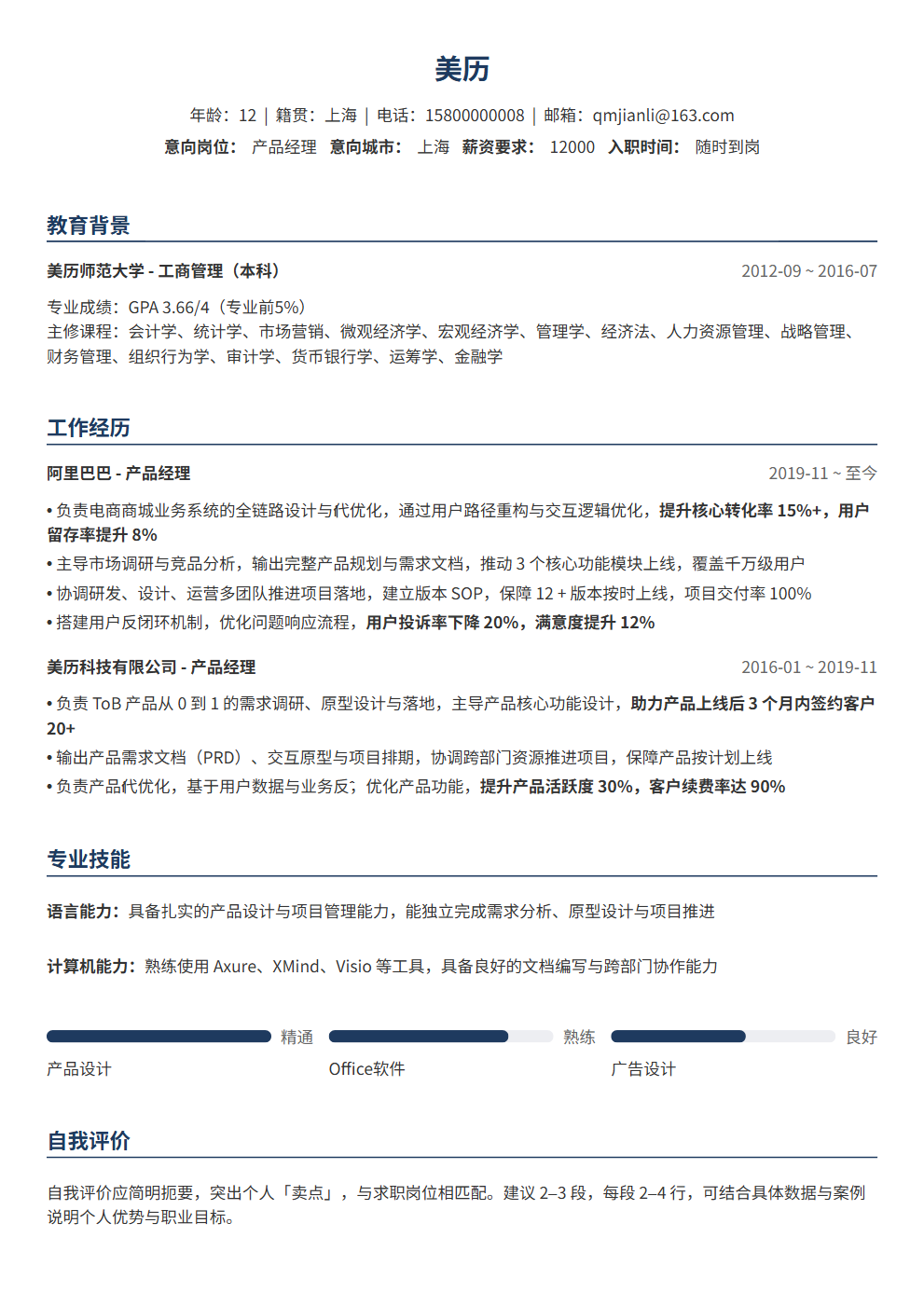
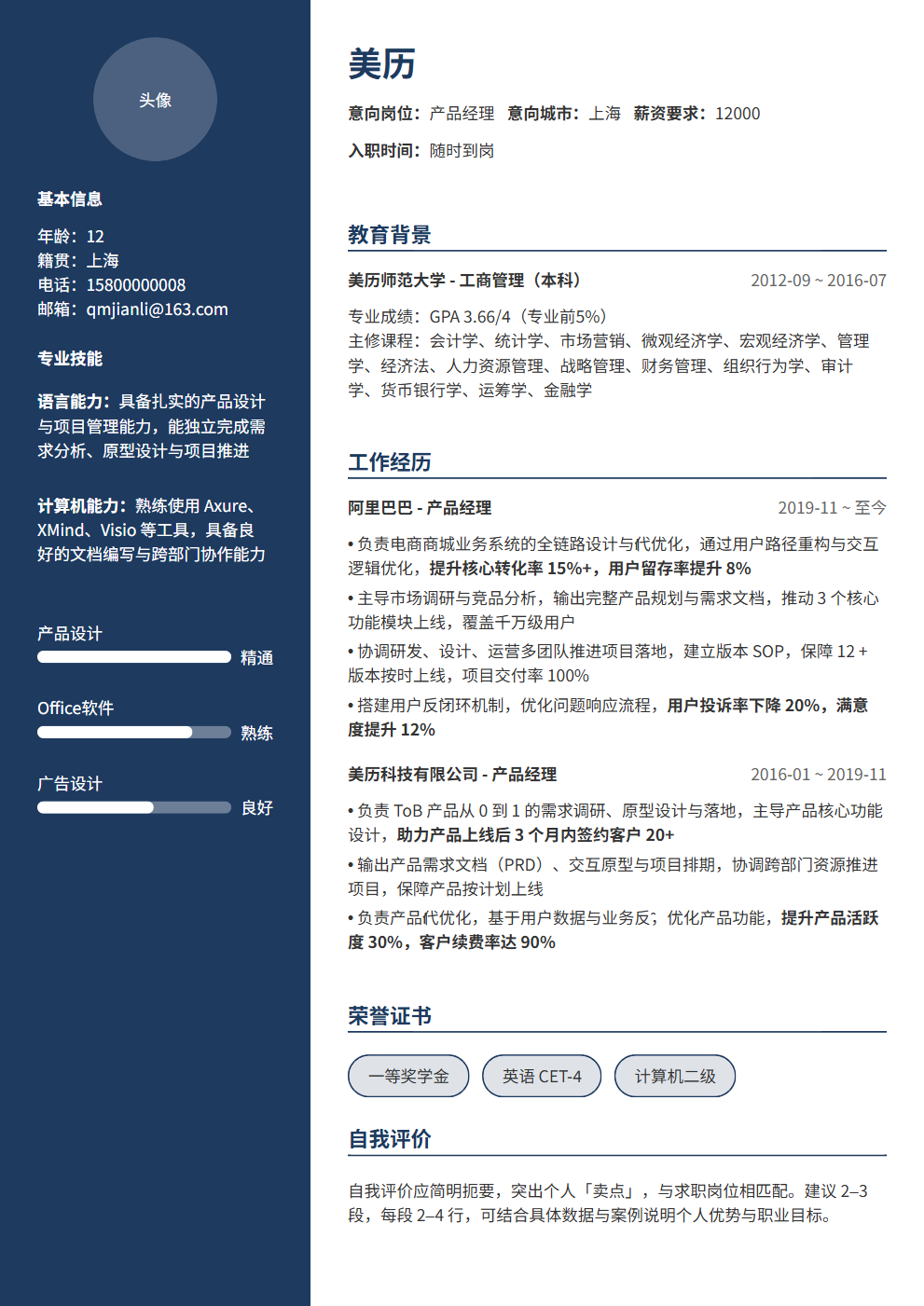
The core of behavioral interviews is telling stories. We recommend preparing 5-6 story materials that can flexibly adapt to different questions — each story can be interpreted from multiple angles. A well-organized resume helps you quickly recall project details. Use our resume tool to review your project experience before the interview, so you can answer with more confidence.
15 High-Frequency Technical Interview Questions (With Assessment Focus)
Technical big tech interview questions typically don't ask "what is X" directly — they assess your depth of technical understanding and practical application ability. These 15 questions cover the most frequently tested areas across backend, frontend, and system design.
16. Explain the CAP theorem and its application in real systems
Assessment focus: Understanding of fundamental distributed system trade-offs. Key points: Definitions of C/A/P → Why you can only choose two → How real systems make trade-offs based on business scenarios (e.g., CP vs AP systems).
17. How would you design a high-concurrency flash sale system?
Assessment focus: System design ability + high-concurrency experience. Key points: Rate limiting (token bucket / leaky bucket) → Peak shaving (async MQ) → Inventory deduction (Redis pre-deduction + DB eventual consistency) → Overselling prevention (distributed lock / optimistic lock) → Degradation plan.
18. What is the principle behind database indexes? How do you optimize slow queries?
Assessment focus: Database internals understanding + practical tuning ability. Key points: B+ tree structure → Clustered vs non-clustered indexes → Covering indexes / composite indexes / leftmost prefix rule → EXPLAIN analysis → Slow query optimization in practice.
19. What data structures does Redis have? What are their use cases?
Assessment focus: Deep understanding of caching technology. Key points: 5 basic structures (String/Hash/List/Set/ZSet) + 3 advanced structures (HyperLogLog/Bitmap/Geo) → Typical use cases for each (e.g., ZSet for leaderboards, HyperLogLog for UV counting).
20. What are microservices? What are the pros and cons?
Assessment focus: Comprehensive architectural thinking. Key points: Definition (single responsibility, independent deployment, decentralization) → Pros (independent scaling, technology heterogeneity, fault isolation) → Cons (distributed complexity, data consistency, operational cost) → When to use / not use.
21. How do you ensure consistency in distributed transactions?
Assessment focus: Understanding of core distributed system challenges. Key points: 2PC/3PC → TCC → Saga → Local message table → Eventual consistency solutions. Core: No silver bullet — choose based on business scenarios.
22. Explain TCP three-way handshake and four-way termination. Why?
Assessment focus: Networking fundamentals. Key points: Three-way handshake flow → Why not two (preventing historical connections) → Four-way termination flow → Why not three (significance of TIME_WAIT) → Troubleshooting excessive TIME_WAIT.
23. How do you troubleshoot a sudden CPU spike in production?
Assessment focus: Practical production troubleshooting ability. Key points: top to locate process → top -Hp to locate thread → jstack to analyze thread stack → Pinpoint code line. Common causes: infinite loops, frequent GC, thread deadlocks.
24. What is DDD (Domain-Driven Design)? How do you practice it?
Assessment focus: Understanding of architectural design methodology. Key points: Core concepts (bounded context, aggregate root, domain events) → Difference from anemic/rich domain models → How to divide bounded contexts in real projects → Pitfalls in implementation.
25. JVM memory model and garbage collection mechanism
Assessment focus: Java internals understanding. Key points: Runtime data areas (heap/stack/method area/program counter) → GC algorithms (mark-sweep/copying/mark-compact) → Common collectors (CMS/G1/ZGC) → Tuning in practice.
26. How would you design a URL shortener service?
Assessment focus: Classic system design question. Key points: Long URL → short URL hashing schemes (MurmurHash / auto-increment ID + Base62) → Storage design → 302 redirect → Caching strategy → High availability design.
27. How do message queues ensure messages aren't lost?
Assessment focus: Understanding of message middleware reliability. Key points: Producer side (confirm mechanism) → Broker side (persistence + replication) → Consumer side (manual ACK) → Idempotency guarantee. All three links must be covered.
28. What is zero-copy? What are the implementation approaches?
Assessment focus: Operating systems and performance optimization. Key points: 4 copies in traditional I/O → 3 zero-copy implementations (mmap/sendfile/splice) → How Kafka leverages zero-copy for performance.
29. How do you implement API idempotency?
Assessment focus: Distributed systems engineering practice. Key points: Unique request ID + deduplication table → Optimistic locking (version number) → Token mechanism → Database unique constraint. Choose different approaches for different scenarios.
30. How do you approach technology selection?
Assessment focus: Systematic thinking in technical decision-making. Key points: Business requirement analysis → Candidate comparison (features/performance/community/operational cost) → POC validation → Gradual rollout → Review. Core: No best technology — only the most appropriate.
10 High-Frequency HR Interview Questions (With Key Points)
HR interviews are the most overlooked part of interview quick reference preparation, but they often determine your level and salary. The core assessment areas aren't technical — they're stability, motivation, and cultural fit.
31. Why do you want to leave your current company?
Key points: Express positively, don't badmouth your current employer. Framework = "I appreciate my current company, but I'm looking for XXX (a larger platform / deeper business / new challenges)." Avoid saying "low pay" or "bad boss."
32. Why did you choose our company?
Key points: 3-layer progression = Industry recognition (the company's position in the industry) → Business interest (why the specific business line/product attracts you) → Personal fit (how your abilities create value for the company). Show "mutual selection" thinking.
33. What are your career plans?
Key points: Short-term (1-2 years) → Mid-term (3-5 years) → Long-term direction. Short-term should be specific (which technical direction / business domain you want to deepen), long-term should be ambitious but not vague. Avoid the single answer "I want to be a manager."
34. What is your salary expectation?
Key points: Don't name a number first. Ask "What's the salary range for this level?" → Give your expected range (20%-30% above your floor) → Emphasize "I care more about total compensation and growth opportunities."
35. Are you interviewing with other companies?
Key points: Be honest but strategic. "Yes, I'm talking with a few companies, but yours is my top choice." Don't say "only you" (loses negotiation leverage) or "I have many offers" (seems insincere).
36. How do you balance work and life?
Key points: Don't say "I can do 996" or "I value work-life balance." A reasonable answer: "I ensure work output through efficient time management and prioritization, while maintaining a healthy life rhythm. I fully commit during high-intensity projects, but I also pay attention to sustainability."
37. What is your biggest failure?
Key points: Similar to the behavioral "failure experience" question, but HR focuses more on your mindset and growth. Choose a real but not catastrophic failure → Focus on reflection and takeaways → Show resilience and self-awareness.
38. Do you have any questions for me?
Key points: This is your chance to demonstrate depth of thought. Good questions: "What's the most important goal for this role in the next six months?" "What's the biggest challenge the team currently faces?" "What common traits do people who excel in this team share?" Avoid asking about salary/benefits (save for negotiation).
39. What if your work style doesn't match your direct manager's?
Key points: Adapt first → Proactively communicate to find common ground → If truly unworkable, seek adjustment through formal channels. Core message: You're a problem-solver, not a problem-avoider.
40. Can you accept overtime?
Key points: Don't simply say "yes" or "no." "If the project requires it, I'm absolutely fine with reasonable overtime. I focus more on work output and efficiency than raw hours. Of course, for sustained high-intensity overtime, I'd look for ways to optimize processes."
5 High-Frequency Case Analysis Questions (With Solution Approaches)
Case analysis interviews are common for product managers, operations, and consulting roles, but increasingly technical roles include them too. The core assessment is structured thinking and business sense.
41. A product's DAU dropped 20% — how do you analyze the cause?
Solution approach: Dimension breakdown = Time dimension (sudden vs gradual) → User dimension (new vs returning vs reactivated users) → Channel dimension (organic vs paid vs social referral) → External factors (competitors / policy / seasonality) → Identify root cause → Propose solutions.
42. How would you estimate the number of bubble tea shops in a city?
Solution approach: Fermi estimation. Method 1: Supply side = city population × per capita consumption frequency ÷ average daily capacity per shop; Method 2: Demand side = number of commercial districts × average bubble tea shops per district. Cross-validate with both methods — the key isn't precise numbers but clear logic.
43. How would you improve an e-commerce app's conversion rate?
Solution approach: Funnel breakdown = Impression → Click → Add to cart → Place order → Payment. Find the stage with the highest drop-off → Targeted optimization (e.g., low click rate → optimize main image/title; cart but no order → optimize pricing/promotions; order but no payment → optimize payment flow/follow-up strategy) → A/B test validation.
44. How do you decide if a feature is worth building?
Solution approach: ROI framework = User value (coverage × usage frequency × pain point severity) ÷ Development cost (effort × time × maintenance cost) → Strategic value (whether it supports core metrics) → Data validation (small-traffic experiment → full rollout decision). Avoid "the boss said to build it."
45. How would you design a rollout strategy for a new feature?
Solution approach: Gradual rollout framework = 1% small traffic to validate core metrics → 5% medium traffic to validate stability → 20% large traffic to validate business impact → 50% half-traffic comparison → 100% full rollout. Set kill switches at each step — roll back immediately if anomalies occur.
5 High-Frequency Salary Negotiation Questions (With Strategies)
Salary negotiation is the final interview stage and often the most nerve-wracking. These 5 big tech interview questions directly impact your income — preparing strategies in advance is more effective than improvising.
46. What is your current salary?
Strategy: Answer honestly (big tech does background checks), but share total compensation rather than just Base. "My current total compensation is approximately XX, including Base + annual bonus + RSUs." If your Base is on the low side, emphasize total comp and other benefits.
47. What are your salary expectations?
Strategy: Don't name a number first. Ask "What's the salary range for this level?" → If they insist, give a range 20%-30% above your floor → Emphasize "I care more about the reasonableness of total compensation and growth opportunities."
48. We can only offer up to XX — can you accept that?
Strategy: Don't accept or reject immediately. "Thank you for the offer — I need some time to evaluate, especially the components of the total package." → Go back and break down the total comp → If Base is maxed out, negotiate for sign-on bonus or RSUs to close the gap.
49. Do you have other offers? What are the terms?
Strategy: If you have offers, acknowledge them but don't reveal specific company names or numbers. "I'm indeed talking with a few other companies and have received offers, but I'm most interested in your role." Use the existence of offers as leverage, but stay professional.
50. If your current company counter-offers with a raise, would you stay?
Strategy: Firm but tactful. "I appreciate my current company, but my reasons for leaving aren't just about salary — they're about XXX (new platform / new challenges / new direction). A raise wouldn't change my decision." Show resolve — avoid being used as a bargaining chip.
3 Ways to Use This Interview Quick Reference
Method 1: Targeted Breakthrough by Category
Don't try to memorize all 50 questions at once. Based on your upcoming interview stage, focus on one category: Review behavioral questions before round 1, technical questions before round 2, and HR questions before the HR round. Review one category at a time, then restate the frameworks in your own words.
Method 2: Prepare 5-6 Universal Stories
50 questions may seem like a lot, but many can be answered with the same story from different angles. For example, the "most challenging problem you solved" story can also answer "how you handle tight deadlines," "leadership in a team," and "taking on extra responsibility." Prepare 5-6 high-quality stories that cover 80% of behavioral questions.
Method 3: Record Mock Interviews and Review
After reviewing the interview quick reference, open your phone's voice recorder and randomly pick 5 questions to answer. When reviewing the recording, check 3 things: Did you use the STAR structure? Did you quantify results? Did you finish within 2 minutes? Recording is the most brutal but most effective feedback.
FAQ
Can this quick reference replace systematic preparation?
No. The interview quick reference is a last-minute sprint tool that helps you quickly review answer frameworks for high-frequency questions. Systematic preparation still requires deep understanding of each knowledge point and polishing each story. The quick reference is a "pre-exam review outline," not a "shortcut that replaces learning."
Do interview questions differ significantly across big tech companies?
Core high-frequency questions overlap heavily, but focus areas differ: Alibaba leans toward deep project follow-ups, Tencent toward technical fundamentals, ByteDance toward algorithms and system design, and Meituan toward business understanding and execution. We recommend supplementing with 2-3 company-specific questions on top of this quick reference.
What if I get a question I haven't prepared for?
Don't panic — use framework thinking to deconstruct it: Behavioral → Apply STAR method; Technical → Expand from principles to applications layer by layer; Case analysis → Break down dimensions first, then analyze each. Remember, interviewers care more about your thought process than a standard answer.
Do I need to prepare for all 50 questions?
No. Prioritize questions most relevant to your role. We recommend reviewing frameworks for all 15 behavioral questions, choosing 10-12 technical questions based on your direction for deeper preparation, and reading through all HR and salary negotiation questions. Case analysis questions depend on your role.
How far in advance should I start using the quick reference?
We recommend starting 3-5 days before your interview for a quick review, with 1-2 days before focused on mock practice. Don't wait until the night before — quick references need time to digest, and frameworks need practice to internalize. Optimal rhythm: 1 week before for systematic preparation + 3 days before for quick reference review + 1 day before for mock practice.
The starting point of interview success is a resume that catches the interviewer's eye. You now have quick reference frameworks for 50 big tech interview questions, but how do you precisely present your project experience and technical abilities on your resume? Use our resume generator to transform your experience into what interviewers want to see — get the interview first, then use this quick reference to land the offer.